

226
5 Optical Power Coupling
5.3.1 Mechanical Misalignment Effects
Mechanical alignment is a major problem when joining two fibers, owing to their
microscopic size [16–19]. A standard multimode graded-index fiber core is 50–
100 μm in diameter, which is roughly the thickness of a human hair, whereas singlemode fibers have core diameters on the order of 9 μm. Radiation losses result from
mechanical misalignments because the radiation cone of the emitting fiber does not
match the acceptance cone of the receiving fiber. The magnitude of the radiation loss
depends on the degree of misalignment. The three fundamental types of misalignment
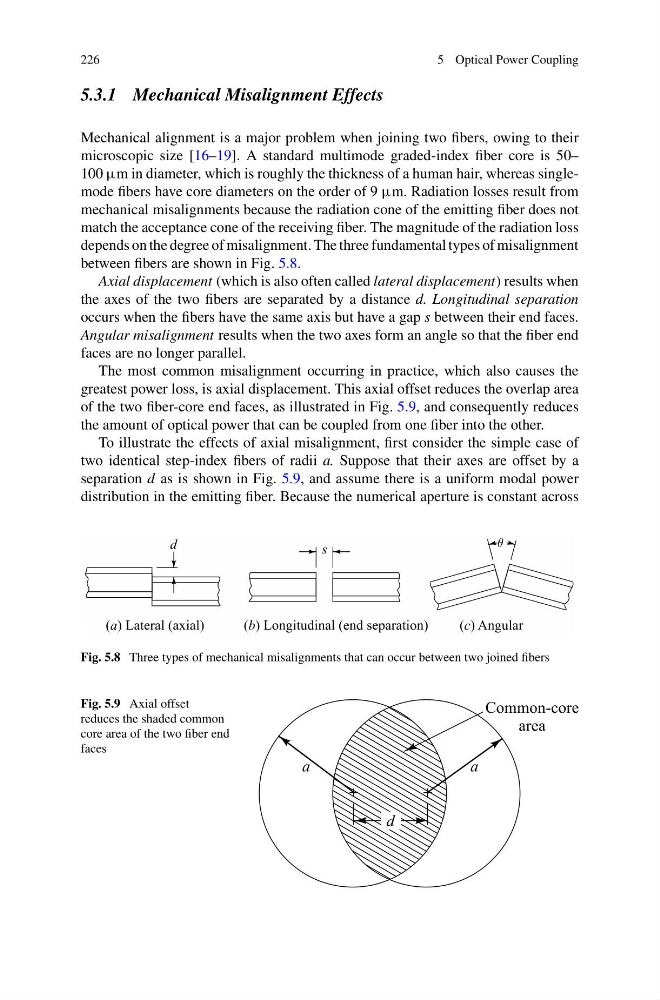
between fibers are shown in Fig. 5.8.
Axial displacement (which is also often called lateral displacement) results when
the axes of the two fibers are separated by a distance d. Longitudinal separation
occurs when the fibers have the same axis but have a gap s between their end faces.
Angular misalignment results when the two axes form an angle so that the fiber end
faces are no longer parallel.
The most common misalignment occurring in practice, which also causes the
greatest power loss, is axial displacement. This axial offset reduces the overlap area
of the two fiber-core end faces, as illustrated in Fig. 5.9, and consequently reduces
the amount of optical power that can be coupled from one fiber into the other.
To illustrate the effects of axial misalignment, first consider the simple case of
two identical step-index fibers of radii a. Suppose that their axes are offset by a
separation d as is shown in Fig. 5.9, and assume there is a uniform modal power
distribution in the emitting fiber. Because the numerical aperture is constant across
Fig. 5.8 Three types of mechanical misalignments that can occur between two joined fibers
Fig. 5.9 Axial offset
reduces the shaded common
core area of the two fiber end
faces
5 Optical Power Coupling
5.3.1 Mechanical Misalignment Effects
Mechanical alignment is a major problem when joining two fibers, owing to their
microscopic size [16–19]. A standard multimode graded-index fiber core is 50–
100 μm in diameter, which is roughly the thickness of a human hair, whereas singlemode fibers have core diameters on the order of 9 μm. Radiation losses result from
mechanical misalignments because the radiation cone of the emitting fiber does not
match the acceptance cone of the receiving fiber. The magnitude of the radiation loss
depends on the degree of misalignment. The three fundamental types of misalignment
between fibers are shown in Fig. 5.8.
Axial displacement (which is also often called lateral displacement) results when
the axes of the two fibers are separated by a distance d. Longitudinal separation
occurs when the fibers have the same axis but have a gap s between their end faces.
Angular misalignment results when the two axes form an angle so that the fiber end
faces are no longer parallel.
The most common misalignment occurring in practice, which also causes the
greatest power loss, is axial displacement. This axial offset reduces the overlap area
of the two fiber-core end faces, as illustrated in Fig. 5.9, and consequently reduces
the amount of optical power that can be coupled from one fiber into the other.
To illustrate the effects of axial misalignment, first consider the simple case of
two identical step-index fibers of radii a. Suppose that their axes are offset by a
separation d as is shown in Fig. 5.9, and assume there is a uniform modal power
distribution in the emitting fiber. Because the numerical aperture is constant across
Fig. 5.8 Three types of mechanical misalignments that can occur between two joined fibers
Fig. 5.9 Axial offset
reduces the shaded common
core area of the two fiber end
faces