

5.3 Losses Between Fiber Joints
225
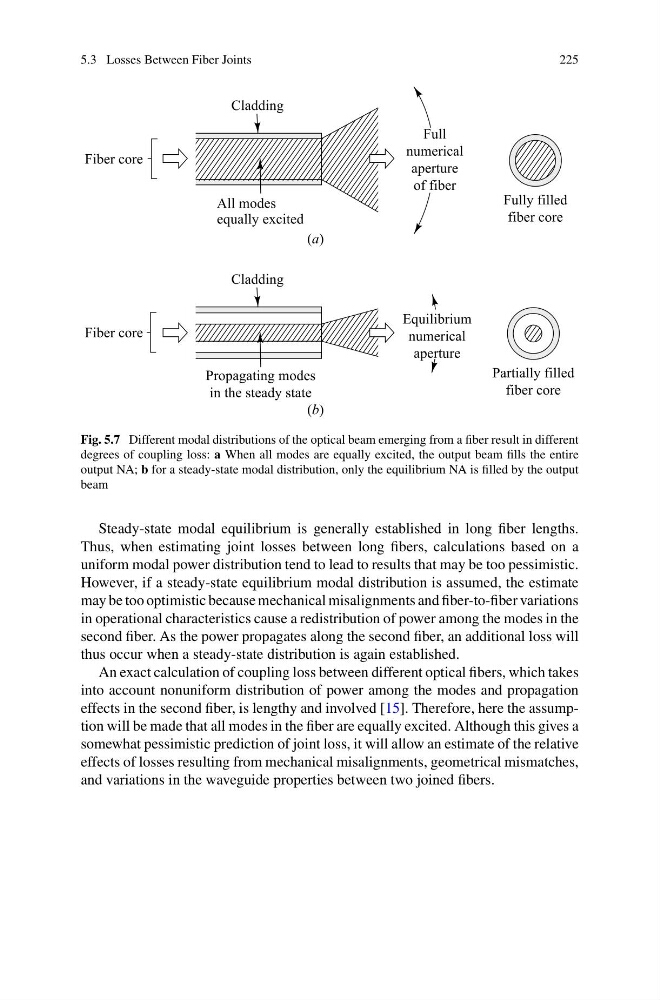
Fig. 5.7 Different modal distributions of the optical beam emerging from a fiber result in different
degrees of coupling loss: a When all modes are equally excited, the output beam fills the entire
output NA; b for a steady-state modal distribution, only the equilibrium NA is filled by the output
beam
Steady-state modal equilibrium is generally established in long fiber lengths.
Thus, when estimating joint losses between long fibers, calculations based on a
uniform modal power distribution tend to lead to results that may be too pessimistic.
However, if a steady-state equilibrium modal distribution is assumed, the estimate
may be too optimistic because mechanical misalignments and fiber-to-fiber variations
in operational characteristics cause a redistribution of power among the modes in the
second fiber. As the power propagates along the second fiber, an additional loss will
thus occur when a steady-state distribution is again established.
An exact calculation of coupling loss between different optical fibers, which takes
into account nonuniform distribution of power among the modes and propagation
effects in the second fiber, is lengthy and involved [15]. Therefore, here the assumption will be made that all modes in the fiber are equally excited. Although this gives a
somewhat pessimistic prediction of joint loss, it will allow an estimate of the relative
effects of losses resulting from mechanical misalignments, geometrical mismatches,
and variations in the waveguide properties between two joined fibers.
225
Fig. 5.7 Different modal distributions of the optical beam emerging from a fiber result in different
degrees of coupling loss: a When all modes are equally excited, the output beam fills the entire
output NA; b for a steady-state modal distribution, only the equilibrium NA is filled by the output
beam
Steady-state modal equilibrium is generally established in long fiber lengths.
Thus, when estimating joint losses between long fibers, calculations based on a
uniform modal power distribution tend to lead to results that may be too pessimistic.
However, if a steady-state equilibrium modal distribution is assumed, the estimate
may be too optimistic because mechanical misalignments and fiber-to-fiber variations
in operational characteristics cause a redistribution of power among the modes in the
second fiber. As the power propagates along the second fiber, an additional loss will
thus occur when a steady-state distribution is again established.
An exact calculation of coupling loss between different optical fibers, which takes
into account nonuniform distribution of power among the modes and propagation
effects in the second fiber, is lengthy and involved [15]. Therefore, here the assumption will be made that all modes in the fiber are equally excited. Although this gives a
somewhat pessimistic prediction of joint loss, it will allow an estimate of the relative
effects of losses resulting from mechanical misalignments, geometrical mismatches,
and variations in the waveguide properties between two joined fibers.