

214
5 Optical Power Coupling
= π L 0
r s
0
2π
0
sin
2
θ A dθ s r dr
= π L 0
r s
0
2π
0
N A
2 dθ s r dr
(5.4)
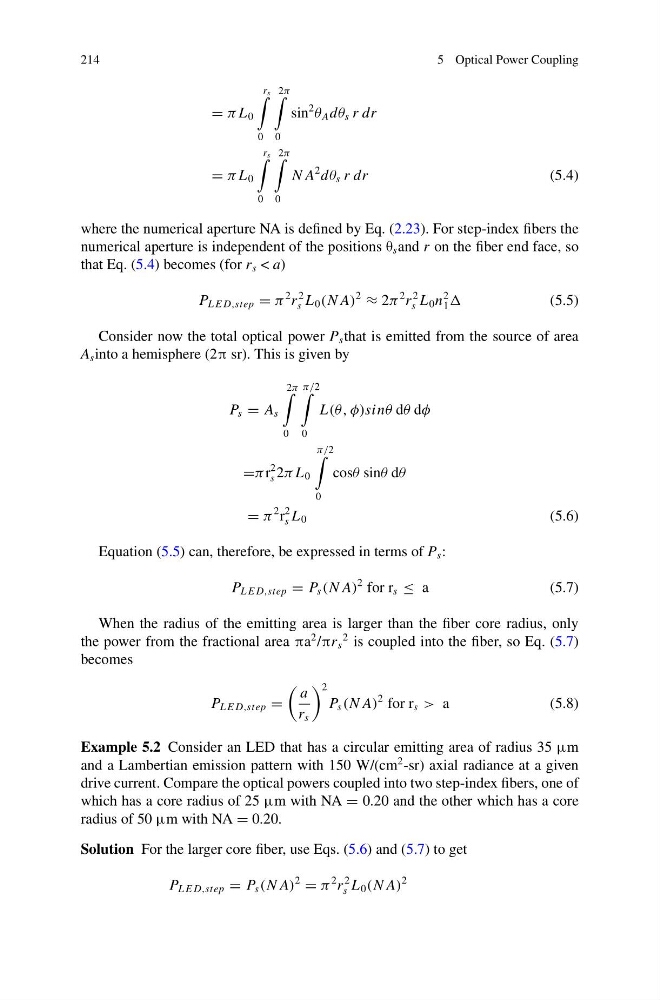
where the numerical aperture NA is defined by Eq. (2.23). For step-index fibers the
numerical aperture is independent of the positions θ s and r on the fiber end face, so
that Eq. (5.4) becomes (for r s < a)
P L E D,step = π
2 r
2
s L 0 (N A)
2
≈ 2π
2 r
2
s L 0 n
2
1
(5.5)
Consider now the total optical power P s that is emitted from the source of area
A s into a hemisphere (2π sr). This is given by
P s = A s
2π
0
π/2
0
L(θ, φ)sinθ dθ dφ
=π r
2
s 2π L 0
π/2
0
cosθ sinθ dθ
= π
2 r
2
s L 0
(5.6)
Equation (5.5) can, therefore, be expressed in terms of P s :
P L E D,step = P s (N A)
2 for r s ≤ a
(5.7)
When the radius of the emitting area is larger than the fiber core radius, only
the power from the fractional area πa
2 /πr s
2 is coupled into the fiber, so Eq. (5.7)
becomes
P L E D,step =
a
r s
2
P s (N A)
2 for r s > a
(5.8)
Example 5.2 Consider an LED that has a circular emitting area of radius 35 μm
and a Lambertian emission pattern with 150 W/(cm
2 -sr) axial radiance at a given
drive current. Compare the optical powers coupled into two step-index fibers, one of
which has a core radius of 25 μm with NA = 0.20 and the other which has a core
radius of 50 μm with NA = 0.20.
Solution For the larger core fiber, use Eqs. (5.6) and (5.7) to get
P L E D,step = P s (N A)
2
= π
2 r
2
s L 0 (N A)
2
5 Optical Power Coupling
= π L 0
r s
0
2π
0
sin
2
θ A dθ s r dr
= π L 0
r s
0
2π
0
N A
2 dθ s r dr
(5.4)
where the numerical aperture NA is defined by Eq. (2.23). For step-index fibers the
numerical aperture is independent of the positions θ s and r on the fiber end face, so
that Eq. (5.4) becomes (for r s < a)
P L E D,step = π
2 r
2
s L 0 (N A)
2
≈ 2π
2 r
2
s L 0 n
2
1
(5.5)
Consider now the total optical power P s that is emitted from the source of area
A s into a hemisphere (2π sr). This is given by
P s = A s
2π
0
π/2
0
L(θ, φ)sinθ dθ dφ
=π r
2
s 2π L 0
π/2
0
cosθ sinθ dθ
= π
2 r
2
s L 0
(5.6)
Equation (5.5) can, therefore, be expressed in terms of P s :
P L E D,step = P s (N A)
2 for r s ≤ a
(5.7)
When the radius of the emitting area is larger than the fiber core radius, only
the power from the fractional area πa
2 /πr s
2 is coupled into the fiber, so Eq. (5.7)
becomes
P L E D,step =
a
r s
2
P s (N A)
2 for r s > a
(5.8)
Example 5.2 Consider an LED that has a circular emitting area of radius 35 μm
and a Lambertian emission pattern with 150 W/(cm
2 -sr) axial radiance at a given
drive current. Compare the optical powers coupled into two step-index fibers, one of
which has a core radius of 25 μm with NA = 0.20 and the other which has a core
radius of 50 μm with NA = 0.20.
Solution For the larger core fiber, use Eqs. (5.6) and (5.7) to get
P L E D,step = P s (N A)
2
= π
2 r
2
s L 0 (N A)
2