

5.1 Source-to-Fiber Power Coupling
211
surface. A reasonable assumption for simplicity of analysis is to take the emission
to be uniform across the source area.
Surface-emitting LEDs are characterized by their Lambertian output pattern,
which means the source has the same luminous intensity (or colloquially “is equally
bright”) when viewed from any direction. The power delivered at an angle θ, measured
relative to a normal to the emitting surface, varies as cos θ because the projected area
of the emitting surface varies as cos θ with viewing direction. The emission pattern
for a Lambertian source thus follows the relationship.
L(θ, ϕ) = L 0 cos θ
(5.1)
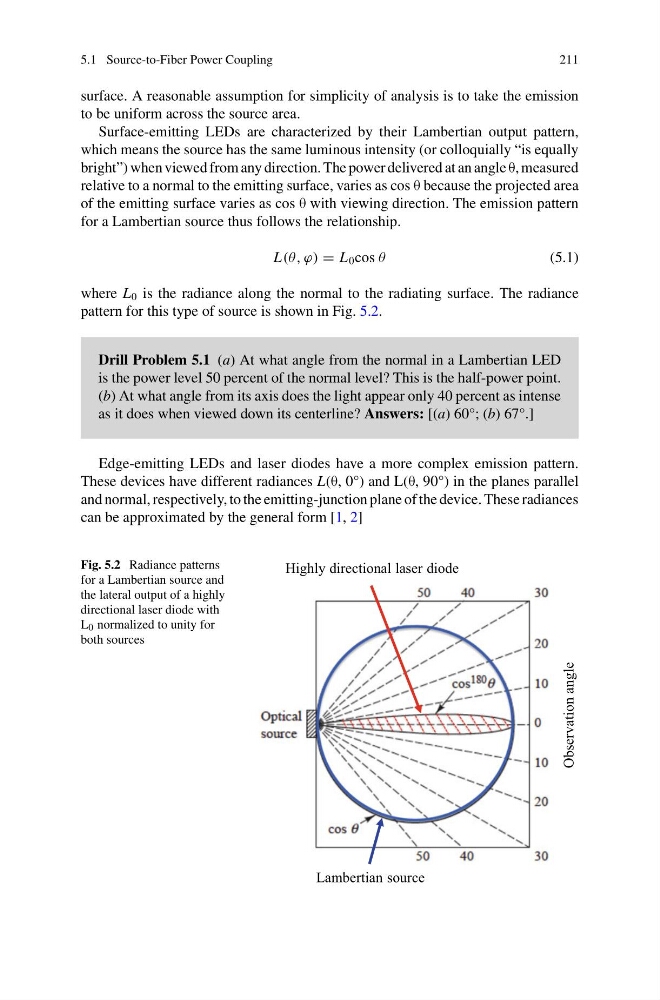
where L 0 is the radiance along the normal to the radiating surface. The radiance
pattern for this type of source is shown in Fig. 5.2.
Drill Problem 5.1 (a) At what angle from the normal in a Lambertian LED
is the power level 50 percent of the normal level? This is the half-power point.
(b) At what angle from its axis does the light appear only 40 percent as intense
as it does when viewed down its centerline? Answers: [(a) 60°; (b) 67°.]
Edge-emitting LEDs and laser diodes have a more complex emission pattern.
These devices have different radiances L(θ, 0°) and L(θ, 90°) in the planes parallel
and normal, respectively, to the emitting-junction plane of the device. These radiances
can be approximated by the general form [1, 2]
Fig. 5.2 Radiance patterns
for a Lambertian source and
the lateral output of a highly
directional laser diode with
L 0 normalized to unity for
both sources
Lambertian source
Highly directional laser diode
Observation angle
211
surface. A reasonable assumption for simplicity of analysis is to take the emission
to be uniform across the source area.
Surface-emitting LEDs are characterized by their Lambertian output pattern,
which means the source has the same luminous intensity (or colloquially “is equally
bright”) when viewed from any direction. The power delivered at an angle θ, measured
relative to a normal to the emitting surface, varies as cos θ because the projected area
of the emitting surface varies as cos θ with viewing direction. The emission pattern
for a Lambertian source thus follows the relationship.
L(θ, ϕ) = L 0 cos θ
(5.1)
where L 0 is the radiance along the normal to the radiating surface. The radiance
pattern for this type of source is shown in Fig. 5.2.
Drill Problem 5.1 (a) At what angle from the normal in a Lambertian LED
is the power level 50 percent of the normal level? This is the half-power point.
(b) At what angle from its axis does the light appear only 40 percent as intense
as it does when viewed down its centerline? Answers: [(a) 60°; (b) 67°.]
Edge-emitting LEDs and laser diodes have a more complex emission pattern.
These devices have different radiances L(θ, 0°) and L(θ, 90°) in the planes parallel
and normal, respectively, to the emitting-junction plane of the device. These radiances
can be approximated by the general form [1, 2]
Fig. 5.2 Radiance patterns
for a Lambertian source and
the lateral output of a highly
directional laser diode with
L 0 normalized to unity for
both sources
Lambertian source
Highly directional laser diode
Observation angle