

196
4 Light Sources for Fiber Links
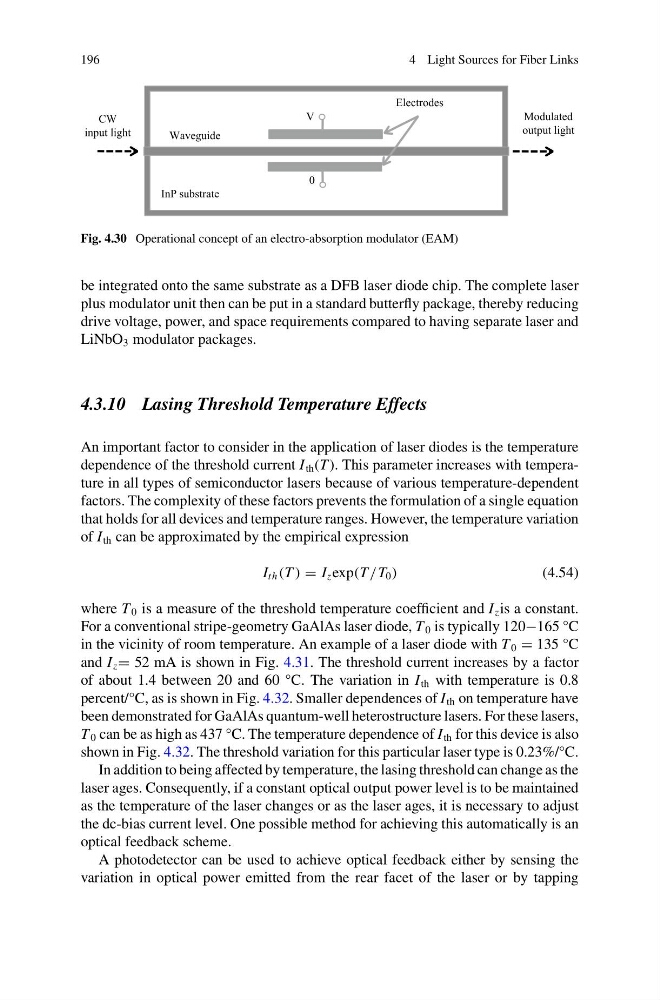
Fig. 4.30 Operational concept of an electro-absorption modulator (EAM)
be integrated onto the same substrate as a DFB laser diode chip. The complete laser
plus modulator unit then can be put in a standard butterfly package, thereby reducing
drive voltage, power, and space requirements compared to having separate laser and
LiNbO 3 modulator packages.
4.3.10 Lasing Threshold Temperature Effects
An important factor to consider in the application of laser diodes is the temperature
dependence of the threshold current I th (T ). This parameter increases with temperature in all types of semiconductor lasers because of various temperature-dependent
factors. The complexity of these factors prevents the formulation of a single equation
that holds for all devices and temperature ranges. However, the temperature variation
of I th can be approximated by the empirical expression
I th (T ) = I z exp(T /T 0 )
(4.54)
where T 0 is a measure of the threshold temperature coefficient and I z is a constant.
For a conventional stripe-geometry GaAlAs laser diode, T 0 is typically 120−165 °C
in the vicinity of room temperature. An example of a laser diode with T 0 = 135 °C
and I z = 52 mA is shown in Fig. 4.31. The threshold current increases by a factor
of about 1.4 between 20 and 60 °C. The variation in I th with temperature is 0.8
percent/°C, as is shown in Fig. 4.32. Smaller dependences of I th on temperature have
been demonstrated for GaAlAs quantum-well heterostructure lasers. For these lasers,
T 0 can be as high as 437 °C. The temperature dependence of I th for this device is also
shown in Fig. 4.32. The threshold variation for this particular laser type is 0.23%/°C.
In addition to being affected by temperature, the lasing threshold can change as the
laser ages. Consequently, if a constant optical output power level is to be maintained
as the temperature of the laser changes or as the laser ages, it is necessary to adjust
the dc-bias current level. One possible method for achieving this automatically is an
optical feedback scheme.
A photodetector can be used to achieve optical feedback either by sensing the
variation in optical power emitted from the rear facet of the laser or by tapping
4 Light Sources for Fiber Links
Fig. 4.30 Operational concept of an electro-absorption modulator (EAM)
be integrated onto the same substrate as a DFB laser diode chip. The complete laser
plus modulator unit then can be put in a standard butterfly package, thereby reducing
drive voltage, power, and space requirements compared to having separate laser and
LiNbO 3 modulator packages.
4.3.10 Lasing Threshold Temperature Effects
An important factor to consider in the application of laser diodes is the temperature
dependence of the threshold current I th (T ). This parameter increases with temperature in all types of semiconductor lasers because of various temperature-dependent
factors. The complexity of these factors prevents the formulation of a single equation
that holds for all devices and temperature ranges. However, the temperature variation
of I th can be approximated by the empirical expression
I th (T ) = I z exp(T /T 0 )
(4.54)
where T 0 is a measure of the threshold temperature coefficient and I z is a constant.
For a conventional stripe-geometry GaAlAs laser diode, T 0 is typically 120−165 °C
in the vicinity of room temperature. An example of a laser diode with T 0 = 135 °C
and I z = 52 mA is shown in Fig. 4.31. The threshold current increases by a factor
of about 1.4 between 20 and 60 °C. The variation in I th with temperature is 0.8
percent/°C, as is shown in Fig. 4.32. Smaller dependences of I th on temperature have
been demonstrated for GaAlAs quantum-well heterostructure lasers. For these lasers,
T 0 can be as high as 437 °C. The temperature dependence of I th for this device is also
shown in Fig. 4.32. The threshold variation for this particular laser type is 0.23%/°C.
In addition to being affected by temperature, the lasing threshold can change as the
laser ages. Consequently, if a constant optical output power level is to be maintained
as the temperature of the laser changes or as the laser ages, it is necessary to adjust
the dc-bias current level. One possible method for achieving this automatically is an
optical feedback scheme.
A photodetector can be used to achieve optical feedback either by sensing the
variation in optical power emitted from the rear facet of the laser or by tapping