

4.3 Principles of Laser Diodes
197
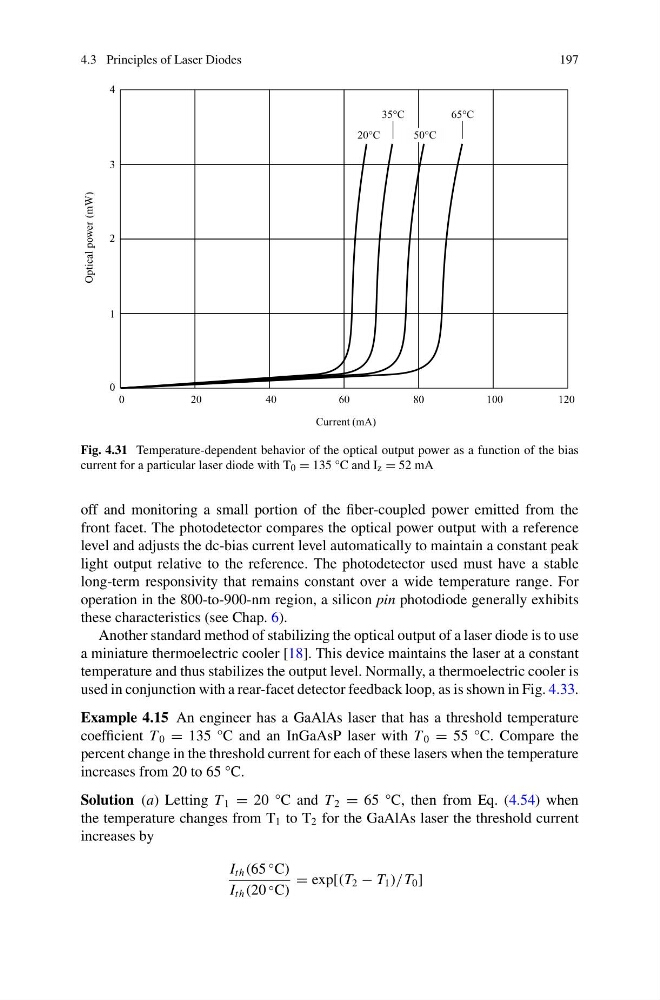
Fig. 4.31 Temperature-dependent behavior of the optical output power as a function of the bias
current for a particular laser diode with T 0 = 135 °C and I z = 52 mA
off and monitoring a small portion of the fiber-coupled power emitted from the
front facet. The photodetector compares the optical power output with a reference
level and adjusts the dc-bias current level automatically to maintain a constant peak
light output relative to the reference. The photodetector used must have a stable
long-term responsivity that remains constant over a wide temperature range. For
operation in the 800-to-900-nm region, a silicon pin photodiode generally exhibits
these characteristics (see Chap. 6).
Another standard method of stabilizing the optical output of a laser diode is to use
a miniature thermoelectric cooler [18]. This device maintains the laser at a constant
temperature and thus stabilizes the output level. Normally, a thermoelectric cooler is
used in conjunction with a rear-facet detector feedback loop, as is shown in Fig. 4.33.
Example 4.15 An engineer has a GaAlAs laser that has a threshold temperature
coefficient T 0 = 135 °C and an InGaAsP laser with T 0 = 55 °C. Compare the
percent change in the threshold current for each of these lasers when the temperature
increases from 20 to 65 °C.
Solution (a) Letting T 1 = 20 °C and T 2 = 65 °C, then from Eq. (4.54) when
the temperature changes from T 1 to T 2 for the GaAlAs laser the threshold current
increases by
I th (65
◦ C)
I th (20 ◦ C)
= exp[(T 2 − T 1 )/T 0 ]
197
Fig. 4.31 Temperature-dependent behavior of the optical output power as a function of the bias
current for a particular laser diode with T 0 = 135 °C and I z = 52 mA
off and monitoring a small portion of the fiber-coupled power emitted from the
front facet. The photodetector compares the optical power output with a reference
level and adjusts the dc-bias current level automatically to maintain a constant peak
light output relative to the reference. The photodetector used must have a stable
long-term responsivity that remains constant over a wide temperature range. For
operation in the 800-to-900-nm region, a silicon pin photodiode generally exhibits
these characteristics (see Chap. 6).
Another standard method of stabilizing the optical output of a laser diode is to use
a miniature thermoelectric cooler [18]. This device maintains the laser at a constant
temperature and thus stabilizes the output level. Normally, a thermoelectric cooler is
used in conjunction with a rear-facet detector feedback loop, as is shown in Fig. 4.33.
Example 4.15 An engineer has a GaAlAs laser that has a threshold temperature
coefficient T 0 = 135 °C and an InGaAsP laser with T 0 = 55 °C. Compare the
percent change in the threshold current for each of these lasers when the temperature
increases from 20 to 65 °C.
Solution (a) Letting T 1 = 20 °C and T 2 = 65 °C, then from Eq. (4.54) when
the temperature changes from T 1 to T 2 for the GaAlAs laser the threshold current
increases by
I th (65
◦ C)
I th (20 ◦ C)
= exp[(T 2 − T 1 )/T 0 ]