

194
4 Light Sources for Fiber Links
Here I is the average number of photons in the lasing cavity, R sp is the spontaneous
emission rate [see Eq. (4.30)], and the parameter α is the linewidth enhancement
factor. Basically this shows that in semiconductor lasers the linewidth is increased
by a factor (1 + α
2 ).
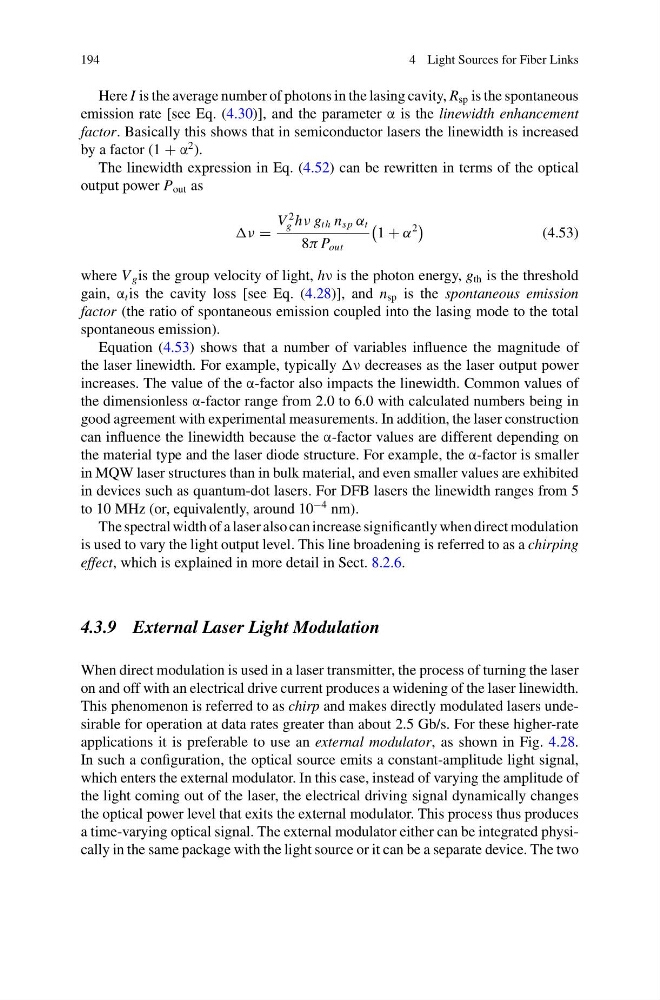
The linewidth expression in Eq. (4.52) can be rewritten in terms of the optical
output power P out as
ν =
V
2
g hν g th n sp α t
8π P out
1 + α
2
(4.53)
where V g is the group velocity of light, hν is the photon energy, g th is the threshold
gain, α t is the cavity loss [see Eq. (4.28)], and n sp is the spontaneous emission
factor (the ratio of spontaneous emission coupled into the lasing mode to the total
spontaneous emission).
Equation (4.53) shows that a number of variables influence the magnitude of
the laser linewidth. For example, typically ν decreases as the laser output power
increases. The value of the α-factor also impacts the linewidth. Common values of
the dimensionless α-factor range from 2.0 to 6.0 with calculated numbers being in
good agreement with experimental measurements. In addition, the laser construction
can influence the linewidth because the α-factor values are different depending on
the material type and the laser diode structure. For example, the α-factor is smaller
in MQW laser structures than in bulk material, and even smaller values are exhibited
in devices such as quantum-dot lasers. For DFB lasers the linewidth ranges from 5
to 10 MHz (or, equivalently, around 10
−4 nm).
The spectral width of a laser also can increase significantly when direct modulation
is used to vary the light output level. This line broadening is referred to as a chirping
effect, which is explained in more detail in Sect. 8.2.6.
4.3.9 External Laser Light Modulation
When direct modulation is used in a laser transmitter, the process of turning the laser
on and off with an electrical drive current produces a widening of the laser linewidth.
This phenomenon is referred to as chirp and makes directly modulated lasers undesirable for operation at data rates greater than about 2.5 Gb/s. For these higher-rate
applications it is preferable to use an external modulator, as shown in Fig. 4.28.
In such a configuration, the optical source emits a constant-amplitude light signal,
which enters the external modulator. In this case, instead of varying the amplitude of
the light coming out of the laser, the electrical driving signal dynamically changes
the optical power level that exits the external modulator. This process thus produces
a time-varying optical signal. The external modulator either can be integrated physically in the same package with the light source or it can be a separate device. The two
4 Light Sources for Fiber Links
Here I is the average number of photons in the lasing cavity, R sp is the spontaneous
emission rate [see Eq. (4.30)], and the parameter α is the linewidth enhancement
factor. Basically this shows that in semiconductor lasers the linewidth is increased
by a factor (1 + α
2 ).
The linewidth expression in Eq. (4.52) can be rewritten in terms of the optical
output power P out as
ν =
V
2
g hν g th n sp α t
8π P out
1 + α
2
(4.53)
where V g is the group velocity of light, hν is the photon energy, g th is the threshold
gain, α t is the cavity loss [see Eq. (4.28)], and n sp is the spontaneous emission
factor (the ratio of spontaneous emission coupled into the lasing mode to the total
spontaneous emission).
Equation (4.53) shows that a number of variables influence the magnitude of
the laser linewidth. For example, typically ν decreases as the laser output power
increases. The value of the α-factor also impacts the linewidth. Common values of
the dimensionless α-factor range from 2.0 to 6.0 with calculated numbers being in
good agreement with experimental measurements. In addition, the laser construction
can influence the linewidth because the α-factor values are different depending on
the material type and the laser diode structure. For example, the α-factor is smaller
in MQW laser structures than in bulk material, and even smaller values are exhibited
in devices such as quantum-dot lasers. For DFB lasers the linewidth ranges from 5
to 10 MHz (or, equivalently, around 10
−4 nm).
The spectral width of a laser also can increase significantly when direct modulation
is used to vary the light output level. This line broadening is referred to as a chirping
effect, which is explained in more detail in Sect. 8.2.6.
4.3.9 External Laser Light Modulation
When direct modulation is used in a laser transmitter, the process of turning the laser
on and off with an electrical drive current produces a widening of the laser linewidth.
This phenomenon is referred to as chirp and makes directly modulated lasers undesirable for operation at data rates greater than about 2.5 Gb/s. For these higher-rate
applications it is preferable to use an external modulator, as shown in Fig. 4.28.
In such a configuration, the optical source emits a constant-amplitude light signal,
which enters the external modulator. In this case, instead of varying the amplitude of
the light coming out of the laser, the electrical driving signal dynamically changes
the optical power level that exits the external modulator. This process thus produces
a time-varying optical signal. The external modulator either can be integrated physically in the same package with the light source or it can be a separate device. The two