

4.3 Principles of Laser Diodes
193
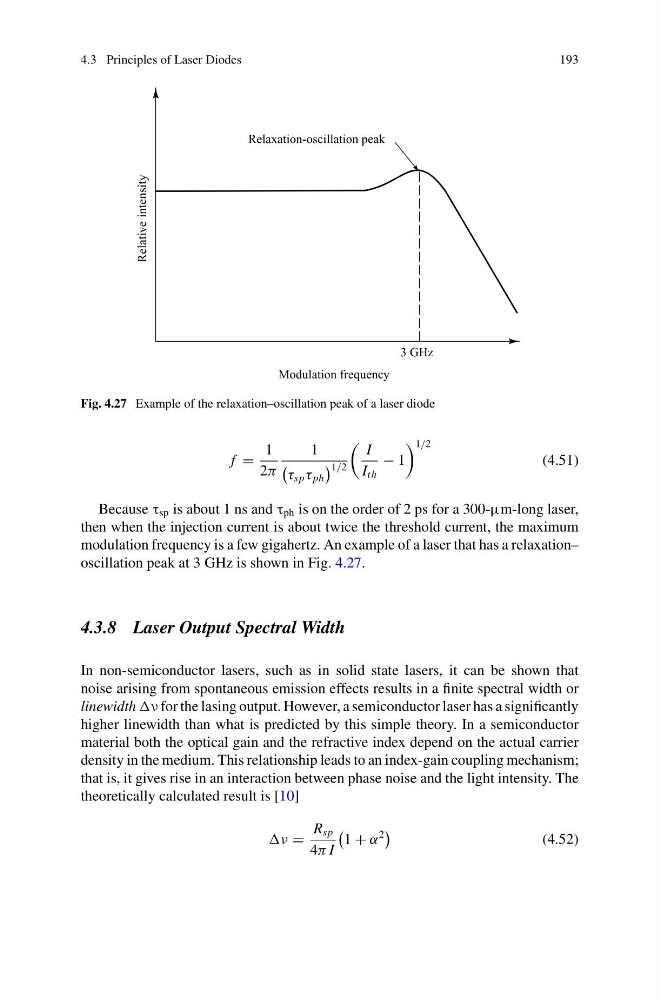
Fig. 4.27 Example of the relaxation–oscillation peak of a laser diode
f =
1
2π
1
τ sp τ ph
1/2
I
I th
− 1
1/2
(4.51)
Because τ sp is about 1 ns and τ ph is on the order of 2 ps for a 300-μm-long laser,
then when the injection current is about twice the threshold current, the maximum
modulation frequency is a few gigahertz. An example of a laser that has a relaxation–
oscillation peak at 3 GHz is shown in Fig. 4.27.
4.3.8 Laser Output Spectral Width
In non-semiconductor lasers, such as in solid state lasers, it can be shown that
noise arising from spontaneous emission effects results in a finite spectral width or
linewidth for the lasing output. However, a semiconductor laser has a significantly
higher linewidth than what is predicted by this simple theory. In a semiconductor
material both the optical gain and the refractive index depend on the actual carrier
density in the medium. This relationship leads to an index-gain coupling mechanism;
that is, it gives rise in an interaction between phase noise and the light intensity. The
theoretically calculated result is [10]
=
R sp
4π I
1 + α
2
(4.52)
193
Fig. 4.27 Example of the relaxation–oscillation peak of a laser diode
f =
1
2π
1
τ sp τ ph
1/2
I
I th
− 1
1/2
(4.51)
Because τ sp is about 1 ns and τ ph is on the order of 2 ps for a 300-μm-long laser,
then when the injection current is about twice the threshold current, the maximum
modulation frequency is a few gigahertz. An example of a laser that has a relaxation–
oscillation peak at 3 GHz is shown in Fig. 4.27.
4.3.8 Laser Output Spectral Width
In non-semiconductor lasers, such as in solid state lasers, it can be shown that
noise arising from spontaneous emission effects results in a finite spectral width or
linewidth for the lasing output. However, a semiconductor laser has a significantly
higher linewidth than what is predicted by this simple theory. In a semiconductor
material both the optical gain and the refractive index depend on the actual carrier
density in the medium. This relationship leads to an index-gain coupling mechanism;
that is, it gives rise in an interaction between phase noise and the light intensity. The
theoretically calculated result is [10]
=
R sp
4π I
1 + α
2
(4.52)