

188
4 Light Sources for Fiber Links
InGaAs quantum-well laser, the peak output wavelength moves from 1550 nm when
d = 10 nm to a peak of 1500 nm when d = 8 nm.
4.3.6 Lasers Operating in a Single Mode
For high-speed long-distance communications one needs single-mode lasers, which
must contain only a single longitudinal mode and a single transverse mode.
Consequently, the spectral width of the optical emission is very narrow.
One way of restricting a laser to have only one longitudinal mode is to reduce the
length L of the lasing cavity to the point where the frequency separation of the
adjacent modes given in Eq. (4.45) is larger than the laser transition line width; that
is, only a single longitudinal mode falls within the gain bandwidth of the device. For
example, for a Fabry-Perot cavity, all longitudinal modes have nearly equal losses
and are spaced by about 1 nm in a 250-μm-long cavity at 1300 nm. By reducing L
from 250 to 25 μm, the mode spacing increases from 1 to 10 nm. However, these
lengths make the device hard to handle, and they are limited to optical output powers
of only a few milliwatts.
Alternative devices were thus developed. Among these are vertical-cavity surfaceemitting lasers, structures that have a built-in frequency-selective grating, and tunable
lasers. This section discusses the first two structures. The special feature of a
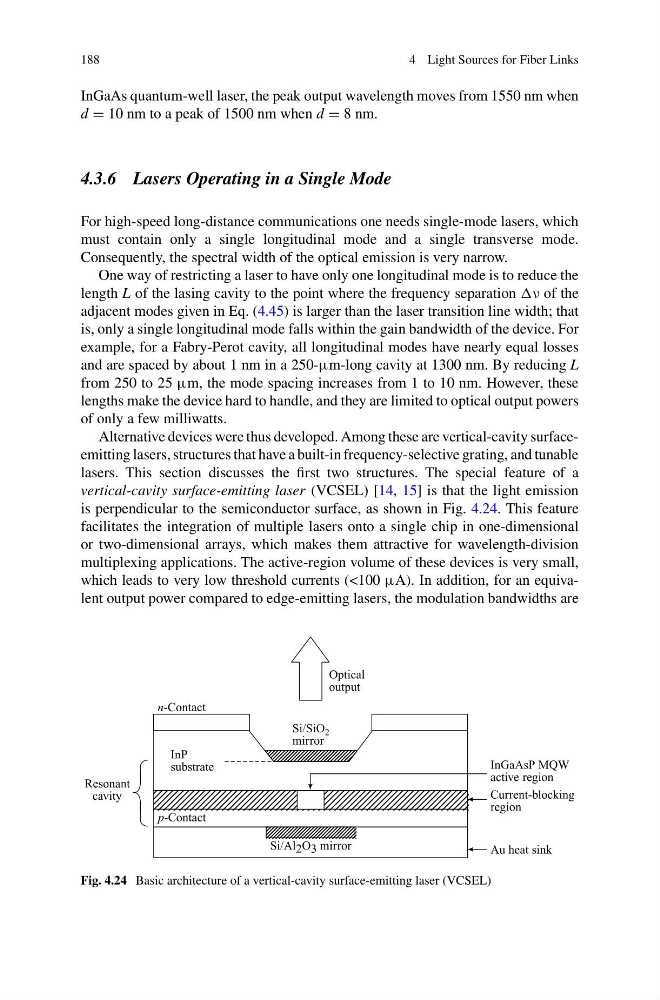
vertical-cavity surface-emitting laser (VCSEL) [14, 15] is that the light emission
is perpendicular to the semiconductor surface, as shown in Fig. 4.24. This feature
facilitates the integration of multiple lasers onto a single chip in one-dimensional
or two-dimensional arrays, which makes them attractive for wavelength-division
multiplexing applications. The active-region volume of these devices is very small,
which leads to very low threshold currents (<100 μA). In addition, for an equivalent output power compared to edge-emitting lasers, the modulation bandwidths are
Fig. 4.24 Basic architecture of a vertical-cavity surface-emitting laser (VCSEL)
4 Light Sources for Fiber Links
InGaAs quantum-well laser, the peak output wavelength moves from 1550 nm when
d = 10 nm to a peak of 1500 nm when d = 8 nm.
4.3.6 Lasers Operating in a Single Mode
For high-speed long-distance communications one needs single-mode lasers, which
must contain only a single longitudinal mode and a single transverse mode.
Consequently, the spectral width of the optical emission is very narrow.
One way of restricting a laser to have only one longitudinal mode is to reduce the
length L of the lasing cavity to the point where the frequency separation of the
adjacent modes given in Eq. (4.45) is larger than the laser transition line width; that
is, only a single longitudinal mode falls within the gain bandwidth of the device. For
example, for a Fabry-Perot cavity, all longitudinal modes have nearly equal losses
and are spaced by about 1 nm in a 250-μm-long cavity at 1300 nm. By reducing L
from 250 to 25 μm, the mode spacing increases from 1 to 10 nm. However, these
lengths make the device hard to handle, and they are limited to optical output powers
of only a few milliwatts.
Alternative devices were thus developed. Among these are vertical-cavity surfaceemitting lasers, structures that have a built-in frequency-selective grating, and tunable
lasers. This section discusses the first two structures. The special feature of a
vertical-cavity surface-emitting laser (VCSEL) [14, 15] is that the light emission
is perpendicular to the semiconductor surface, as shown in Fig. 4.24. This feature
facilitates the integration of multiple lasers onto a single chip in one-dimensional
or two-dimensional arrays, which makes them attractive for wavelength-division
multiplexing applications. The active-region volume of these devices is very small,
which leads to very low threshold currents (<100 μA). In addition, for an equivalent output power compared to edge-emitting lasers, the modulation bandwidths are
Fig. 4.24 Basic architecture of a vertical-cavity surface-emitting laser (VCSEL)