

4.3 Principles of Laser Diodes
187
the thickness of the active region is increased, a narrowing occurs of the lateral
or transverse beam widths, respectively, but at the expense of an increase in the
threshold current density. Most waveguide lasers have a lasing spot 3 μm wide by
0.6 μm high. This is significantly greater than the active-layer thickness, because
about half the light travels in the confining layers. Such lasers can operate reliably
only up to continuous-wave (CW) output powers of 3−5 mW.
Although the active layer in a standard double-heterostructure laser is thin enough
(1−3 μm) to confine electrons and the optical field, the electronic and optical properties remain the same as in the bulk material. This limits the achievable threshold
current density, modulation speed, and linewidth of the device. Quantum-well lasers
overcome these limitations by having an active-layer thickness around 10 nm [13].
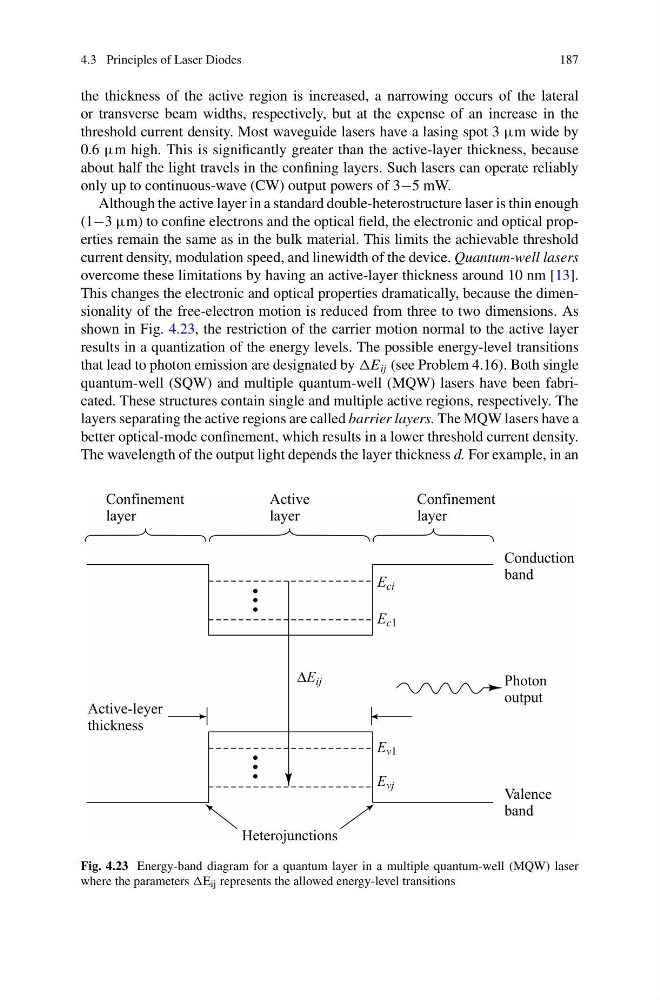
This changes the electronic and optical properties dramatically, because the dimensionality of the free-electron motion is reduced from three to two dimensions. As
shown in Fig. 4.23, the restriction of the carrier motion normal to the active layer
results in a quantization of the energy levels. The possible energy-level transitions
that lead to photon emission are designated by ij (see Problem 4.16). Both single
quantum-well (SQW) and multiple quantum-well (MQW) lasers have been fabricated. These structures contain single and multiple active regions, respectively. The
layers separating the active regions are called barrier layers. The MQW lasers have a
better optical-mode confinement, which results in a lower threshold current density.
The wavelength of the output light depends the layer thickness d. For example, in an
Fig. 4.23 Energy-band diagram for a quantum layer in a multiple quantum-well (MQW) laser
where the parameters ij represents the allowed energy-level transitions
187
the thickness of the active region is increased, a narrowing occurs of the lateral
or transverse beam widths, respectively, but at the expense of an increase in the
threshold current density. Most waveguide lasers have a lasing spot 3 μm wide by
0.6 μm high. This is significantly greater than the active-layer thickness, because
about half the light travels in the confining layers. Such lasers can operate reliably
only up to continuous-wave (CW) output powers of 3−5 mW.
Although the active layer in a standard double-heterostructure laser is thin enough
(1−3 μm) to confine electrons and the optical field, the electronic and optical properties remain the same as in the bulk material. This limits the achievable threshold
current density, modulation speed, and linewidth of the device. Quantum-well lasers
overcome these limitations by having an active-layer thickness around 10 nm [13].
This changes the electronic and optical properties dramatically, because the dimensionality of the free-electron motion is reduced from three to two dimensions. As
shown in Fig. 4.23, the restriction of the carrier motion normal to the active layer
results in a quantization of the energy levels. The possible energy-level transitions
that lead to photon emission are designated by ij (see Problem 4.16). Both single
quantum-well (SQW) and multiple quantum-well (MQW) lasers have been fabricated. These structures contain single and multiple active regions, respectively. The
layers separating the active regions are called barrier layers. The MQW lasers have a
better optical-mode confinement, which results in a lower threshold current density.
The wavelength of the output light depends the layer thickness d. For example, in an
Fig. 4.23 Energy-band diagram for a quantum layer in a multiple quantum-well (MQW) laser
where the parameters ij represents the allowed energy-level transitions