

4.3 Principles of Laser Diodes
189
much greater, because the higher photon densities reduce radiative lifetimes. The
mirror system used in VCSELs to form the resonant cavity is of critical importance,
because maximum reflectivity is needed for efficient operation. Figure 4.24 shows
one mirror system that consists of a semiconductor material, such as Si/SiO 2 , as one
material and an oxide layer, such as Si/Al 2 O 3 , as the other material.
Three types of laser configurations using a built-in frequency-selective reflector
are shown in Fig. 4.25. In each case, the frequency-selective reflector is a corrugated
grating that is a passive waveguide layer adjacent to the active region. The optical
wave propagates parallel to this grating. The operation of these types of lasers is based
on the use of a distributed Bragg phase-grating reflector. A phase grating is essentially
a region of periodically varying refractive index that causes two counter propagating
traveling waves to couple. The coupling is at a maximum for wavelengths close to
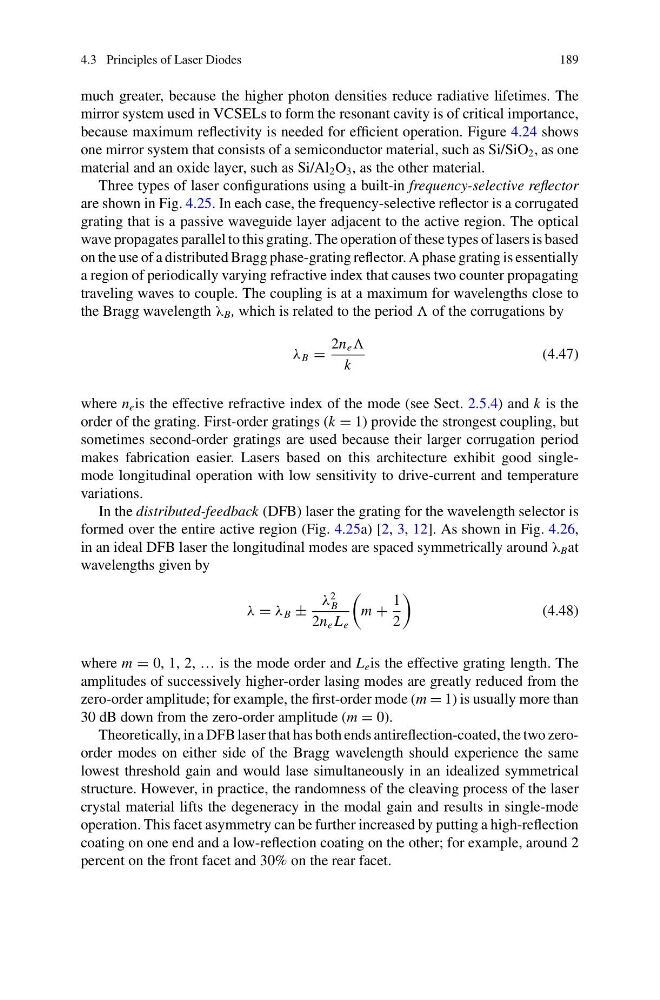
the Bragg wavelength λ B , which is related to the period of the corrugations by
λ B =
2n e
k
(4.47)
where n e is the effective refractive index of the mode (see Sect. 2.5.4) and k is the
order of the grating. First-order gratings (k = 1) provide the strongest coupling, but
sometimes second-order gratings are used because their larger corrugation period
makes fabrication easier. Lasers based on this architecture exhibit good singlemode longitudinal operation with low sensitivity to drive-current and temperature
variations.
In the distributed-feedback (DFB) laser the grating for the wavelength selector is
formed over the entire active region (Fig. 4.25a) [2, 3, 12]. As shown in Fig. 4.26,
in an ideal DFB laser the longitudinal modes are spaced symmetrically around λ B at
wavelengths given by
λ = λ B ±
λ
2
B
2n e L e
m +
1
2
(4.48)
where m = 0, 1, 2, … is the mode order and L e is the effective grating length. The
amplitudes of successively higher-order lasing modes are greatly reduced from the
zero-order amplitude; for example, the first-order mode (m = 1) is usually more than
30 dB down from the zero-order amplitude (m = 0).
Theoretically, in a DFB laser that has both ends antireflection-coated, the two zeroorder modes on either side of the Bragg wavelength should experience the same
lowest threshold gain and would lase simultaneously in an idealized symmetrical
structure. However, in practice, the randomness of the cleaving process of the laser
crystal material lifts the degeneracy in the modal gain and results in single-mode
operation. This facet asymmetry can be further increased by putting a high-reflection
coating on one end and a low-reflection coating on the other; for example, around 2
percent on the front facet and 30% on the rear facet.
189
much greater, because the higher photon densities reduce radiative lifetimes. The
mirror system used in VCSELs to form the resonant cavity is of critical importance,
because maximum reflectivity is needed for efficient operation. Figure 4.24 shows
one mirror system that consists of a semiconductor material, such as Si/SiO 2 , as one
material and an oxide layer, such as Si/Al 2 O 3 , as the other material.
Three types of laser configurations using a built-in frequency-selective reflector
are shown in Fig. 4.25. In each case, the frequency-selective reflector is a corrugated
grating that is a passive waveguide layer adjacent to the active region. The optical
wave propagates parallel to this grating. The operation of these types of lasers is based
on the use of a distributed Bragg phase-grating reflector. A phase grating is essentially
a region of periodically varying refractive index that causes two counter propagating
traveling waves to couple. The coupling is at a maximum for wavelengths close to
the Bragg wavelength λ B , which is related to the period of the corrugations by
λ B =
2n e
k
(4.47)
where n e is the effective refractive index of the mode (see Sect. 2.5.4) and k is the
order of the grating. First-order gratings (k = 1) provide the strongest coupling, but
sometimes second-order gratings are used because their larger corrugation period
makes fabrication easier. Lasers based on this architecture exhibit good singlemode longitudinal operation with low sensitivity to drive-current and temperature
variations.
In the distributed-feedback (DFB) laser the grating for the wavelength selector is
formed over the entire active region (Fig. 4.25a) [2, 3, 12]. As shown in Fig. 4.26,
in an ideal DFB laser the longitudinal modes are spaced symmetrically around λ B at
wavelengths given by
λ = λ B ±
λ
2
B
2n e L e
m +
1
2
(4.48)
where m = 0, 1, 2, … is the mode order and L e is the effective grating length. The
amplitudes of successively higher-order lasing modes are greatly reduced from the
zero-order amplitude; for example, the first-order mode (m = 1) is usually more than
30 dB down from the zero-order amplitude (m = 0).
Theoretically, in a DFB laser that has both ends antireflection-coated, the two zeroorder modes on either side of the Bragg wavelength should experience the same
lowest threshold gain and would lase simultaneously in an idealized symmetrical
structure. However, in practice, the randomness of the cleaving process of the laser
crystal material lifts the degeneracy in the modal gain and results in single-mode
operation. This facet asymmetry can be further increased by putting a high-reflection
coating on one end and a low-reflection coating on the other; for example, around 2
percent on the front facet and 30% on the rear facet.