

4.3 Principles of Laser Diodes
177
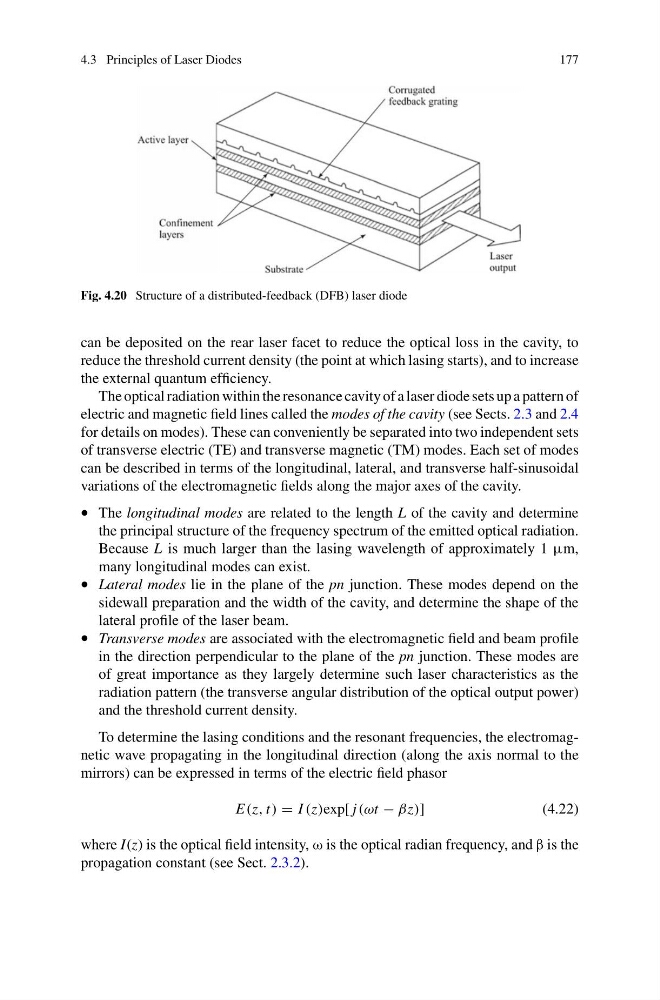
Fig. 4.20 Structure of a distributed-feedback (DFB) laser diode
can be deposited on the rear laser facet to reduce the optical loss in the cavity, to
reduce the threshold current density (the point at which lasing starts), and to increase
the external quantum efficiency.
The optical radiation within the resonance cavity of a laser diode sets up a pattern of
electric and magnetic field lines called the modes of the cavity (see Sects. 2.3 and 2.4
for details on modes). These can conveniently be separated into two independent sets
of transverse electric (TE) and transverse magnetic (TM) modes. Each set of modes
can be described in terms of the longitudinal, lateral, and transverse half-sinusoidal
variations of the electromagnetic fields along the major axes of the cavity.
• The longitudinal modes are related to the length L of the cavity and determine
the principal structure of the frequency spectrum of the emitted optical radiation.
Because L is much larger than the lasing wavelength of approximately 1 μm,
many longitudinal modes can exist.
• Lateral modes lie in the plane of the pn junction. These modes depend on the
sidewall preparation and the width of the cavity, and determine the shape of the
lateral profile of the laser beam.
• Transverse modes are associated with the electromagnetic field and beam profile
in the direction perpendicular to the plane of the pn junction. These modes are
of great importance as they largely determine such laser characteristics as the
radiation pattern (the transverse angular distribution of the optical output power)
and the threshold current density.
To determine the lasing conditions and the resonant frequencies, the electromagnetic wave propagating in the longitudinal direction (along the axis normal to the
mirrors) can be expressed in terms of the electric field phasor
E(z, t) = I (z)exp[ j (ωt − βz)]
(4.22)
where I(z) is the optical field intensity, ω is the optical radian frequency, and β is the
propagation constant (see Sect. 2.3.2).
177
Fig. 4.20 Structure of a distributed-feedback (DFB) laser diode
can be deposited on the rear laser facet to reduce the optical loss in the cavity, to
reduce the threshold current density (the point at which lasing starts), and to increase
the external quantum efficiency.
The optical radiation within the resonance cavity of a laser diode sets up a pattern of
electric and magnetic field lines called the modes of the cavity (see Sects. 2.3 and 2.4
for details on modes). These can conveniently be separated into two independent sets
of transverse electric (TE) and transverse magnetic (TM) modes. Each set of modes
can be described in terms of the longitudinal, lateral, and transverse half-sinusoidal
variations of the electromagnetic fields along the major axes of the cavity.
• The longitudinal modes are related to the length L of the cavity and determine
the principal structure of the frequency spectrum of the emitted optical radiation.
Because L is much larger than the lasing wavelength of approximately 1 μm,
many longitudinal modes can exist.
• Lateral modes lie in the plane of the pn junction. These modes depend on the
sidewall preparation and the width of the cavity, and determine the shape of the
lateral profile of the laser beam.
• Transverse modes are associated with the electromagnetic field and beam profile
in the direction perpendicular to the plane of the pn junction. These modes are
of great importance as they largely determine such laser characteristics as the
radiation pattern (the transverse angular distribution of the optical output power)
and the threshold current density.
To determine the lasing conditions and the resonant frequencies, the electromagnetic wave propagating in the longitudinal direction (along the axis normal to the
mirrors) can be expressed in terms of the electric field phasor
E(z, t) = I (z)exp[ j (ωt − βz)]
(4.22)
where I(z) is the optical field intensity, ω is the optical radian frequency, and β is the
propagation constant (see Sect. 2.3.2).