

178
4 Light Sources for Fiber Links
Lasing is the condition at which light amplification becomes possible in the laser
diode. The requirement for lasing is that a population inversion be achieved. This
condition can be understood by considering the fundamental relationship between the
optical field intensity I, the absorption coefficient α λ , and the gain coefficient g in the
Fabry-Perot cavity. The stimulated emission rate into a given mode is proportional to
the intensity of the radiation in that mode. The radiation intensity at a photon energy
hν varies exponentially with the distance z that it traverses along the lasing cavity
according to the relationship
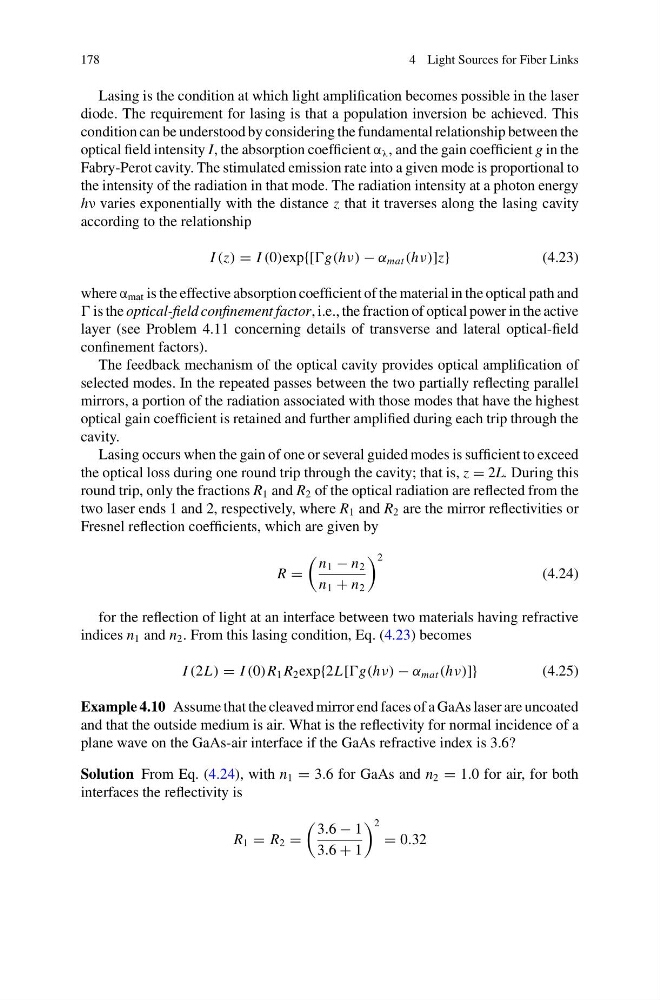
I (z) = I (0)exp{[g(hν) − α mat (hν)]z}
(4.23)
where α mat is the effective absorption coefficient of the material in the optical path and
is the optical-field confinement factor, i.e., the fraction of optical power in the active
layer (see Problem 4.11 concerning details of transverse and lateral optical-field
confinement factors).
The feedback mechanism of the optical cavity provides optical amplification of
selected modes. In the repeated passes between the two partially reflecting parallel
mirrors, a portion of the radiation associated with those modes that have the highest
optical gain coefficient is retained and further amplified during each trip through the
cavity.
Lasing occurs when the gain of one or several guided modes is sufficient to exceed
the optical loss during one round trip through the cavity; that is, z = 2L. During this
round trip, only the fractions R 1 and R 2 of the optical radiation are reflected from the
two laser ends 1 and 2, respectively, where R 1 and R 2 are the mirror reflectivities or
Fresnel reflection coefficients, which are given by
R =
n 1 − n 2
n 1 + n 2
2
(4.24)
for the reflection of light at an interface between two materials having refractive
indices n 1 and n 2 . From this lasing condition, Eq. (4.23) becomes
I (2L) = I (0)R 1 R 2 exp{2L[g(hν) − α mat (hν)]}
(4.25)
Example 4.10 Assume that the cleaved mirror end faces of a GaAs laser are uncoated
and that the outside medium is air. What is the reflectivity for normal incidence of a
plane wave on the GaAs-air interface if the GaAs refractive index is 3.6?
Solution From Eq. (4.24), with n 1 = 3.6 for GaAs and n 2 = 1.0 for air, for both
interfaces the reflectivity is
R 1 = R 2 =
3.6 − 1
3.6 + 1
2
= 0.32
4 Light Sources for Fiber Links
Lasing is the condition at which light amplification becomes possible in the laser
diode. The requirement for lasing is that a population inversion be achieved. This
condition can be understood by considering the fundamental relationship between the
optical field intensity I, the absorption coefficient α λ , and the gain coefficient g in the
Fabry-Perot cavity. The stimulated emission rate into a given mode is proportional to
the intensity of the radiation in that mode. The radiation intensity at a photon energy
hν varies exponentially with the distance z that it traverses along the lasing cavity
according to the relationship
I (z) = I (0)exp{[g(hν) − α mat (hν)]z}
(4.23)
where α mat is the effective absorption coefficient of the material in the optical path and
is the optical-field confinement factor, i.e., the fraction of optical power in the active
layer (see Problem 4.11 concerning details of transverse and lateral optical-field
confinement factors).
The feedback mechanism of the optical cavity provides optical amplification of
selected modes. In the repeated passes between the two partially reflecting parallel
mirrors, a portion of the radiation associated with those modes that have the highest
optical gain coefficient is retained and further amplified during each trip through the
cavity.
Lasing occurs when the gain of one or several guided modes is sufficient to exceed
the optical loss during one round trip through the cavity; that is, z = 2L. During this
round trip, only the fractions R 1 and R 2 of the optical radiation are reflected from the
two laser ends 1 and 2, respectively, where R 1 and R 2 are the mirror reflectivities or
Fresnel reflection coefficients, which are given by
R =
n 1 − n 2
n 1 + n 2
2
(4.24)
for the reflection of light at an interface between two materials having refractive
indices n 1 and n 2 . From this lasing condition, Eq. (4.23) becomes
I (2L) = I (0)R 1 R 2 exp{2L[g(hν) − α mat (hν)]}
(4.25)
Example 4.10 Assume that the cleaved mirror end faces of a GaAs laser are uncoated
and that the outside medium is air. What is the reflectivity for normal incidence of a
plane wave on the GaAs-air interface if the GaAs refractive index is 3.6?
Solution From Eq. (4.24), with n 1 = 3.6 for GaAs and n 2 = 1.0 for air, for both
interfaces the reflectivity is
R 1 = R 2 =
3.6 − 1
3.6 + 1
2
= 0.32