

176
4 Light Sources for Fiber Links
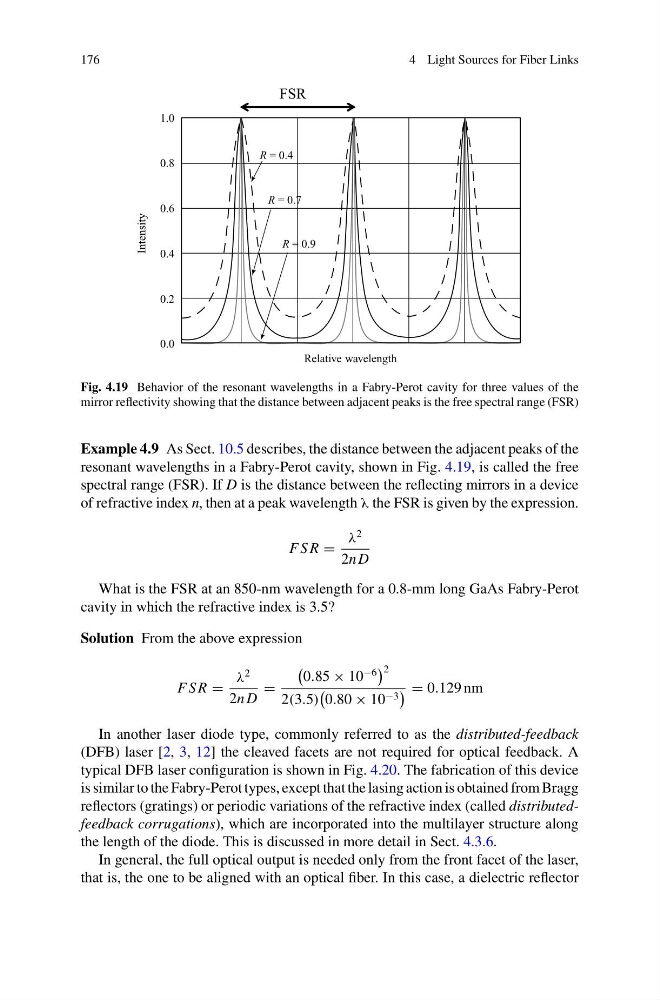
FSR
Fig. 4.19 Behavior of the resonant wavelengths in a Fabry-Perot cavity for three values of the
mirror reflectivity showing that the distance between adjacent peaks is the free spectral range (FSR)
Example 4.9 As Sect. 10.5 describes, the distance between the adjacent peaks of the
resonant wavelengths in a Fabry-Perot cavity, shown in Fig. 4.19, is called the free
spectral range (FSR). If D is the distance between the reflecting mirrors in a device
of refractive index n, then at a peak wavelength λ the FSR is given by the expression.
F S R =
λ
2
2n D
What is the FSR at an 850-nm wavelength for a 0.8-mm long GaAs Fabry-Perot
cavity in which the refractive index is 3.5?
Solution From the above expression
F S R =
λ
2
2n D
=
0.85 × 10
−6
2
2(3.5)
0.80 × 10 −3
= 0.129 nm
In another laser diode type, commonly referred to as the distributed-feedback
(DFB) laser [2, 3, 12] the cleaved facets are not required for optical feedback. A
typical DFB laser configuration is shown in Fig. 4.20. The fabrication of this device
is similar to the Fabry-Perot types, except that the lasing action is obtained from Bragg
reflectors (gratings) or periodic variations of the refractive index (called distributedfeedback corrugations), which are incorporated into the multilayer structure along
the length of the diode. This is discussed in more detail in Sect. 4.3.6.
In general, the full optical output is needed only from the front facet of the laser,
that is, the one to be aligned with an optical fiber. In this case, a dielectric reflector
4 Light Sources for Fiber Links
FSR
Fig. 4.19 Behavior of the resonant wavelengths in a Fabry-Perot cavity for three values of the
mirror reflectivity showing that the distance between adjacent peaks is the free spectral range (FSR)
Example 4.9 As Sect. 10.5 describes, the distance between the adjacent peaks of the
resonant wavelengths in a Fabry-Perot cavity, shown in Fig. 4.19, is called the free
spectral range (FSR). If D is the distance between the reflecting mirrors in a device
of refractive index n, then at a peak wavelength λ the FSR is given by the expression.
F S R =
λ
2
2n D
What is the FSR at an 850-nm wavelength for a 0.8-mm long GaAs Fabry-Perot
cavity in which the refractive index is 3.5?
Solution From the above expression
F S R =
λ
2
2n D
=
0.85 × 10
−6
2
2(3.5)
0.80 × 10 −3
= 0.129 nm
In another laser diode type, commonly referred to as the distributed-feedback
(DFB) laser [2, 3, 12] the cleaved facets are not required for optical feedback. A
typical DFB laser configuration is shown in Fig. 4.20. The fabrication of this device
is similar to the Fabry-Perot types, except that the lasing action is obtained from Bragg
reflectors (gratings) or periodic variations of the refractive index (called distributedfeedback corrugations), which are incorporated into the multilayer structure along
the length of the diode. This is discussed in more detail in Sect. 4.3.6.
In general, the full optical output is needed only from the front facet of the laser,
that is, the one to be aligned with an optical fiber. In this case, a dielectric reflector