

4.2 Principles of Light-Emitting Diodes (LEDs)
169
η ext =
1
4π
φ c
0
T (φ)(2π sinφ)dφ
(4.14)
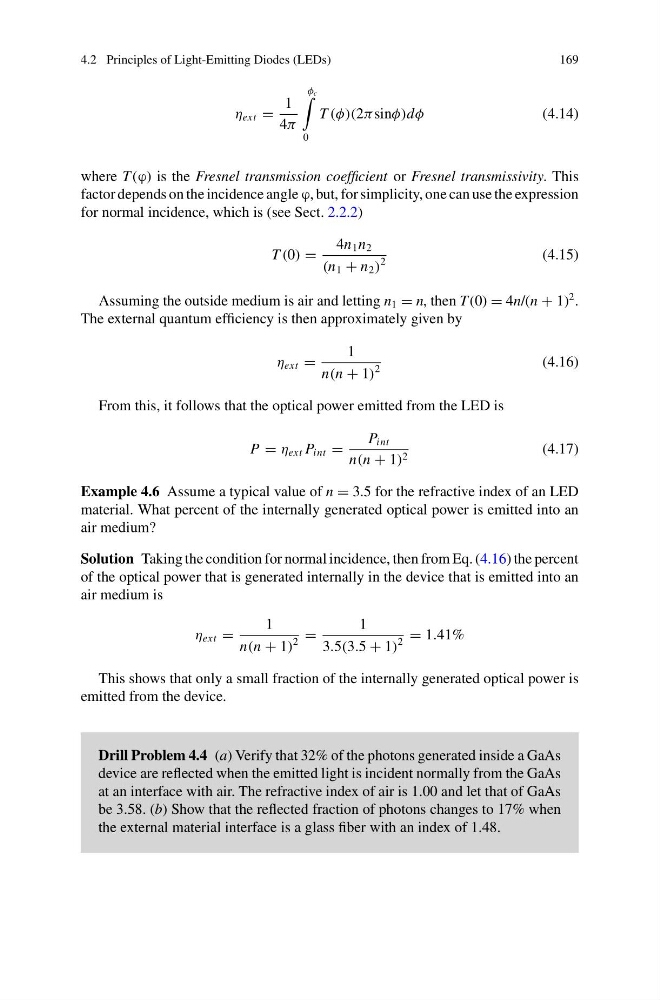
where T (ϕ) is the Fresnel transmission coefficient or Fresnel transmissivity. This
factor depends on the incidence angle ϕ, but, for simplicity, one can use the expression
for normal incidence, which is (see Sect. 2.2.2)
T (0) =
4n 1 n 2
(n 1 + n 2 )
2
(4.15)
Assuming the outside medium is air and letting n 1 = n, then T (0) = 4n/(n + 1)
2 .
The external quantum efficiency is then approximately given by
η ext =
1
n(n + 1)
2
(4.16)
From this, it follows that the optical power emitted from the LED is
P = η ext P int =
P int
n(n + 1) 2
(4.17)
Example 4.6 Assume a typical value of n = 3.5 for the refractive index of an LED
material. What percent of the internally generated optical power is emitted into an
air medium?
Solution Taking the condition for normal incidence, then from Eq. (4.16) the percent
of the optical power that is generated internally in the device that is emitted into an
air medium is
η ext =
1
n(n + 1)
2
=
1
3.5(3.5 + 1)
2
= 1.41%
This shows that only a small fraction of the internally generated optical power is
emitted from the device.
Drill Problem 4.4 (a) Verify that 32% of the photons generated inside a GaAs
device are reflected when the emitted light is incident normally from the GaAs
at an interface with air. The refractive index of air is 1.00 and let that of GaAs
be 3.58. (b) Show that the reflected fraction of photons changes to 17% when
the external material interface is a glass fiber with an index of 1.48.
169
η ext =
1
4π
φ c
0
T (φ)(2π sinφ)dφ
(4.14)
where T (ϕ) is the Fresnel transmission coefficient or Fresnel transmissivity. This
factor depends on the incidence angle ϕ, but, for simplicity, one can use the expression
for normal incidence, which is (see Sect. 2.2.2)
T (0) =
4n 1 n 2
(n 1 + n 2 )
2
(4.15)
Assuming the outside medium is air and letting n 1 = n, then T (0) = 4n/(n + 1)
2 .
The external quantum efficiency is then approximately given by
η ext =
1
n(n + 1)
2
(4.16)
From this, it follows that the optical power emitted from the LED is
P = η ext P int =
P int
n(n + 1) 2
(4.17)
Example 4.6 Assume a typical value of n = 3.5 for the refractive index of an LED
material. What percent of the internally generated optical power is emitted into an
air medium?
Solution Taking the condition for normal incidence, then from Eq. (4.16) the percent
of the optical power that is generated internally in the device that is emitted into an
air medium is
η ext =
1
n(n + 1)
2
=
1
3.5(3.5 + 1)
2
= 1.41%
This shows that only a small fraction of the internally generated optical power is
emitted from the device.
Drill Problem 4.4 (a) Verify that 32% of the photons generated inside a GaAs
device are reflected when the emitted light is incident normally from the GaAs
at an interface with air. The refractive index of air is 1.00 and let that of GaAs
be 3.58. (b) Show that the reflected fraction of photons changes to 17% when
the external material interface is a glass fiber with an index of 1.48.