

138
3 Optical Signal Attenuation and Dispersion
Bending loss
at 1550 nm
Bending loss
at 1310 nm
Bending loss (dB)
Bending radius (cm)
0.1
100
1
10
0.5
1000
1.0
1.5
100 dB bending
loss at 1550 nm
1 dB bending
loss at 1310 nm
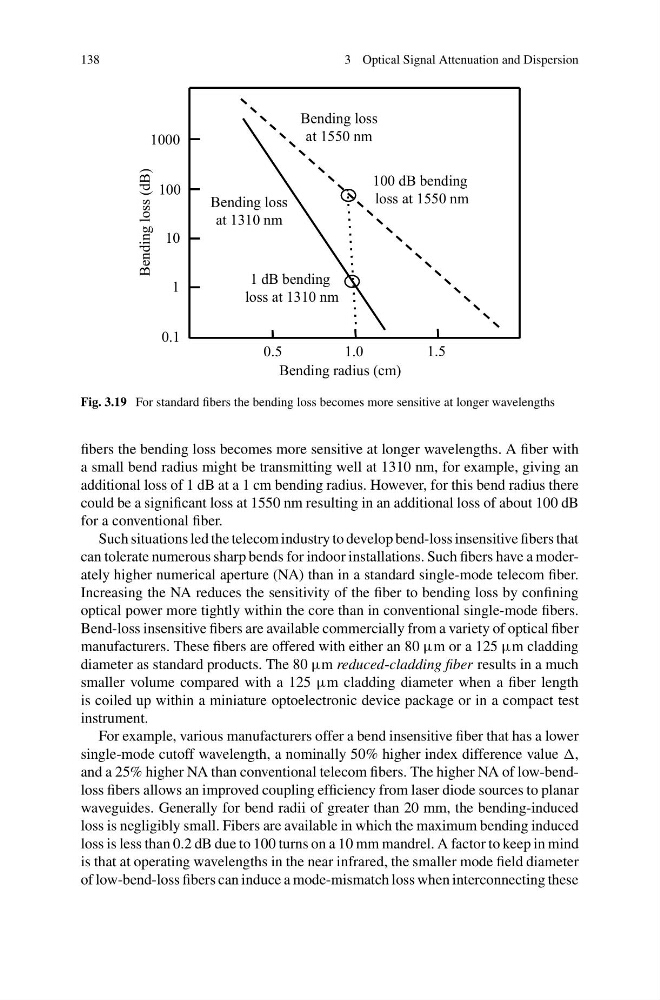
Fig. 3.19 For standard fibers the bending loss becomes more sensitive at longer wavelengths
fibers the bending loss becomes more sensitive at longer wavelengths. A fiber with
a small bend radius might be transmitting well at 1310 nm, for example, giving an
additional loss of 1 dB at a 1 cm bending radius. However, for this bend radius there
could be a significant loss at 1550 nm resulting in an additional loss of about 100 dB
for a conventional fiber.
Such situations led the telecom industry to develop bend-loss insensitive fibers that
can tolerate numerous sharp bends for indoor installations. Such fibers have a moderately higher numerical aperture (NA) than in a standard single-mode telecom fiber.
Increasing the NA reduces the sensitivity of the fiber to bending loss by confining
optical power more tightly within the core than in conventional single-mode fibers.
Bend-loss insensitive fibers are available commercially from a variety of optical fiber
manufacturers. These fibers are offered with either an 80 μm or a 125 μm cladding
diameter as standard products. The 80 μm reduced-cladding fiber results in a much
smaller volume compared with a 125 μm cladding diameter when a fiber length
is coiled up within a miniature optoelectronic device package or in a compact test
instrument.
For example, various manufacturers offer a bend insensitive fiber that has a lower
single-mode cutoff wavelength, a nominally 50% higher index difference value
and a 25% higher NA than conventional telecom fibers. The higher NA of low-bendloss fibers allows an improved coupling efficiency from laser diode sources to planar
waveguides. Generally for bend radii of greater than 20 mm, the bending-induced
loss is negligibly small. Fibers are available in which the maximum bending induced
loss is less than 0.2 dB due to 100 turns on a 10 mm mandrel. A factor to keep in mind
is that at operating wavelengths in the near infrared, the smaller mode field diameter
of low-bend-loss fibers can induce a mode-mismatch loss when interconnecting these
3 Optical Signal Attenuation and Dispersion
Bending loss
at 1550 nm
Bending loss
at 1310 nm
Bending loss (dB)
Bending radius (cm)
0.1
100
1
10
0.5
1000
1.0
1.5
100 dB bending
loss at 1550 nm
1 dB bending
loss at 1310 nm
Fig. 3.19 For standard fibers the bending loss becomes more sensitive at longer wavelengths
fibers the bending loss becomes more sensitive at longer wavelengths. A fiber with
a small bend radius might be transmitting well at 1310 nm, for example, giving an
additional loss of 1 dB at a 1 cm bending radius. However, for this bend radius there
could be a significant loss at 1550 nm resulting in an additional loss of about 100 dB
for a conventional fiber.
Such situations led the telecom industry to develop bend-loss insensitive fibers that
can tolerate numerous sharp bends for indoor installations. Such fibers have a moderately higher numerical aperture (NA) than in a standard single-mode telecom fiber.
Increasing the NA reduces the sensitivity of the fiber to bending loss by confining
optical power more tightly within the core than in conventional single-mode fibers.
Bend-loss insensitive fibers are available commercially from a variety of optical fiber
manufacturers. These fibers are offered with either an 80 μm or a 125 μm cladding
diameter as standard products. The 80 μm reduced-cladding fiber results in a much
smaller volume compared with a 125 μm cladding diameter when a fiber length
is coiled up within a miniature optoelectronic device package or in a compact test
instrument.
For example, various manufacturers offer a bend insensitive fiber that has a lower
single-mode cutoff wavelength, a nominally 50% higher index difference value
and a 25% higher NA than conventional telecom fibers. The higher NA of low-bendloss fibers allows an improved coupling efficiency from laser diode sources to planar
waveguides. Generally for bend radii of greater than 20 mm, the bending-induced
loss is negligibly small. Fibers are available in which the maximum bending induced
loss is less than 0.2 dB due to 100 turns on a 10 mm mandrel. A factor to keep in mind
is that at operating wavelengths in the near infrared, the smaller mode field diameter
of low-bend-loss fibers can induce a mode-mismatch loss when interconnecting these