

3.5 Designs and Use of Specialty Fibers
137
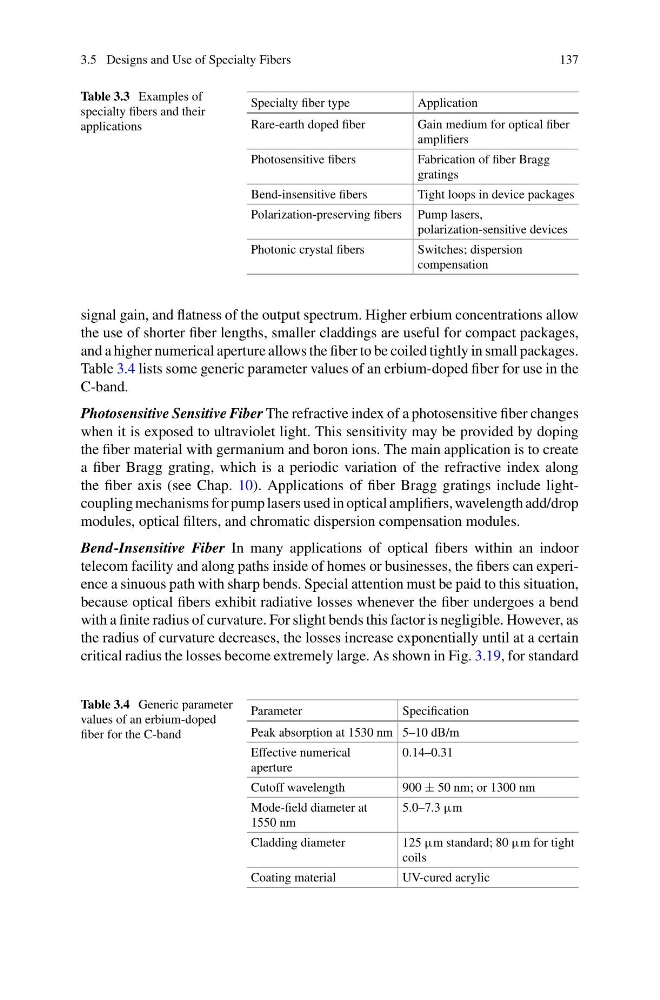
Table 3.3 Examples of
specialty fibers and their
applications
Specialty fiber type
Application
Rare-earth doped fiber
Gain medium for optical fiber
amplifiers
Photosensitive fibers
Fabrication of fiber Bragg
gratings
Bend-insensitive fibers
Tight loops in device packages
Polarization-preserving fibers Pump lasers,
polarization-sensitive devices
Photonic crystal fibers
Switches; dispersion
compensation
signal gain, and flatness of the output spectrum. Higher erbium concentrations allow
the use of shorter fiber lengths, smaller claddings are useful for compact packages,
and a higher numerical aperture allows the fiber to be coiled tightly in small packages.
Table 3.4 lists some generic parameter values of an erbium-doped fiber for use in the
C-band.
Photosensitive Sensitive Fiber The refractive index of a photosensitive fiber changes
when it is exposed to ultraviolet light. This sensitivity may be provided by doping
the fiber material with germanium and boron ions. The main application is to create
a fiber Bragg grating, which is a periodic variation of the refractive index along
the fiber axis (see Chap. 10). Applications of fiber Bragg gratings include lightcoupling mechanisms for pump lasers used in optical amplifiers, wavelength add/drop
modules, optical filters, and chromatic dispersion compensation modules.
Bend-Insensitive Fiber In many applications of optical fibers within an indoor
telecom facility and along paths inside of homes or businesses, the fibers can experience a sinuous path with sharp bends. Special attention must be paid to this situation,
because optical fibers exhibit radiative losses whenever the fiber undergoes a bend
with a finite radius of curvature. For slight bends this factor is negligible. However, as
the radius of curvature decreases, the losses increase exponentially until at a certain
critical radius the losses become extremely large. As shown in Fig. 3.19, for standard
Table 3.4 Generic parameter
values of an erbium-doped
fiber for the C-band
Parameter
Specification
Peak absorption at 1530 nm 5–10 dB/m
Effective numerical
aperture
0.14–0.31
Cutoff wavelength
900 ± 50 nm; or 1300 nm
Mode-field diameter at
1550 nm
5.0–7.3 μm
Cladding diameter
125 μm standard; 80 μm for tight
coils
Coating material
UV-cured acrylic
137
Table 3.3 Examples of
specialty fibers and their
applications
Specialty fiber type
Application
Rare-earth doped fiber
Gain medium for optical fiber
amplifiers
Photosensitive fibers
Fabrication of fiber Bragg
gratings
Bend-insensitive fibers
Tight loops in device packages
Polarization-preserving fibers Pump lasers,
polarization-sensitive devices
Photonic crystal fibers
Switches; dispersion
compensation
signal gain, and flatness of the output spectrum. Higher erbium concentrations allow
the use of shorter fiber lengths, smaller claddings are useful for compact packages,
and a higher numerical aperture allows the fiber to be coiled tightly in small packages.
Table 3.4 lists some generic parameter values of an erbium-doped fiber for use in the
C-band.
Photosensitive Sensitive Fiber The refractive index of a photosensitive fiber changes
when it is exposed to ultraviolet light. This sensitivity may be provided by doping
the fiber material with germanium and boron ions. The main application is to create
a fiber Bragg grating, which is a periodic variation of the refractive index along
the fiber axis (see Chap. 10). Applications of fiber Bragg gratings include lightcoupling mechanisms for pump lasers used in optical amplifiers, wavelength add/drop
modules, optical filters, and chromatic dispersion compensation modules.
Bend-Insensitive Fiber In many applications of optical fibers within an indoor
telecom facility and along paths inside of homes or businesses, the fibers can experience a sinuous path with sharp bends. Special attention must be paid to this situation,
because optical fibers exhibit radiative losses whenever the fiber undergoes a bend
with a finite radius of curvature. For slight bends this factor is negligible. However, as
the radius of curvature decreases, the losses increase exponentially until at a certain
critical radius the losses become extremely large. As shown in Fig. 3.19, for standard
Table 3.4 Generic parameter
values of an erbium-doped
fiber for the C-band
Parameter
Specification
Peak absorption at 1530 nm 5–10 dB/m
Effective numerical
aperture
0.14–0.31
Cutoff wavelength
900 ± 50 nm; or 1300 nm
Mode-field diameter at
1550 nm
5.0–7.3 μm
Cladding diameter
125 μm standard; 80 μm for tight
coils
Coating material
UV-cured acrylic