

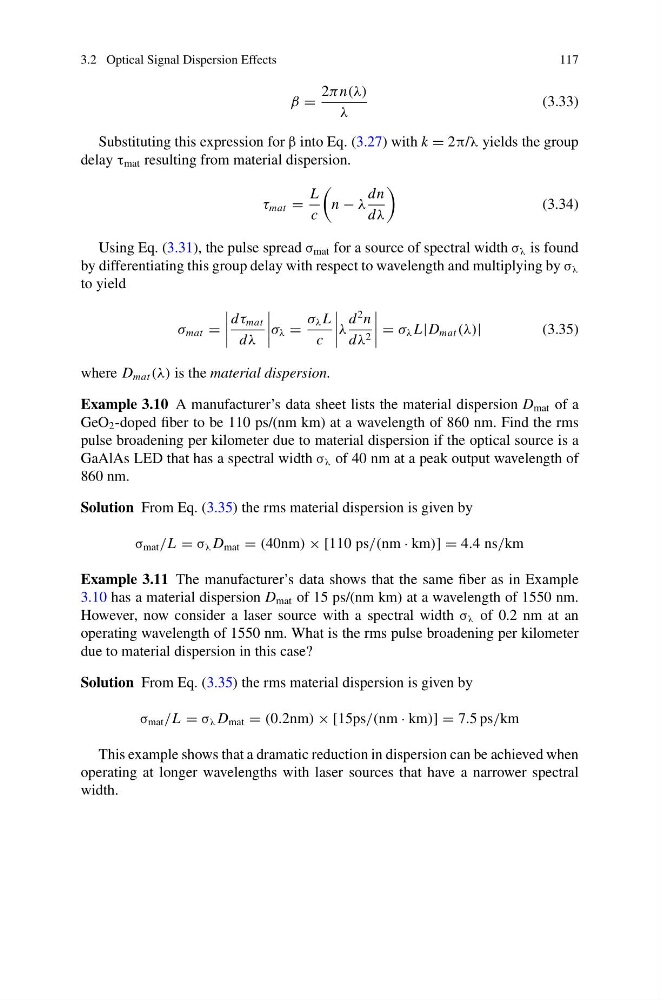
3.2 Optical Signal Dispersion Effects
117
β =
2π n(λ)
λ
(3.33)
Substituting this expression for β into Eq. (3.27) with k = 2π/λ yields the group
delay τ mat resulting from material dispersion.
τ mat =
L
c
n − λ
dn
dλ
(3.34)
Using Eq. (3.31), the pulse spread σ mat for a source of spectral width σ λ is found
by differentiating this group delay with respect to wavelength and multiplying by σ λ
to yield
σ mat =
dτ mat
dλ
σ λ =
σ λ L
c
λ
d
2 n
dλ 2
= σ λ L|D mat (λ)|
(3.35)
where D mat (λ) is the material dispersion.
Example 3.10 A manufacturer’s data sheet lists the material dispersion D mat of a
GeO 2 -doped fiber to be 110 ps/(nm km) at a wavelength of 860 nm. Find the rms
pulse broadening per kilometer due to material dispersion if the optical source is a
GaAlAs LED that has a spectral width σ λ of 40 nm at a peak output wavelength of
860 nm.
Solution From Eq. (3.35) the rms material dispersion is given by
σ mat /L = σ λ D mat = (40nm) × [110 ps/(nm · km)] = 4.4 ns/km
Example 3.11 The manufacturer’s data shows that the same fiber as in Example
3.10 has a material dispersion D mat of 15 ps/(nm km) at a wavelength of 1550 nm.
However, now consider a laser source with a spectral width σ λ of 0.2 nm at an
operating wavelength of 1550 nm. What is the rms pulse broadening per kilometer
due to material dispersion in this case?
Solution From Eq. (3.35) the rms material dispersion is given by
σ mat /L = σ λ D mat = (0.2nm) × [15ps/(nm · km)] = 7.5 ps/km
This example shows that a dramatic reduction in dispersion can be achieved when
operating at longer wavelengths with laser sources that have a narrower spectral
width.
117
β =
2π n(λ)
λ
(3.33)
Substituting this expression for β into Eq. (3.27) with k = 2π/λ yields the group
delay τ mat resulting from material dispersion.
τ mat =
L
c
n − λ
dn
dλ
(3.34)
Using Eq. (3.31), the pulse spread σ mat for a source of spectral width σ λ is found
by differentiating this group delay with respect to wavelength and multiplying by σ λ
to yield
σ mat =
dτ mat
dλ
σ λ =
σ λ L
c
λ
d
2 n
dλ 2
= σ λ L|D mat (λ)|
(3.35)
where D mat (λ) is the material dispersion.
Example 3.10 A manufacturer’s data sheet lists the material dispersion D mat of a
GeO 2 -doped fiber to be 110 ps/(nm km) at a wavelength of 860 nm. Find the rms
pulse broadening per kilometer due to material dispersion if the optical source is a
GaAlAs LED that has a spectral width σ λ of 40 nm at a peak output wavelength of
860 nm.
Solution From Eq. (3.35) the rms material dispersion is given by
σ mat /L = σ λ D mat = (40nm) × [110 ps/(nm · km)] = 4.4 ns/km
Example 3.11 The manufacturer’s data shows that the same fiber as in Example
3.10 has a material dispersion D mat of 15 ps/(nm km) at a wavelength of 1550 nm.
However, now consider a laser source with a spectral width σ λ of 0.2 nm at an
operating wavelength of 1550 nm. What is the rms pulse broadening per kilometer
due to material dispersion in this case?
Solution From Eq. (3.35) the rms material dispersion is given by
σ mat /L = σ λ D mat = (0.2nm) × [15ps/(nm · km)] = 7.5 ps/km
This example shows that a dramatic reduction in dispersion can be achieved when
operating at longer wavelengths with laser sources that have a narrower spectral
width.