

118
3 Optical Signal Attenuation and Dispersion
3.2.6 Effects of Waveguide Dispersion
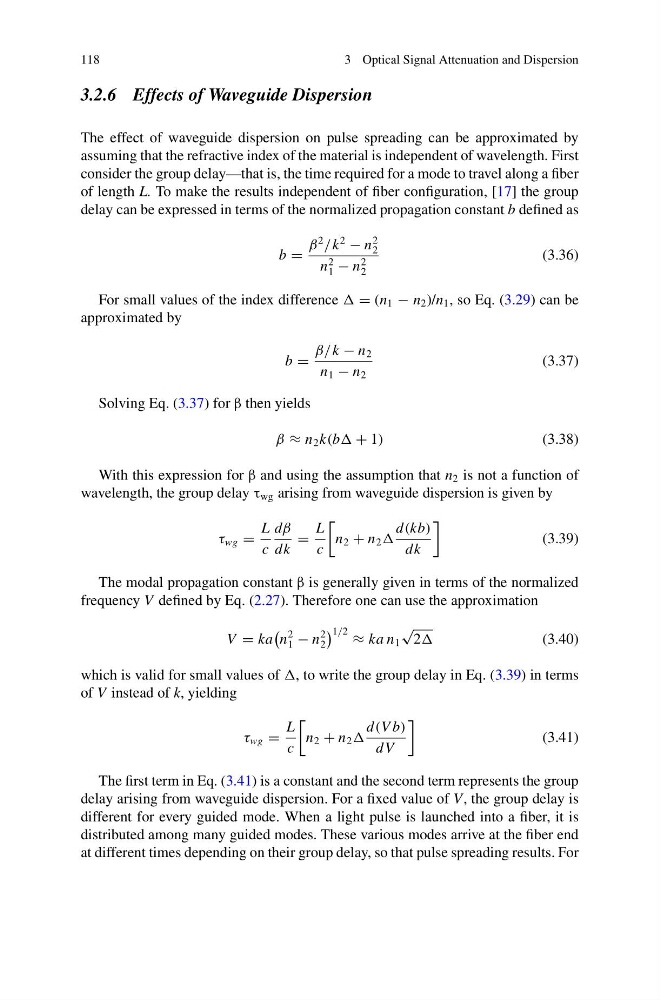
The effect of waveguide dispersion on pulse spreading can be approximated by
assuming that the refractive index of the material is independent of wavelength. First
consider the group delay—that is, the time required for a mode to travel along a fiber
of length L. To make the results independent of fiber configuration, [17] the group
delay can be expressed in terms of the normalized propagation constant b defined as
b =
β
2
/k
2
− n
2
2
n
2
1 − n
2
2
(3.36)
For small values of the index difference = (n 1 − n 2 )/n 1 , so Eq. (3.29) can be
approximated by
b =
β/k − n 2
n 1 − n 2
(3.37)
Solving Eq. (3.37) for β then yields
β ≈ n 2 k(b + 1)
(3.38)
With this expression for β and using the assumption that n 2 is not a function of
wavelength, the group delay τ wg arising from waveguide dispersion is given by
τ wg =
L
c
dβ
dk
=
L
c
n 2 + n 2
d(kb)
dk
(3.39)
The modal propagation constant β is generally given in terms of the normalized
frequency V defined by Eq. (2.27). Therefore one can use the approximation
V = ka
n
2
1 − n
2
2
1/2 ≈ ka n 1
√
2
(3.40)
which is valid for small values of , to write the group delay in Eq. (3.39) in terms
of V instead of k, yielding
τ wg =
L
c
n 2 + n 2
d(V b)
dV
(3.41)
The first term in Eq. (3.41) is a constant and the second term represents the group
delay arising from waveguide dispersion. For a fixed value of V, the group delay is
different for every guided mode. When a light pulse is launched into a fiber, it is
distributed among many guided modes. These various modes arrive at the fiber end
at different times depending on their group delay, so that pulse spreading results. For
3 Optical Signal Attenuation and Dispersion
3.2.6 Effects of Waveguide Dispersion
The effect of waveguide dispersion on pulse spreading can be approximated by
assuming that the refractive index of the material is independent of wavelength. First
consider the group delay—that is, the time required for a mode to travel along a fiber
of length L. To make the results independent of fiber configuration, [17] the group
delay can be expressed in terms of the normalized propagation constant b defined as
b =
β
2
/k
2
− n
2
2
n
2
1 − n
2
2
(3.36)
For small values of the index difference = (n 1 − n 2 )/n 1 , so Eq. (3.29) can be
approximated by
b =
β/k − n 2
n 1 − n 2
(3.37)
Solving Eq. (3.37) for β then yields
β ≈ n 2 k(b + 1)
(3.38)
With this expression for β and using the assumption that n 2 is not a function of
wavelength, the group delay τ wg arising from waveguide dispersion is given by
τ wg =
L
c
dβ
dk
=
L
c
n 2 + n 2
d(kb)
dk
(3.39)
The modal propagation constant β is generally given in terms of the normalized
frequency V defined by Eq. (2.27). Therefore one can use the approximation
V = ka
n
2
1 − n
2
2
1/2 ≈ ka n 1
√
2
(3.40)
which is valid for small values of , to write the group delay in Eq. (3.39) in terms
of V instead of k, yielding
τ wg =
L
c
n 2 + n 2
d(V b)
dV
(3.41)
The first term in Eq. (3.41) is a constant and the second term represents the group
delay arising from waveguide dispersion. For a fixed value of V, the group delay is
different for every guided mode. When a light pulse is launched into a fiber, it is
distributed among many guided modes. These various modes arrive at the fiber end
at different times depending on their group delay, so that pulse spreading results. For