

116
3 Optical Signal Attenuation and Dispersion
to the fact that the dispersive properties of the refractive index (which give rise to
material dispersion) also affect the waveguide dispersion. However, an examination
[16] of the interdependence of material and waveguide dispersion has shown that,
unless a very precise value to a fraction of a percent is desired, a good estimate of
the total intramodal dispersion can be obtained by calculating the effect of signal
distortion arising from one type of dispersion in the absence of the other. Thus, to a
very good approximation, D can be written as the sum of the material dispersion D mat
and the waveguide dispersion D wg . Material dispersion and waveguide dispersion are
therefore considered separately in the next two sections.
3.2.5 Material-Induced Dispersion
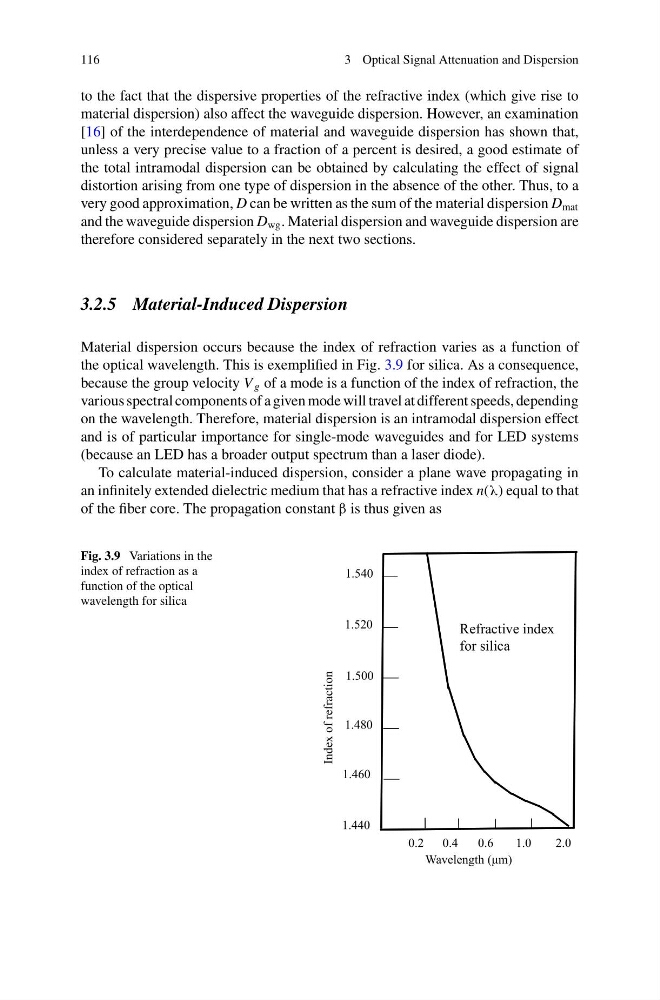
Material dispersion occurs because the index of refraction varies as a function of
the optical wavelength. This is exemplified in Fig. 3.9 for silica. As a consequence,
because the group velocity V g of a mode is a function of the index of refraction, the
various spectral components of a given mode will travel at different speeds, depending
on the wavelength. Therefore, material dispersion is an intramodal dispersion effect
and is of particular importance for single-mode waveguides and for LED systems
(because an LED has a broader output spectrum than a laser diode).
To calculate material-induced dispersion, consider a plane wave propagating in
an infinitely extended dielectric medium that has a refractive index n(λ) equal to that
of the fiber core. The propagation constant β is thus given as
Fig. 3.9 Variations in the
index of refraction as a
function of the optical
wavelength for silica
1.540
1.520
1.500
1.480
1.460
1.440
0.2
0.4
0.6
1.0
2.0
Wavelength (μm)
Index of refraction
Refractive index
for silica
3 Optical Signal Attenuation and Dispersion
to the fact that the dispersive properties of the refractive index (which give rise to
material dispersion) also affect the waveguide dispersion. However, an examination
[16] of the interdependence of material and waveguide dispersion has shown that,
unless a very precise value to a fraction of a percent is desired, a good estimate of
the total intramodal dispersion can be obtained by calculating the effect of signal
distortion arising from one type of dispersion in the absence of the other. Thus, to a
very good approximation, D can be written as the sum of the material dispersion D mat
and the waveguide dispersion D wg . Material dispersion and waveguide dispersion are
therefore considered separately in the next two sections.
3.2.5 Material-Induced Dispersion
Material dispersion occurs because the index of refraction varies as a function of
the optical wavelength. This is exemplified in Fig. 3.9 for silica. As a consequence,
because the group velocity V g of a mode is a function of the index of refraction, the
various spectral components of a given mode will travel at different speeds, depending
on the wavelength. Therefore, material dispersion is an intramodal dispersion effect
and is of particular importance for single-mode waveguides and for LED systems
(because an LED has a broader output spectrum than a laser diode).
To calculate material-induced dispersion, consider a plane wave propagating in
an infinitely extended dielectric medium that has a refractive index n(λ) equal to that
of the fiber core. The propagation constant β is thus given as
Fig. 3.9 Variations in the
index of refraction as a
function of the optical
wavelength for silica
1.540
1.520
1.500
1.480
1.460
1.440
0.2
0.4
0.6
1.0
2.0
Wavelength (μm)
Index of refraction
Refractive index
for silica