

3.2 Optical Signal Dispersion Effects
115
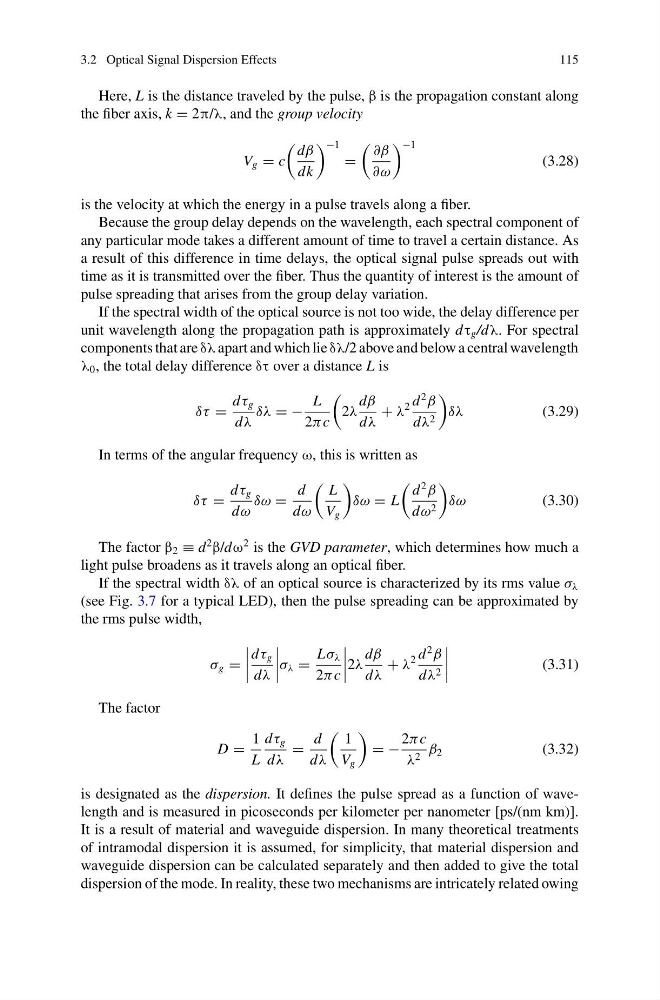
Here, L is the distance traveled by the pulse, β is the propagation constant along
the fiber axis, k = 2π/λ, and the group velocity
V g = c
dβ
dk
−1
=
∂β
∂ω
−1
(3.28)
is the velocity at which the energy in a pulse travels along a fiber.
Because the group delay depends on the wavelength, each spectral component of
any particular mode takes a different amount of time to travel a certain distance. As
a result of this difference in time delays, the optical signal pulse spreads out with
time as it is transmitted over the fiber. Thus the quantity of interest is the amount of
pulse spreading that arises from the group delay variation.
If the spectral width of the optical source is not too wide, the delay difference per
unit wavelength along the propagation path is approximately dτ g /dλ. For spectral
components that are δλ apart and which lie δλ/2 above and below a central wavelength
λ 0 , the total delay difference δτ over a distance L is
δτ =
dτ g
dλ
δλ = −
L
2π c
2λ
dβ
dλ
+ λ
2 d
2
β
dλ 2
δλ
(3.29)
In terms of the angular frequency ω, this is written as
δτ =
dτ g
dω
δω =
d
dω
L
V g
δω = L
d
2
β
dω 2
δω
(3.30)
The factor β 2 ≡ d
2
β/dω
2 is the GVD parameter, which determines how much a
light pulse broadens as it travels along an optical fiber.
If the spectral width δλ of an optical source is characterized by its rms value σ λ
(see Fig. 3.7 for a typical LED), then the pulse spreading can be approximated by
the rms pulse width,
σ g =
dτ g
dλ
σ λ =
Lσ λ
2π c
2λ
dβ
dλ
+ λ
2 d
2
β
dλ 2
(3.31)
The factor
D =
1
L
dτ g
dλ
=
d
dλ
1
V g
= −
2π c
λ 2 β 2
(3.32)
is designated as the dispersion. It defines the pulse spread as a function of wavelength and is measured in picoseconds per kilometer per nanometer [ps/(nm km)].
It is a result of material and waveguide dispersion. In many theoretical treatments
of intramodal dispersion it is assumed, for simplicity, that material dispersion and
waveguide dispersion can be calculated separately and then added to give the total
dispersion of the mode. In reality, these two mechanisms are intricately related owing
115
Here, L is the distance traveled by the pulse, β is the propagation constant along
the fiber axis, k = 2π/λ, and the group velocity
V g = c
dβ
dk
−1
=
∂β
∂ω
−1
(3.28)
is the velocity at which the energy in a pulse travels along a fiber.
Because the group delay depends on the wavelength, each spectral component of
any particular mode takes a different amount of time to travel a certain distance. As
a result of this difference in time delays, the optical signal pulse spreads out with
time as it is transmitted over the fiber. Thus the quantity of interest is the amount of
pulse spreading that arises from the group delay variation.
If the spectral width of the optical source is not too wide, the delay difference per
unit wavelength along the propagation path is approximately dτ g /dλ. For spectral
components that are δλ apart and which lie δλ/2 above and below a central wavelength
λ 0 , the total delay difference δτ over a distance L is
δτ =
dτ g
dλ
δλ = −
L
2π c
2λ
dβ
dλ
+ λ
2 d
2
β
dλ 2
δλ
(3.29)
In terms of the angular frequency ω, this is written as
δτ =
dτ g
dω
δω =
d
dω
L
V g
δω = L
d
2
β
dω 2
δω
(3.30)
The factor β 2 ≡ d
2
β/dω
2 is the GVD parameter, which determines how much a
light pulse broadens as it travels along an optical fiber.
If the spectral width δλ of an optical source is characterized by its rms value σ λ
(see Fig. 3.7 for a typical LED), then the pulse spreading can be approximated by
the rms pulse width,
σ g =
dτ g
dλ
σ λ =
Lσ λ
2π c
2λ
dβ
dλ
+ λ
2 d
2
β
dλ 2
(3.31)
The factor
D =
1
L
dτ g
dλ
=
d
dλ
1
V g
= −
2π c
λ 2 β 2
(3.32)
is designated as the dispersion. It defines the pulse spread as a function of wavelength and is measured in picoseconds per kilometer per nanometer [ps/(nm km)].
It is a result of material and waveguide dispersion. In many theoretical treatments
of intramodal dispersion it is assumed, for simplicity, that material dispersion and
waveguide dispersion can be calculated separately and then added to give the total
dispersion of the mode. In reality, these two mechanisms are intricately related owing