

114
3 Optical Signal Attenuation and Dispersion
is called the polarization-mode dispersion (PMD) of the ideal uniform fiber.
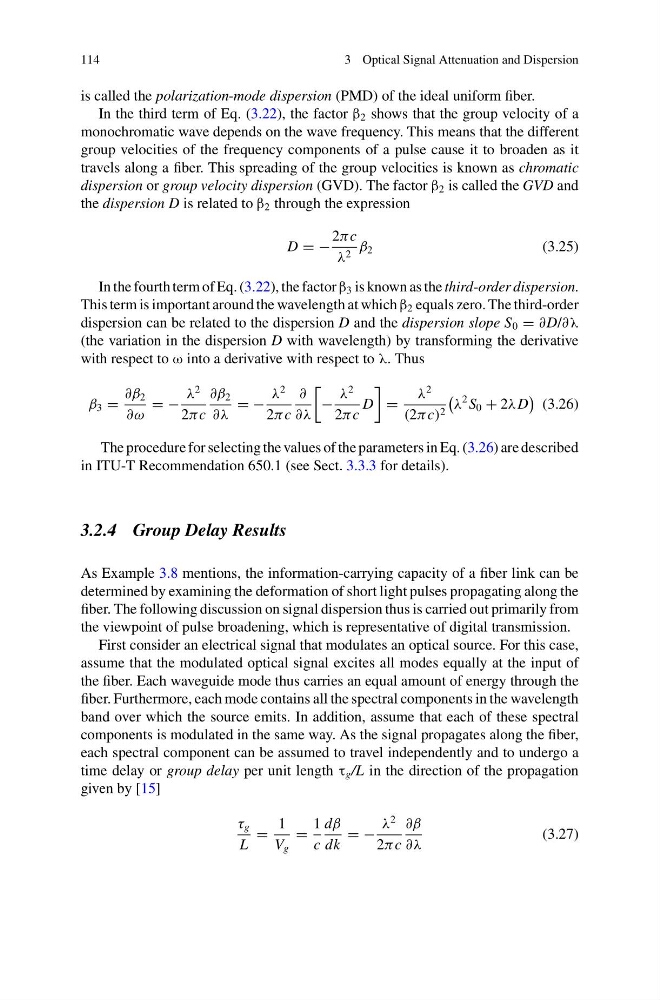
In the third term of Eq. (3.22), the factor β 2 shows that the group velocity of a
monochromatic wave depends on the wave frequency. This means that the different
group velocities of the frequency components of a pulse cause it to broaden as it
travels along a fiber. This spreading of the group velocities is known as chromatic
dispersion or group velocity dispersion (GVD). The factor β 2 is called the GVD and
the dispersion D is related to β 2 through the expression
D = −
2π c
λ 2 β 2
(3.25)
In the fourth term of Eq. (3.22), the factor β 3 is known as the third-order dispersion.
This term is important around the wavelength at which β 2 equals zero. The third-order
dispersion can be related to the dispersion D and the dispersion slope S 0 = ∂D/∂λ
(the variation in the dispersion D with wavelength) by transforming the derivative
with respect to ω into a derivative with respect to λ. Thus
β 3 =
∂β 2
∂ω
= −
λ
2
2π c
∂β 2
∂λ
= −
λ
2
2π c
∂
∂λ
−
λ
2
2π c
D
=
λ
2
(2π c) 2
λ
2 S 0 + 2λD
(3.26)
The procedure for selecting the values of the parameters in Eq. (3.26) are described
in ITU-T Recommendation 650.1 (see Sect. 3.3.3 for details).
3.2.4 Group Delay Results
As Example 3.8 mentions, the information-carrying capacity of a fiber link can be
determined by examining the deformation of short light pulses propagating along the
fiber. The following discussion on signal dispersion thus is carried out primarily from
the viewpoint of pulse broadening, which is representative of digital transmission.
First consider an electrical signal that modulates an optical source. For this case,
assume that the modulated optical signal excites all modes equally at the input of
the fiber. Each waveguide mode thus carries an equal amount of energy through the
fiber. Furthermore, each mode contains all the spectral components in the wavelength
band over which the source emits. In addition, assume that each of these spectral
components is modulated in the same way. As the signal propagates along the fiber,
each spectral component can be assumed to travel independently and to undergo a
time delay or group delay per unit length τ g /L in the direction of the propagation
given by [15]
τ g
L
=
1
V g
=
1
c
dβ
dk
= −
λ
2
2π c
∂β
∂λ
(3.27)
3 Optical Signal Attenuation and Dispersion
is called the polarization-mode dispersion (PMD) of the ideal uniform fiber.
In the third term of Eq. (3.22), the factor β 2 shows that the group velocity of a
monochromatic wave depends on the wave frequency. This means that the different
group velocities of the frequency components of a pulse cause it to broaden as it
travels along a fiber. This spreading of the group velocities is known as chromatic
dispersion or group velocity dispersion (GVD). The factor β 2 is called the GVD and
the dispersion D is related to β 2 through the expression
D = −
2π c
λ 2 β 2
(3.25)
In the fourth term of Eq. (3.22), the factor β 3 is known as the third-order dispersion.
This term is important around the wavelength at which β 2 equals zero. The third-order
dispersion can be related to the dispersion D and the dispersion slope S 0 = ∂D/∂λ
(the variation in the dispersion D with wavelength) by transforming the derivative
with respect to ω into a derivative with respect to λ. Thus
β 3 =
∂β 2
∂ω
= −
λ
2
2π c
∂β 2
∂λ
= −
λ
2
2π c
∂
∂λ
−
λ
2
2π c
D
=
λ
2
(2π c) 2
λ
2 S 0 + 2λD
(3.26)
The procedure for selecting the values of the parameters in Eq. (3.26) are described
in ITU-T Recommendation 650.1 (see Sect. 3.3.3 for details).
3.2.4 Group Delay Results
As Example 3.8 mentions, the information-carrying capacity of a fiber link can be
determined by examining the deformation of short light pulses propagating along the
fiber. The following discussion on signal dispersion thus is carried out primarily from
the viewpoint of pulse broadening, which is representative of digital transmission.
First consider an electrical signal that modulates an optical source. For this case,
assume that the modulated optical signal excites all modes equally at the input of
the fiber. Each waveguide mode thus carries an equal amount of energy through the
fiber. Furthermore, each mode contains all the spectral components in the wavelength
band over which the source emits. In addition, assume that each of these spectral
components is modulated in the same way. As the signal propagates along the fiber,
each spectral component can be assumed to travel independently and to undergo a
time delay or group delay per unit length τ g /L in the direction of the propagation
given by [15]
τ g
L
=
1
V g
=
1
c
dβ
dk
= −
λ
2
2π c
∂β
∂λ
(3.27)