

74
J. Zhou and S. Chang
fourth largest natural gas consumer in China, after Jiangsu, Sichuan and Guangdong
provinces.
Third, oil consumption has seen continuous growth, rising from 14.55 million
tons in 2010 to 16.56 million tons in 2017. But the growth is not primarily attributed
to the use of gasoline and diesel, which are mainly used for road transportation, and
dropped from 3.72 million tons and 2.37 million tons respectively in 2010 to 1.9
million tons and 1.75 million tons in 2017. The city has seen some modest increase
in the consumption of kerosene, which is mainly used for air transport and climbed
from 3.93 million tons in 2010 to 6.44 million tons in 2017. Beijing’s kerosene
consumption in 2017 matched that of Shanghai, with the two cities accounting for
about 36% of China’s total kerosene consumption.
Fourth, local renewable energy is not adequately utilized. In 2015, the development and utilization of new and renewable energy in Beijing was about 4.5 million
tce, which only made up 6.6% of the total energy consumption (Beijing Municipal
Government 2017), much lower than the national level in the same period.
Fifth, the net import of electricity represents a relatively high proportion. In 2017,
it comprised more than 25% of the total energy use, and accounted for over 60% of
electricity demand of the entire city.
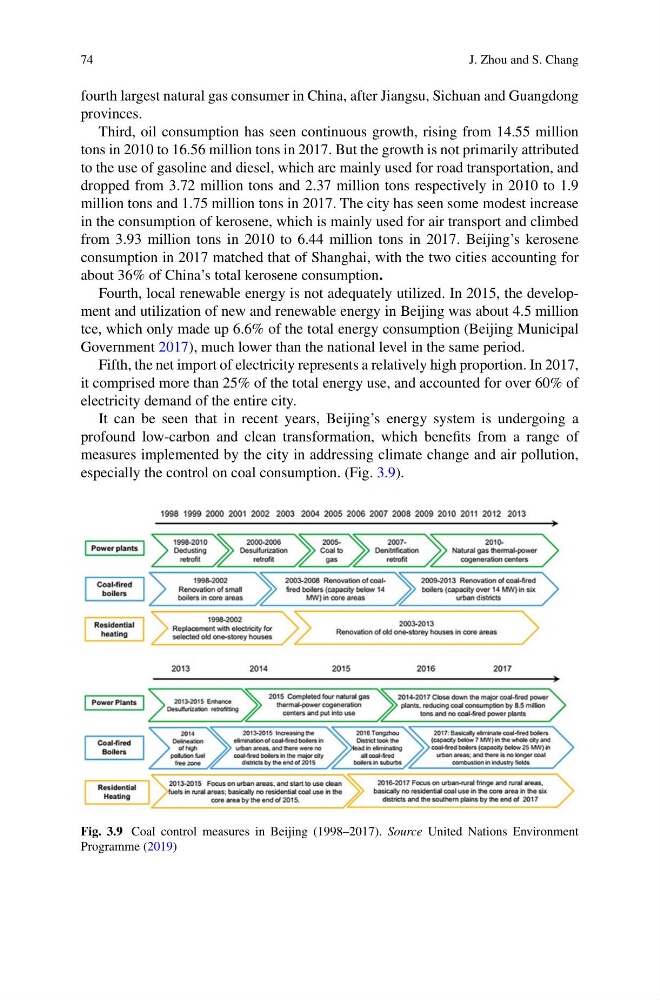
It can be seen that in recent years, Beijing’s energy system is undergoing a
profound low-carbon and clean transformation, which benefits from a range of
measures implemented by the city in addressing climate change and air pollution,
especially the control on coal consumption. (Fig. 3.9).
Fig. 3.9 Coal control measures in Beijing (1998–2017). Source United Nations Environment
Programme (2019)
J. Zhou and S. Chang
fourth largest natural gas consumer in China, after Jiangsu, Sichuan and Guangdong
provinces.
Third, oil consumption has seen continuous growth, rising from 14.55 million
tons in 2010 to 16.56 million tons in 2017. But the growth is not primarily attributed
to the use of gasoline and diesel, which are mainly used for road transportation, and
dropped from 3.72 million tons and 2.37 million tons respectively in 2010 to 1.9
million tons and 1.75 million tons in 2017. The city has seen some modest increase
in the consumption of kerosene, which is mainly used for air transport and climbed
from 3.93 million tons in 2010 to 6.44 million tons in 2017. Beijing’s kerosene
consumption in 2017 matched that of Shanghai, with the two cities accounting for
about 36% of China’s total kerosene consumption.
Fourth, local renewable energy is not adequately utilized. In 2015, the development and utilization of new and renewable energy in Beijing was about 4.5 million
tce, which only made up 6.6% of the total energy consumption (Beijing Municipal
Government 2017), much lower than the national level in the same period.
Fifth, the net import of electricity represents a relatively high proportion. In 2017,
it comprised more than 25% of the total energy use, and accounted for over 60% of
electricity demand of the entire city.
It can be seen that in recent years, Beijing’s energy system is undergoing a
profound low-carbon and clean transformation, which benefits from a range of
measures implemented by the city in addressing climate change and air pollution,
especially the control on coal consumption. (Fig. 3.9).
Fig. 3.9 Coal control measures in Beijing (1998–2017). Source United Nations Environment
Programme (2019)