

3 Low-Carbon Transition (Peaking) of Chinese Cities: The Case …
75
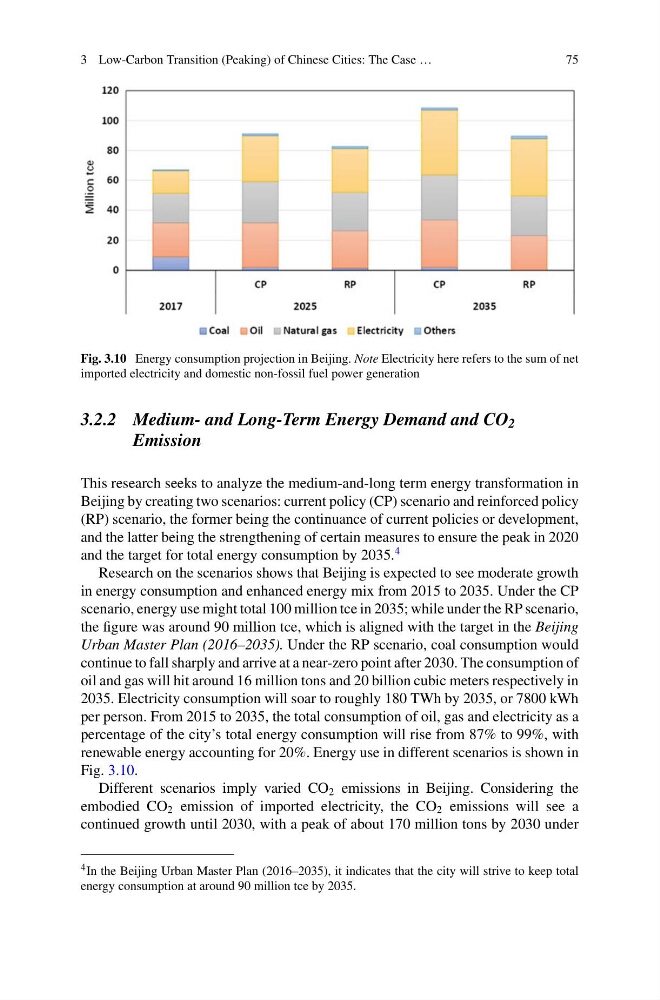
Fig. 3.10 Energy consumption projection in Beijing. Note Electricity here refers to the sum of net
imported electricity and domestic non-fossil fuel power generation
3.2.2 Medium- and Long-Term Energy Demand and CO 2
Emission
This research seeks to analyze the medium-and-long term energy transformation in
Beijing by creating two scenarios: current policy (CP) scenario and reinforced policy
(RP) scenario, the former being the continuance of current policies or development,
and the latter being the strengthening of certain measures to ensure the peak in 2020
and the target for total energy consumption by 2035.
4
Research on the scenarios shows that Beijing is expected to see moderate growth
in energy consumption and enhanced energy mix from 2015 to 2035. Under the CP
scenario, energy use might total 100 million tce in 2035; while under the RP scenario,
the figure was around 90 million tce, which is aligned with the target in the Beijing
Urban Master Plan (2016–2035). Under the RP scenario, coal consumption would
continue to fall sharply and arrive at a near-zero point after 2030. The consumption of
oil and gas will hit around 16 million tons and 20 billion cubic meters respectively in
2035. Electricity consumption will soar to roughly 180 TWh by 2035, or 7800 kWh
per person. From 2015 to 2035, the total consumption of oil, gas and electricity as a
percentage of the city’s total energy consumption will rise from 87% to 99%, with
renewable energy accounting for 20%. Energy use in different scenarios is shown in
Fig. 3.10.
Different scenarios imply varied CO 2 emissions in Beijing. Considering the
embodied CO 2 emission of imported electricity, the CO 2 emissions will see a
continued growth until 2030, with a peak of about 170 million tons by 2030 under
4 In the Beijing Urban Master Plan (2016–2035), it indicates that the city will strive to keep total
energy consumption at around 90 million tce by 2035.
75
Fig. 3.10 Energy consumption projection in Beijing. Note Electricity here refers to the sum of net
imported electricity and domestic non-fossil fuel power generation
3.2.2 Medium- and Long-Term Energy Demand and CO 2
Emission
This research seeks to analyze the medium-and-long term energy transformation in
Beijing by creating two scenarios: current policy (CP) scenario and reinforced policy
(RP) scenario, the former being the continuance of current policies or development,
and the latter being the strengthening of certain measures to ensure the peak in 2020
and the target for total energy consumption by 2035.
4
Research on the scenarios shows that Beijing is expected to see moderate growth
in energy consumption and enhanced energy mix from 2015 to 2035. Under the CP
scenario, energy use might total 100 million tce in 2035; while under the RP scenario,
the figure was around 90 million tce, which is aligned with the target in the Beijing
Urban Master Plan (2016–2035). Under the RP scenario, coal consumption would
continue to fall sharply and arrive at a near-zero point after 2030. The consumption of
oil and gas will hit around 16 million tons and 20 billion cubic meters respectively in
2035. Electricity consumption will soar to roughly 180 TWh by 2035, or 7800 kWh
per person. From 2015 to 2035, the total consumption of oil, gas and electricity as a
percentage of the city’s total energy consumption will rise from 87% to 99%, with
renewable energy accounting for 20%. Energy use in different scenarios is shown in
Fig. 3.10.
Different scenarios imply varied CO 2 emissions in Beijing. Considering the
embodied CO 2 emission of imported electricity, the CO 2 emissions will see a
continued growth until 2030, with a peak of about 170 million tons by 2030 under
4 In the Beijing Urban Master Plan (2016–2035), it indicates that the city will strive to keep total
energy consumption at around 90 million tce by 2035.