

2 Research on Urbanization and Low-Carbon Development in China
53
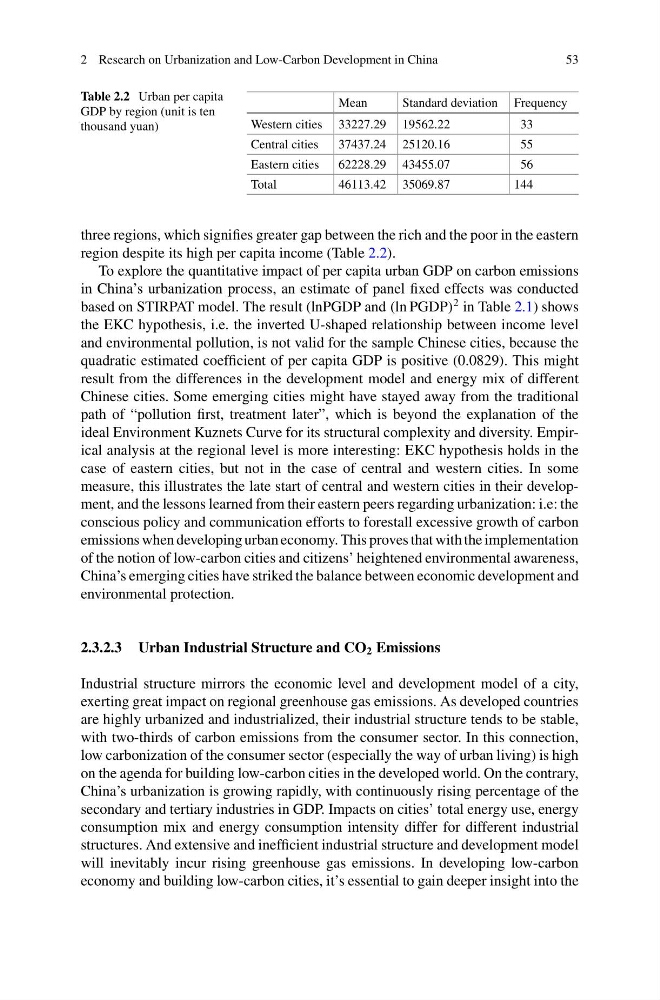
Table 2.2 Urban per capita
GDP by region (unit is ten
thousand yuan)
Mean
Standard deviation Frequency
Western cities 33227.29 19562.22
33
Central cities
37437.24 25120.16
55
Eastern cities
62228.29 43455.07
56
Total
46113.42 35069.87
144
three regions, which signifies greater gap between the rich and the poor in the eastern
region despite its high per capita income (Table 2.2).
To explore the quantitative impact of per capita urban GDP on carbon emissions
in China’s urbanization process, an estimate of panel fixed effects was conducted
based on STIRPAT model. The result (lnPGDP and (ln PGDP)
2 in Table 2.1) shows
the EKC hypothesis, i.e. the inverted U-shaped relationship between income level
and environmental pollution, is not valid for the sample Chinese cities, because the
quadratic estimated coefficient of per capita GDP is positive (0.0829). This might
result from the differences in the development model and energy mix of different
Chinese cities. Some emerging cities might have stayed away from the traditional
path of “pollution first, treatment later”, which is beyond the explanation of the
ideal Environment Kuznets Curve for its structural complexity and diversity. Empirical analysis at the regional level is more interesting: EKC hypothesis holds in the
case of eastern cities, but not in the case of central and western cities. In some
measure, this illustrates the late start of central and western cities in their development, and the lessons learned from their eastern peers regarding urbanization: i.e: the
conscious policy and communication efforts to forestall excessive growth of carbon
emissions when developing urban economy. This proves that with the implementation
of the notion of low-carbon cities and citizens’ heightened environmental awareness,
China’s emerging cities have striked the balance between economic development and
environmental protection.
2.3.2.3 Urban Industrial Structure and CO 2 Emissions
Industrial structure mirrors the economic level and development model of a city,
exerting great impact on regional greenhouse gas emissions. As developed countries
are highly urbanized and industrialized, their industrial structure tends to be stable,
with two-thirds of carbon emissions from the consumer sector. In this connection,
low carbonization of the consumer sector (especially the way of urban living) is high
on the agenda for building low-carbon cities in the developed world. On the contrary,
China’s urbanization is growing rapidly, with continuously rising percentage of the
secondary and tertiary industries in GDP. Impacts on cities’ total energy use, energy
consumption mix and energy consumption intensity differ for different industrial
structures. And extensive and inefficient industrial structure and development model
will inevitably incur rising greenhouse gas emissions. In developing low-carbon
economy and building low-carbon cities, it’s essential to gain deeper insight into the
53
Table 2.2 Urban per capita
GDP by region (unit is ten
thousand yuan)
Mean
Standard deviation Frequency
Western cities 33227.29 19562.22
33
Central cities
37437.24 25120.16
55
Eastern cities
62228.29 43455.07
56
Total
46113.42 35069.87
144
three regions, which signifies greater gap between the rich and the poor in the eastern
region despite its high per capita income (Table 2.2).
To explore the quantitative impact of per capita urban GDP on carbon emissions
in China’s urbanization process, an estimate of panel fixed effects was conducted
based on STIRPAT model. The result (lnPGDP and (ln PGDP)
2 in Table 2.1) shows
the EKC hypothesis, i.e. the inverted U-shaped relationship between income level
and environmental pollution, is not valid for the sample Chinese cities, because the
quadratic estimated coefficient of per capita GDP is positive (0.0829). This might
result from the differences in the development model and energy mix of different
Chinese cities. Some emerging cities might have stayed away from the traditional
path of “pollution first, treatment later”, which is beyond the explanation of the
ideal Environment Kuznets Curve for its structural complexity and diversity. Empirical analysis at the regional level is more interesting: EKC hypothesis holds in the
case of eastern cities, but not in the case of central and western cities. In some
measure, this illustrates the late start of central and western cities in their development, and the lessons learned from their eastern peers regarding urbanization: i.e: the
conscious policy and communication efforts to forestall excessive growth of carbon
emissions when developing urban economy. This proves that with the implementation
of the notion of low-carbon cities and citizens’ heightened environmental awareness,
China’s emerging cities have striked the balance between economic development and
environmental protection.
2.3.2.3 Urban Industrial Structure and CO 2 Emissions
Industrial structure mirrors the economic level and development model of a city,
exerting great impact on regional greenhouse gas emissions. As developed countries
are highly urbanized and industrialized, their industrial structure tends to be stable,
with two-thirds of carbon emissions from the consumer sector. In this connection,
low carbonization of the consumer sector (especially the way of urban living) is high
on the agenda for building low-carbon cities in the developed world. On the contrary,
China’s urbanization is growing rapidly, with continuously rising percentage of the
secondary and tertiary industries in GDP. Impacts on cities’ total energy use, energy
consumption mix and energy consumption intensity differ for different industrial
structures. And extensive and inefficient industrial structure and development model
will inevitably incur rising greenhouse gas emissions. In developing low-carbon
economy and building low-carbon cities, it’s essential to gain deeper insight into the