

38
J. Wu and H. Zhao
millon tons oil equivalent
US
France
Germany
United Kingdom
China
Japan
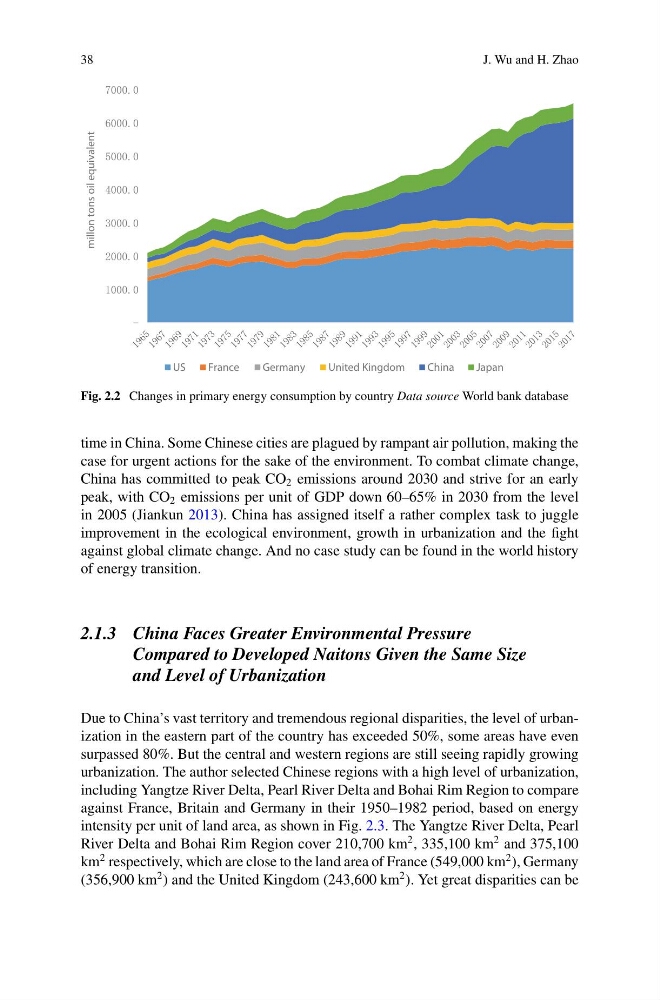
Fig. 2.2 Changes in primary energy consumption by country Data source World bank database
time in China. Some Chinese cities are plagued by rampant air pollution, making the
case for urgent actions for the sake of the environment. To combat climate change,
China has committed to peak CO 2 emissions around 2030 and strive for an early
peak, with CO 2 emissions per unit of GDP down 60–65% in 2030 from the level
in 2005 (Jiankun 2013). China has assigned itself a rather complex task to juggle
improvement in the ecological environment, growth in urbanization and the fight
against global climate change. And no case study can be found in the world history
of energy transition.
2.1.3 China Faces Greater Environmental Pressure
Compared to Developed Naitons Given the Same Size
and Level of Urbanization
Due to China’s vast territory and tremendous regional disparities, the level of urbanization in the eastern part of the country has exceeded 50%, some areas have even
surpassed 80%. But the central and western regions are still seeing rapidly growing
urbanization. The author selected Chinese regions with a high level of urbanization,
including Yangtze River Delta, Pearl River Delta and Bohai Rim Region to compare
against France, Britain and Germany in their 1950–1982 period, based on energy
intensity per unit of land area, as shown in Fig. 2.3. The Yangtze River Delta, Pearl
River Delta and Bohai Rim Region cover 210,700 km
2 , 335,100 km
2 and 375,100
km
2 respectively, which are close to the land area of France (549,000 km
2 ), Germany
(356,900 km
2 ) and the United Kingdom (243,600 km
2 ). Yet great disparities can be
J. Wu and H. Zhao
millon tons oil equivalent
US
France
Germany
United Kingdom
China
Japan
Fig. 2.2 Changes in primary energy consumption by country Data source World bank database
time in China. Some Chinese cities are plagued by rampant air pollution, making the
case for urgent actions for the sake of the environment. To combat climate change,
China has committed to peak CO 2 emissions around 2030 and strive for an early
peak, with CO 2 emissions per unit of GDP down 60–65% in 2030 from the level
in 2005 (Jiankun 2013). China has assigned itself a rather complex task to juggle
improvement in the ecological environment, growth in urbanization and the fight
against global climate change. And no case study can be found in the world history
of energy transition.
2.1.3 China Faces Greater Environmental Pressure
Compared to Developed Naitons Given the Same Size
and Level of Urbanization
Due to China’s vast territory and tremendous regional disparities, the level of urbanization in the eastern part of the country has exceeded 50%, some areas have even
surpassed 80%. But the central and western regions are still seeing rapidly growing
urbanization. The author selected Chinese regions with a high level of urbanization,
including Yangtze River Delta, Pearl River Delta and Bohai Rim Region to compare
against France, Britain and Germany in their 1950–1982 period, based on energy
intensity per unit of land area, as shown in Fig. 2.3. The Yangtze River Delta, Pearl
River Delta and Bohai Rim Region cover 210,700 km
2 , 335,100 km
2 and 375,100
km
2 respectively, which are close to the land area of France (549,000 km
2 ), Germany
(356,900 km
2 ) and the United Kingdom (243,600 km
2 ). Yet great disparities can be