

256
L. Ren et al.
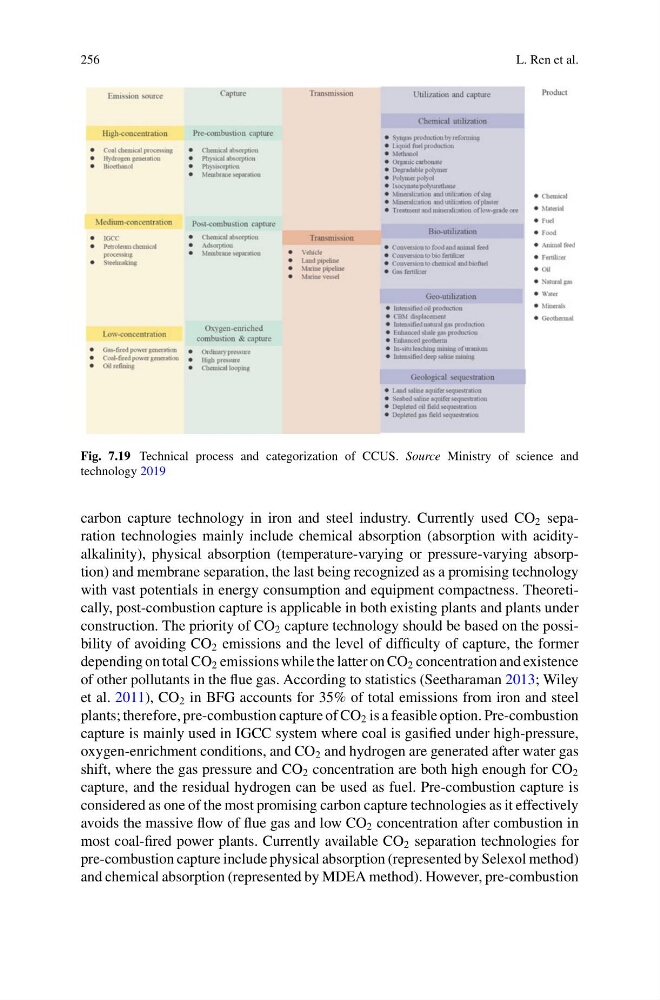
Fig. 7.19 Technical process and categorization of CCUS. Source Ministry of science and
technology 2019
carbon capture technology in iron and steel industry. Currently used CO 2 separation technologies mainly include chemical absorption (absorption with acidityalkalinity), physical absorption (temperature-varying or pressure-varying absorption) and membrane separation, the last being recognized as a promising technology
with vast potentials in energy consumption and equipment compactness. Theoretically, post-combustion capture is applicable in both existing plants and plants under
construction. The priority of CO 2 capture technology should be based on the possibility of avoiding CO 2 emissions and the level of difficulty of capture, the former
depending on total CO 2 emissions while the latter on CO 2 concentration and existence
of other pollutants in the flue gas. According to statistics (Seetharaman 2013; Wiley
et al. 2011), CO 2 in BFG accounts for 35% of total emissions from iron and steel
plants; therefore, pre-combustion capture of CO 2 is a feasible option. Pre-combustion
capture is mainly used in IGCC system where coal is gasified under high-pressure,
oxygen-enrichment conditions, and CO 2 and hydrogen are generated after water gas
shift, where the gas pressure and CO 2 concentration are both high enough for CO 2
capture, and the residual hydrogen can be used as fuel. Pre-combustion capture is
considered as one of the most promising carbon capture technologies as it effectively
avoids the massive flow of flue gas and low CO 2 concentration after combustion in
most coal-fired power plants. Currently available CO 2 separation technologies for
pre-combustion capture include physical absorption (represented by Selexol method)
and chemical absorption (represented by MDEA method). However, pre-combustion
L. Ren et al.
Fig. 7.19 Technical process and categorization of CCUS. Source Ministry of science and
technology 2019
carbon capture technology in iron and steel industry. Currently used CO 2 separation technologies mainly include chemical absorption (absorption with acidityalkalinity), physical absorption (temperature-varying or pressure-varying absorption) and membrane separation, the last being recognized as a promising technology
with vast potentials in energy consumption and equipment compactness. Theoretically, post-combustion capture is applicable in both existing plants and plants under
construction. The priority of CO 2 capture technology should be based on the possibility of avoiding CO 2 emissions and the level of difficulty of capture, the former
depending on total CO 2 emissions while the latter on CO 2 concentration and existence
of other pollutants in the flue gas. According to statistics (Seetharaman 2013; Wiley
et al. 2011), CO 2 in BFG accounts for 35% of total emissions from iron and steel
plants; therefore, pre-combustion capture of CO 2 is a feasible option. Pre-combustion
capture is mainly used in IGCC system where coal is gasified under high-pressure,
oxygen-enrichment conditions, and CO 2 and hydrogen are generated after water gas
shift, where the gas pressure and CO 2 concentration are both high enough for CO 2
capture, and the residual hydrogen can be used as fuel. Pre-combustion capture is
considered as one of the most promising carbon capture technologies as it effectively
avoids the massive flow of flue gas and low CO 2 concentration after combustion in
most coal-fired power plants. Currently available CO 2 separation technologies for
pre-combustion capture include physical absorption (represented by Selexol method)
and chemical absorption (represented by MDEA method). However, pre-combustion