

7 Development of Low Carbon Technology in China’s Iron …
249
• Production techniques: development of new technologies required in actual
production, such as hydrogen injection, furnace chemical reaction optimization,
reduction of ores of low deductibility and low grade, design of coke/sinter/slag
quality, etc.
• Development of ultra-thermal-resistant/ultra-corrosion-resistant materials: ultracorrosion resistant materials used for high-temperature, high-pressure storage of
hydrogen at over 900 °C need to be developed;
• Direct reduction of iron (DRI): direct reduction of iron ore at its solid state with
hydrogen.
Apart from steelmaking technology itself, the source of hydrogen used in steelmaking also produces major impact on carbon reduction. Currently there are mainly
two hydrogen sources in the demo projects:
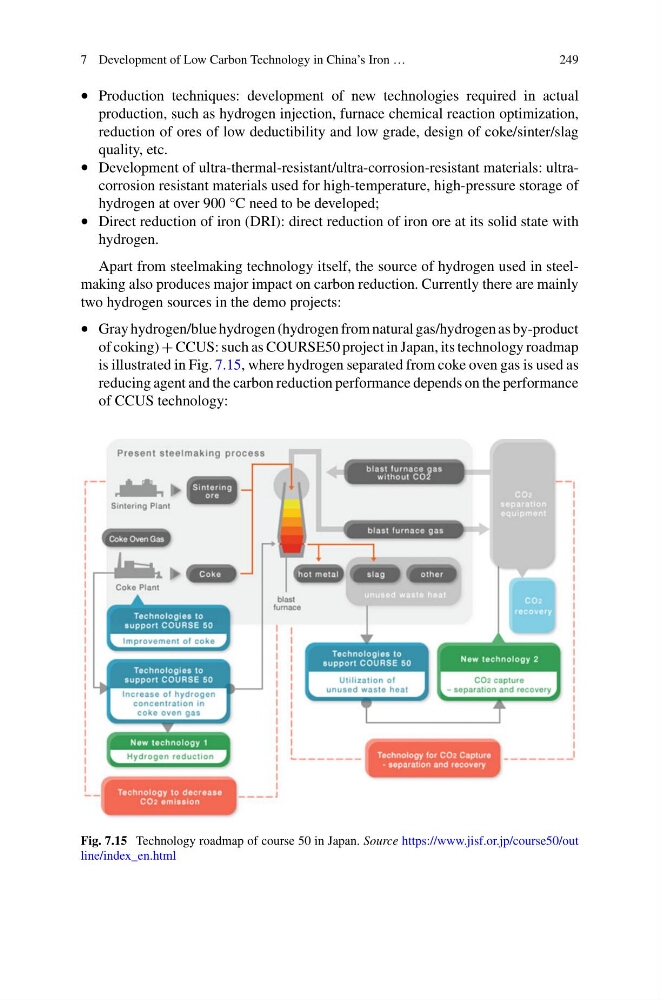
• Gray hydrogen/blue hydrogen (hydrogen from natural gas/hydrogen as by-product
of coking) + CCUS: such as COURSE50 project in Japan, its technology roadmap
is illustrated in Fig. 7.15, where hydrogen separated from coke oven gas is used as
reducing agent and the carbon reduction performance depends on the performance
of CCUS technology:
Fig. 7.15 Technology roadmap of course 50 in Japan. Source https://www.jisf.or.jp/course50/out
line/index_en.html
249
• Production techniques: development of new technologies required in actual
production, such as hydrogen injection, furnace chemical reaction optimization,
reduction of ores of low deductibility and low grade, design of coke/sinter/slag
quality, etc.
• Development of ultra-thermal-resistant/ultra-corrosion-resistant materials: ultracorrosion resistant materials used for high-temperature, high-pressure storage of
hydrogen at over 900 °C need to be developed;
• Direct reduction of iron (DRI): direct reduction of iron ore at its solid state with
hydrogen.
Apart from steelmaking technology itself, the source of hydrogen used in steelmaking also produces major impact on carbon reduction. Currently there are mainly
two hydrogen sources in the demo projects:
• Gray hydrogen/blue hydrogen (hydrogen from natural gas/hydrogen as by-product
of coking) + CCUS: such as COURSE50 project in Japan, its technology roadmap
is illustrated in Fig. 7.15, where hydrogen separated from coke oven gas is used as
reducing agent and the carbon reduction performance depends on the performance
of CCUS technology:
Fig. 7.15 Technology roadmap of course 50 in Japan. Source https://www.jisf.or.jp/course50/out
line/index_en.html