

248
L. Ren et al.
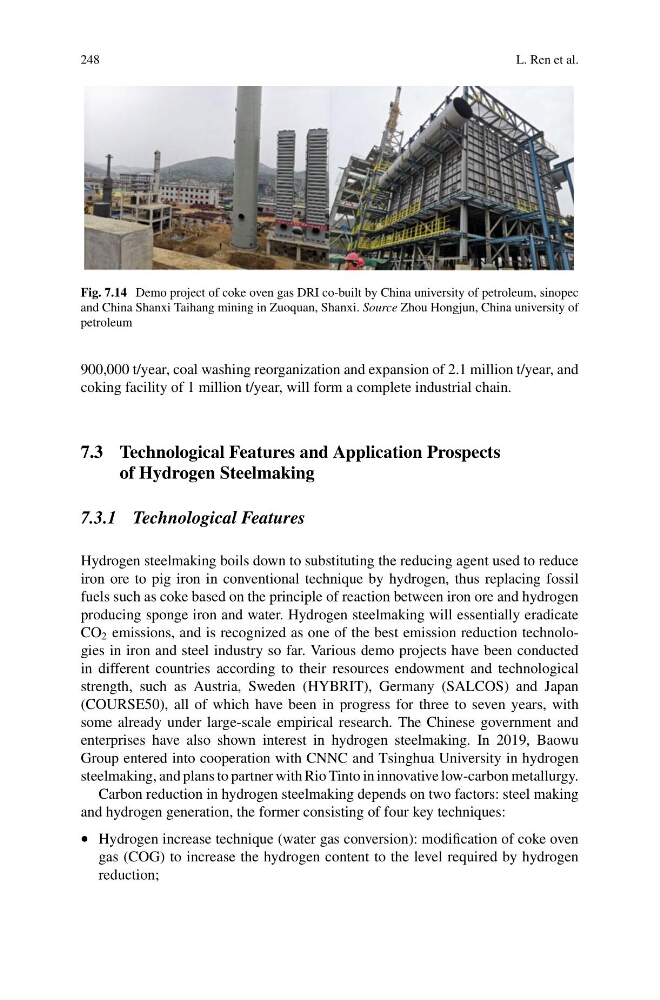
Fig. 7.14 Demo project of coke oven gas DRI co-built by China university of petroleum, sinopec
and China Shanxi Taihang mining in Zuoquan, Shanxi. Source Zhou Hongjun, China university of
petroleum
900,000 t/year, coal washing reorganization and expansion of 2.1 million t/year, and
coking facility of 1 million t/year, will form a complete industrial chain.
7.3 Technological Features and Application Prospects
of Hydrogen Steelmaking
7.3.1 Technological Features
Hydrogen steelmaking boils down to substituting the reducing agent used to reduce
iron ore to pig iron in conventional technique by hydrogen, thus replacing fossil
fuels such as coke based on the principle of reaction between iron ore and hydrogen
producing sponge iron and water. Hydrogen steelmaking will essentially eradicate
CO 2 emissions, and is recognized as one of the best emission reduction technologies in iron and steel industry so far. Various demo projects have been conducted
in different countries according to their resources endowment and technological
strength, such as Austria, Sweden (HYBRIT), Germany (SALCOS) and Japan
(COURSE50), all of which have been in progress for three to seven years, with
some already under large-scale empirical research. The Chinese government and
enterprises have also shown interest in hydrogen steelmaking. In 2019, Baowu
Group entered into cooperation with CNNC and Tsinghua University in hydrogen
steelmaking, and plans to partner with Rio Tinto in innovative low-carbon metallurgy.
Carbon reduction in hydrogen steelmaking depends on two factors: steel making
and hydrogen generation, the former consisting of four key techniques:
• Hydrogen increase technique (water gas conversion): modification of coke oven
gas (COG) to increase the hydrogen content to the level required by hydrogen
reduction;
L. Ren et al.
Fig. 7.14 Demo project of coke oven gas DRI co-built by China university of petroleum, sinopec
and China Shanxi Taihang mining in Zuoquan, Shanxi. Source Zhou Hongjun, China university of
petroleum
900,000 t/year, coal washing reorganization and expansion of 2.1 million t/year, and
coking facility of 1 million t/year, will form a complete industrial chain.
7.3 Technological Features and Application Prospects
of Hydrogen Steelmaking
7.3.1 Technological Features
Hydrogen steelmaking boils down to substituting the reducing agent used to reduce
iron ore to pig iron in conventional technique by hydrogen, thus replacing fossil
fuels such as coke based on the principle of reaction between iron ore and hydrogen
producing sponge iron and water. Hydrogen steelmaking will essentially eradicate
CO 2 emissions, and is recognized as one of the best emission reduction technologies in iron and steel industry so far. Various demo projects have been conducted
in different countries according to their resources endowment and technological
strength, such as Austria, Sweden (HYBRIT), Germany (SALCOS) and Japan
(COURSE50), all of which have been in progress for three to seven years, with
some already under large-scale empirical research. The Chinese government and
enterprises have also shown interest in hydrogen steelmaking. In 2019, Baowu
Group entered into cooperation with CNNC and Tsinghua University in hydrogen
steelmaking, and plans to partner with Rio Tinto in innovative low-carbon metallurgy.
Carbon reduction in hydrogen steelmaking depends on two factors: steel making
and hydrogen generation, the former consisting of four key techniques:
• Hydrogen increase technique (water gas conversion): modification of coke oven
gas (COG) to increase the hydrogen content to the level required by hydrogen
reduction;