

6 The Impacts of Electric Vehicles …
197
6.1.2 An Overview of Battery
Battery is at the core of EV components, and its installation has soared driven by
the flourishing EV market, jumping from 3.7 GWh in 2014 to 62.2 GWh (CABIIC,
China automotive battery statistics 2020) in 2019, implying a higher growth rate than
EV sales.
Currently, EV batteries are mainly based on Li-ion chemistry, which consists of
multiple chemical forms commonly differentiated by cathode materials of batteries,
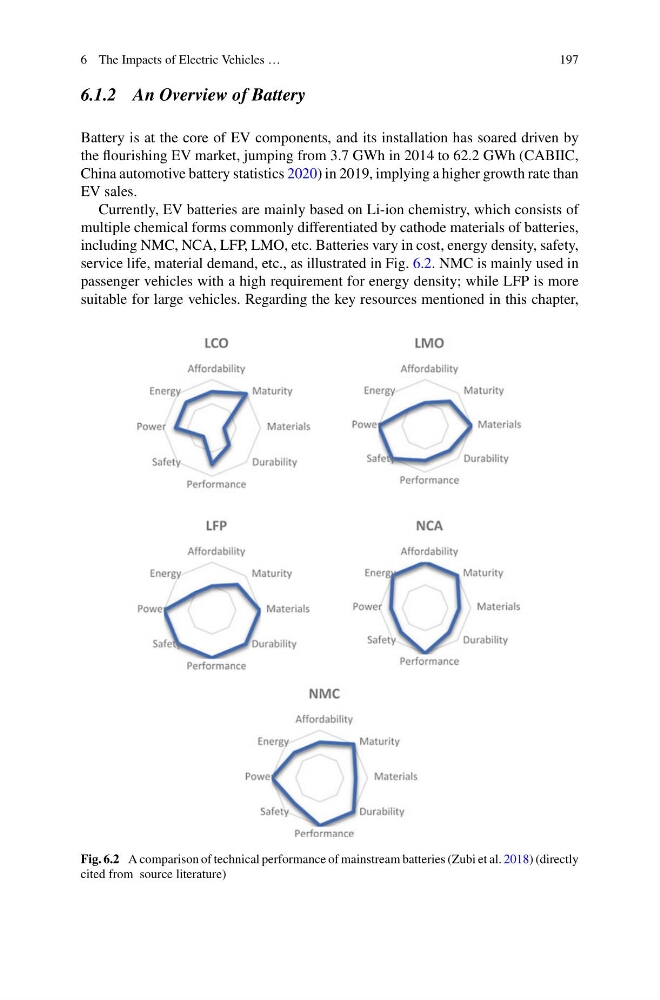
including NMC, NCA, LFP, LMO, etc. Batteries vary in cost, energy density, safety,
service life, material demand, etc., as illustrated in Fig. 6.2. NMC is mainly used in
passenger vehicles with a high requirement for energy density; while LFP is more
suitable for large vehicles. Regarding the key resources mentioned in this chapter,
Fig. 6.2 A comparison of technical performance of mainstream batteries (Zubi et al. 2018) (directly
cited from source literature)
197
6.1.2 An Overview of Battery
Battery is at the core of EV components, and its installation has soared driven by
the flourishing EV market, jumping from 3.7 GWh in 2014 to 62.2 GWh (CABIIC,
China automotive battery statistics 2020) in 2019, implying a higher growth rate than
EV sales.
Currently, EV batteries are mainly based on Li-ion chemistry, which consists of
multiple chemical forms commonly differentiated by cathode materials of batteries,
including NMC, NCA, LFP, LMO, etc. Batteries vary in cost, energy density, safety,
service life, material demand, etc., as illustrated in Fig. 6.2. NMC is mainly used in
passenger vehicles with a high requirement for energy density; while LFP is more
suitable for large vehicles. Regarding the key resources mentioned in this chapter,
Fig. 6.2 A comparison of technical performance of mainstream batteries (Zubi et al. 2018) (directly
cited from source literature)