

198
H. Hao and X. Sun
NMC requires lithium, nickel and cobalt; while LFP and LMO only rely on lithium
and demand less for critical resources.
Currently, rapid development of battery technologies has spawned tremendous
technological innovation of mainstream Li-ion batteries, such as the blade battery
of BYD, CTP (Cell-to-Pack) technology of CATL, etc. Swift improvement of key
indicators such as cost and energy density has made EVs a considerable rival of
conventional vehicles. Meanwhile, the steady development of next generation battery
technologies such as solid state, Li-S, and metal air promises great potential of
slashing the cost and improving energy density and other critical resources of battery.
However, it should be noted that these technologies are still under experiments with
much uncertainty in terms of their technical prospect, thus requiring enormous R&D
and industrial input for their sophistication and application.
6.1.3 Overview of Critical Resources
6.1.3.1 Resources Supply
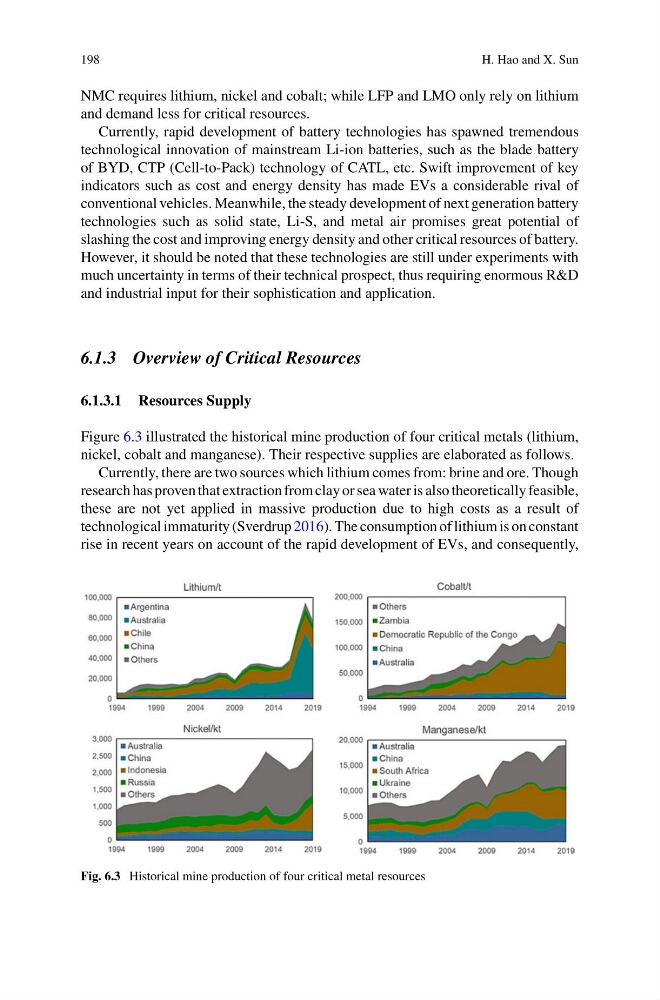
Figure 6.3 illustrated the historical mine production of four critical metals (lithium,
nickel, cobalt and manganese). Their respective supplies are elaborated as follows.
Currently, there are two sources which lithium comes from: brine and ore. Though
research has proven that extraction from clay or sea water is also theoretically feasible,
these are not yet applied in massive production due to high costs as a result of
technological immaturity (Sverdrup 2016). The consumption of lithium is on constant
rise in recent years on account of the rapid development of EVs, and consequently,
Fig. 6.3 Historical mine production of four critical metal resources
H. Hao and X. Sun
NMC requires lithium, nickel and cobalt; while LFP and LMO only rely on lithium
and demand less for critical resources.
Currently, rapid development of battery technologies has spawned tremendous
technological innovation of mainstream Li-ion batteries, such as the blade battery
of BYD, CTP (Cell-to-Pack) technology of CATL, etc. Swift improvement of key
indicators such as cost and energy density has made EVs a considerable rival of
conventional vehicles. Meanwhile, the steady development of next generation battery
technologies such as solid state, Li-S, and metal air promises great potential of
slashing the cost and improving energy density and other critical resources of battery.
However, it should be noted that these technologies are still under experiments with
much uncertainty in terms of their technical prospect, thus requiring enormous R&D
and industrial input for their sophistication and application.
6.1.3 Overview of Critical Resources
6.1.3.1 Resources Supply
Figure 6.3 illustrated the historical mine production of four critical metals (lithium,
nickel, cobalt and manganese). Their respective supplies are elaborated as follows.
Currently, there are two sources which lithium comes from: brine and ore. Though
research has proven that extraction from clay or sea water is also theoretically feasible,
these are not yet applied in massive production due to high costs as a result of
technological immaturity (Sverdrup 2016). The consumption of lithium is on constant
rise in recent years on account of the rapid development of EVs, and consequently,
Fig. 6.3 Historical mine production of four critical metal resources