

134
Z. Lu and G. Zhu
In 2005, 2014, and 2019, China’s hydropower installed capacity stood at
110 million kW, 300 million kW and 360 million kW, respectively. Given the target
of 480 million kW by 2035, it is predicted that hydropower installed capacity and the
amount of power generated will total 450 million kW and 1.71 trillion kWh respectively by 2030. By 2050, China will have mostly tapped its full hydropower potential,
with an installed capacity exceeding 90% of the technically exploitable hydropower
capacity. Total hydropower installed capacity will reach 500 million kW and annual
power generation will stand at 1.9 trillion kWh.
In 2019, the installed capacity of nuclear power in China was registered at
48.74 million kW, and the total capacity of reactors under construction topped
13 million kW. Assuming that 10 nuclear power units, each with a generation
capacity of 1 million kW, are approved for construction each year, and each requires
a construction time of 6 years, which has been the domestic average in recent years,
China’s nuclear installed capacity is expected to reach 100 million kW by 2030
and 300 million kW by 2050, producing some 700 billion and 2.1 trillion kWh of
electricity respectively.
In order to meet the target of peaking carbon emissions by around 2030, new installations of coal power should be reduced year by year, and total coal-fired installed
capacity should peak by 2030 at approximately 1.3 billion kW. Though natural gas
is a cleaner form of energy than coal, its burning still yields a significant amount of
carbon dioxide emissions. It is assumed that natural gas installed capacity will also
peak by 2030. China’s natural gas installed capacity stood at 76, 84 and 95 million
kW respectively in 2017, 2018 and 2019. New installations amounted to roughly
10 million kW of added capacity annually. According to the latest data from the
National Development and Reform Commission and the National Bureau of Statistics, natural gas output in China rose by 9.8% y-o-y to 173.62 billion cubic meters
(bcm) in 2019. Its consumption was up by 9.4% to 306.7 bcm, with 44% of the
country’s gas demand satisfied by imports. China’s natural resource profile dictates
that its natural gas installed capacity won’t be able to sustain continuous, high growth
in the future, which is projected to reach 200 million kW by 2030. It is estimated,
on the basis of coal and natural gas projections, that thermal installed capacity will
peak at 1.5 billion kW by 2030, generating some 6 trillion kWh of electricity.
Assuming that the ratios of wind and solar installed capacity are the same in
2030 and 2050, and the annual time of usage of renewable facilities, calculated by
averaging the hours of utilization of wind and solar facilities, is 1850 h, projections
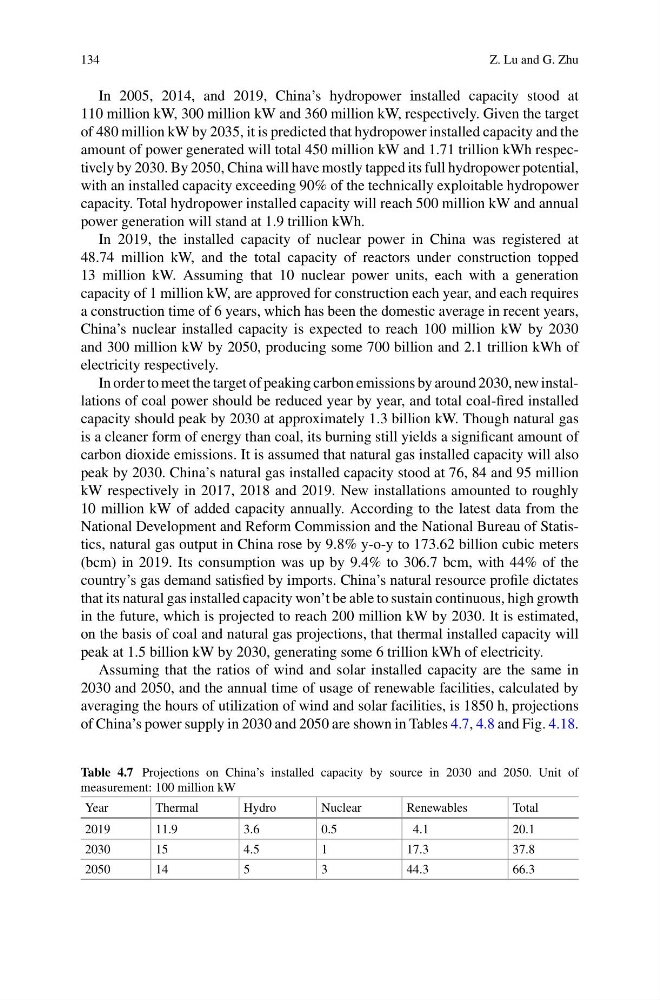
of China’s power supply in 2030 and 2050 are shown in Tables 4.7, 4.8 and Fig. 4.18.
Table 4.7 Projections on China’s installed capacity by source in 2030 and 2050. Unit of
measurement: 100 million kW
Year
Thermal
Hydro
Nuclear
Renewables
Total
2019
11.9
3.6
0.5
4.1
20.1
2030
15
4.5
1
17.3
37.8
2050
14
5
3
44.3
66.3
Z. Lu and G. Zhu
In 2005, 2014, and 2019, China’s hydropower installed capacity stood at
110 million kW, 300 million kW and 360 million kW, respectively. Given the target
of 480 million kW by 2035, it is predicted that hydropower installed capacity and the
amount of power generated will total 450 million kW and 1.71 trillion kWh respectively by 2030. By 2050, China will have mostly tapped its full hydropower potential,
with an installed capacity exceeding 90% of the technically exploitable hydropower
capacity. Total hydropower installed capacity will reach 500 million kW and annual
power generation will stand at 1.9 trillion kWh.
In 2019, the installed capacity of nuclear power in China was registered at
48.74 million kW, and the total capacity of reactors under construction topped
13 million kW. Assuming that 10 nuclear power units, each with a generation
capacity of 1 million kW, are approved for construction each year, and each requires
a construction time of 6 years, which has been the domestic average in recent years,
China’s nuclear installed capacity is expected to reach 100 million kW by 2030
and 300 million kW by 2050, producing some 700 billion and 2.1 trillion kWh of
electricity respectively.
In order to meet the target of peaking carbon emissions by around 2030, new installations of coal power should be reduced year by year, and total coal-fired installed
capacity should peak by 2030 at approximately 1.3 billion kW. Though natural gas
is a cleaner form of energy than coal, its burning still yields a significant amount of
carbon dioxide emissions. It is assumed that natural gas installed capacity will also
peak by 2030. China’s natural gas installed capacity stood at 76, 84 and 95 million
kW respectively in 2017, 2018 and 2019. New installations amounted to roughly
10 million kW of added capacity annually. According to the latest data from the
National Development and Reform Commission and the National Bureau of Statistics, natural gas output in China rose by 9.8% y-o-y to 173.62 billion cubic meters
(bcm) in 2019. Its consumption was up by 9.4% to 306.7 bcm, with 44% of the
country’s gas demand satisfied by imports. China’s natural resource profile dictates
that its natural gas installed capacity won’t be able to sustain continuous, high growth
in the future, which is projected to reach 200 million kW by 2030. It is estimated,
on the basis of coal and natural gas projections, that thermal installed capacity will
peak at 1.5 billion kW by 2030, generating some 6 trillion kWh of electricity.
Assuming that the ratios of wind and solar installed capacity are the same in
2030 and 2050, and the annual time of usage of renewable facilities, calculated by
averaging the hours of utilization of wind and solar facilities, is 1850 h, projections
of China’s power supply in 2030 and 2050 are shown in Tables 4.7, 4.8 and Fig. 4.18.
Table 4.7 Projections on China’s installed capacity by source in 2030 and 2050. Unit of
measurement: 100 million kW
Year
Thermal
Hydro
Nuclear
Renewables
Total
2019
11.9
3.6
0.5
4.1
20.1
2030
15
4.5
1
17.3
37.8
2050
14
5
3
44.3
66.3