

4 The Transition of China’s Power System
135
It is projected that total installed capacity will grow to 3.78 billion kW by 2030.
Thermal, hydro, nuclear and renewables including wind and solar will account for
40%, 12%, 2% and 46% respectively of the total. By 2050, total installed capacity is
expected to climb to 6.63 billion kW, of which thermal, hydro, nuclear and renewables
(incl. wind and solar) will represent 21%, 8%, 4% and 67% respectively.
4.3 Research on the Structural Transition of China’s Power
Grids
The development of China’s power grids can be roughly divided into three stages:
The first stage: the formation of local/provincial power grids, spanning from the
founding of the People’s Republic of China in 1949 to the late 1960s and early 1970s.
In this stage, distribution networks centering around large and medium-sized cities
were gradually connected through 220 kV transmission lines. And local power grids,
mainly covering provincial areas and with 220 kV lines as the backbone network,
were set up.
The second stage: inter-provincial connection, spanning from the early 1970s to
the 1980s, when the improvement of provincial power grids and the formation of
inter-provincial power grids went hand in hand. By the end of the 1970s, nearly 30
provincial power grids with 220 kV lines as the backbone gradually emerged in China,
Table 4.8 Projections on China’s power generation by source in 2030 and 2050. Unit of
measurement: trillion kWh
Year
Thermal
Hydro
Nuclear
Renewables
Total
2019
5.1
1.3
0.3
0.6
7.3
2030
6.0
1.71
0.7
3.19
11.6
2050
5.6
1.9
2.1
8.2
17.8
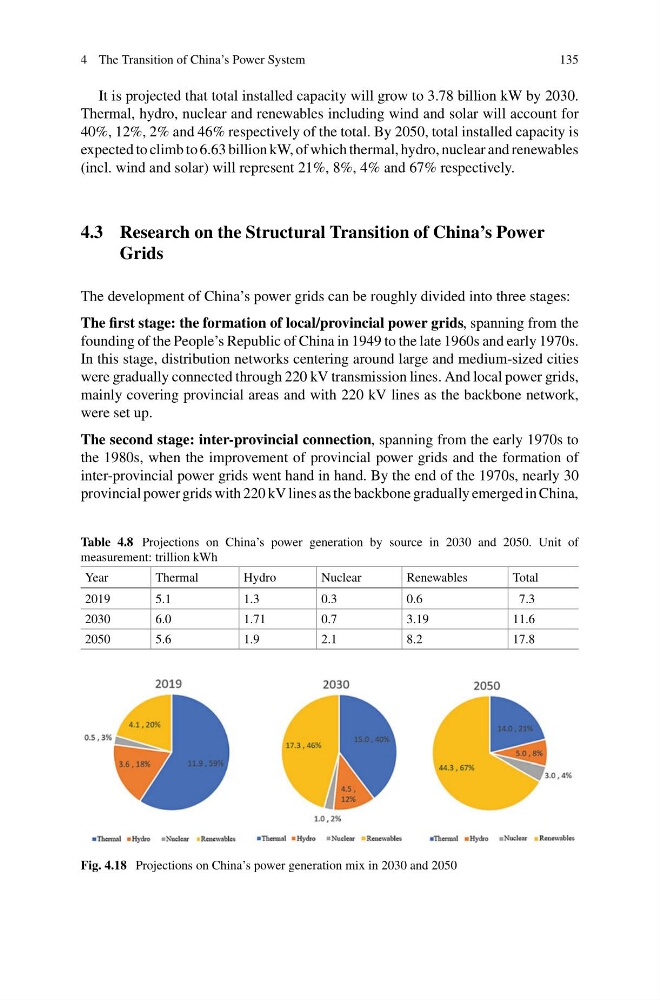
Fig. 4.18 Projections on China’s power generation mix in 2030 and 2050
135
It is projected that total installed capacity will grow to 3.78 billion kW by 2030.
Thermal, hydro, nuclear and renewables including wind and solar will account for
40%, 12%, 2% and 46% respectively of the total. By 2050, total installed capacity is
expected to climb to 6.63 billion kW, of which thermal, hydro, nuclear and renewables
(incl. wind and solar) will represent 21%, 8%, 4% and 67% respectively.
4.3 Research on the Structural Transition of China’s Power
Grids
The development of China’s power grids can be roughly divided into three stages:
The first stage: the formation of local/provincial power grids, spanning from the
founding of the People’s Republic of China in 1949 to the late 1960s and early 1970s.
In this stage, distribution networks centering around large and medium-sized cities
were gradually connected through 220 kV transmission lines. And local power grids,
mainly covering provincial areas and with 220 kV lines as the backbone network,
were set up.
The second stage: inter-provincial connection, spanning from the early 1970s to
the 1980s, when the improvement of provincial power grids and the formation of
inter-provincial power grids went hand in hand. By the end of the 1970s, nearly 30
provincial power grids with 220 kV lines as the backbone gradually emerged in China,
Table 4.8 Projections on China’s power generation by source in 2030 and 2050. Unit of
measurement: trillion kWh
Year
Thermal
Hydro
Nuclear
Renewables
Total
2019
5.1
1.3
0.3
0.6
7.3
2030
6.0
1.71
0.7
3.19
11.6
2050
5.6
1.9
2.1
8.2
17.8
Fig. 4.18 Projections on China’s power generation mix in 2030 and 2050