

4 Phthalocyanine and Related Analogues
89
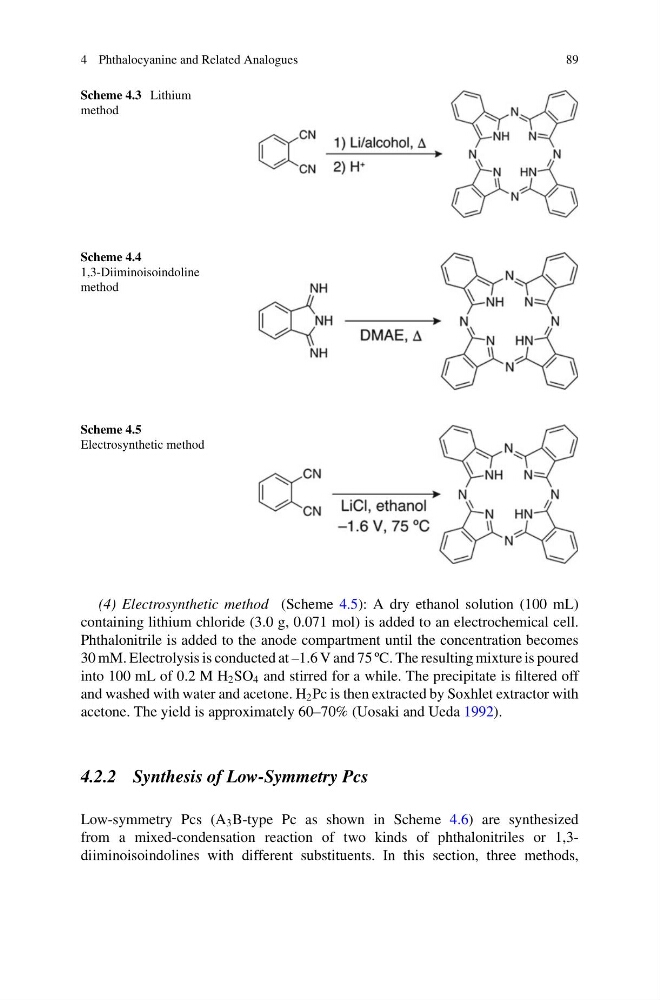
Scheme 4.3 Lithium
method
Scheme 4.4
1,3-Diiminoisoindoline
method
Scheme 4.5
Electrosynthetic method
(4) Electrosynthetic method (Scheme 4.5): A dry ethanol solution (100 mL)
containing lithium chloride (3.0 g, 0.071 mol) is added to an electrochemical cell.
Phthalonitrile is added to the anode compartment until the concentration becomes
30 mM. Electrolysis is conducted at –1.6 V and 75 ºC. The resulting mixture is poured
into 100 mL of 0.2 M H 2 SO 4 and stirred for a while. The precipitate is filtered off
and washed with water and acetone. H 2 Pc is then extracted by Soxhlet extractor with
acetone. The yield is approximately 60–70% (Uosaki and Ueda 1992).
4.2.2 Synthesis of Low-Symmetry Pcs
Low-symmetry Pcs (A 3 B-type Pc as shown in Scheme 4.6) are synthesized
from a mixed-condensation reaction of two kinds of phthalonitriles or 1,3diiminoisoindolines with different substituents. In this section, three methods,
89
Scheme 4.3 Lithium
method
Scheme 4.4
1,3-Diiminoisoindoline
method
Scheme 4.5
Electrosynthetic method
(4) Electrosynthetic method (Scheme 4.5): A dry ethanol solution (100 mL)
containing lithium chloride (3.0 g, 0.071 mol) is added to an electrochemical cell.
Phthalonitrile is added to the anode compartment until the concentration becomes
30 mM. Electrolysis is conducted at –1.6 V and 75 ºC. The resulting mixture is poured
into 100 mL of 0.2 M H 2 SO 4 and stirred for a while. The precipitate is filtered off
and washed with water and acetone. H 2 Pc is then extracted by Soxhlet extractor with
acetone. The yield is approximately 60–70% (Uosaki and Ueda 1992).
4.2.2 Synthesis of Low-Symmetry Pcs
Low-symmetry Pcs (A 3 B-type Pc as shown in Scheme 4.6) are synthesized
from a mixed-condensation reaction of two kinds of phthalonitriles or 1,3diiminoisoindolines with different substituents. In this section, three methods,