

88
S. Shimizu
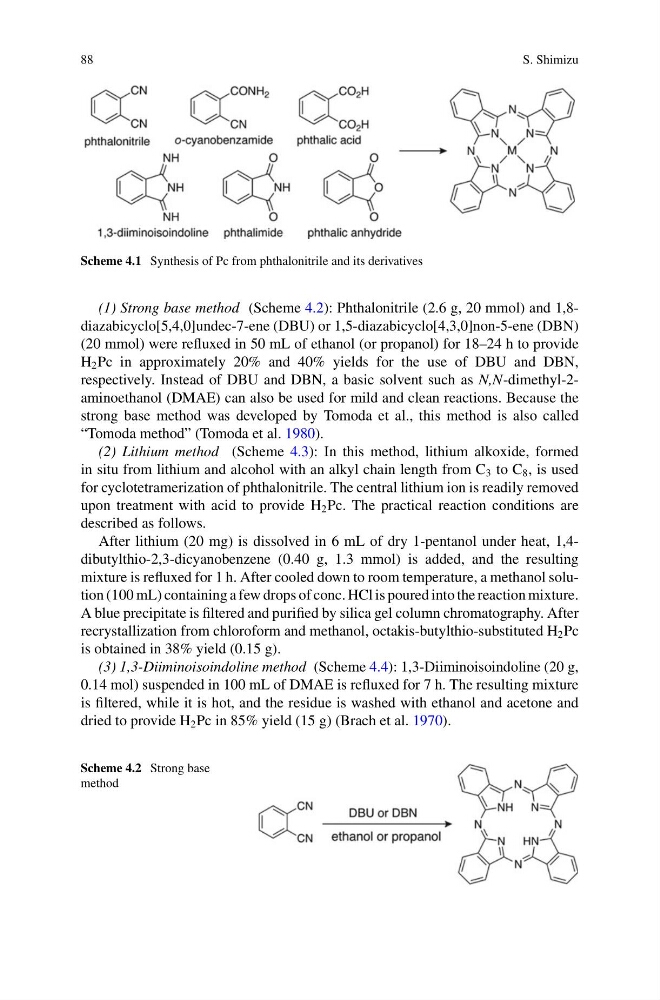
Scheme 4.1 Synthesis of Pc from phthalonitrile and its derivatives
(1) Strong base method (Scheme 4.2): Phthalonitrile (2.6 g, 20 mmol) and 1,8diazabicyclo[5,4,0]undec-7-ene (DBU) or 1,5-diazabicyclo[4,3,0]non-5-ene (DBN)
(20 mmol) were refluxed in 50 mL of ethanol (or propanol) for 18–24 h to provide
H 2 Pc in approximately 20% and 40% yields for the use of DBU and DBN,
respectively. Instead of DBU and DBN, a basic solvent such as N,N-dimethyl-2aminoethanol (DMAE) can also be used for mild and clean reactions. Because the
strong base method was developed by Tomoda et al., this method is also called
“Tomoda method” (Tomoda et al. 1980).
(2) Lithium method (Scheme 4.3): In this method, lithium alkoxide, formed
in situ from lithium and alcohol with an alkyl chain length from C 3 to C 8 , is used
for cyclotetramerization of phthalonitrile. The central lithium ion is readily removed
upon treatment with acid to provide H 2 Pc. The practical reaction conditions are
described as follows.
After lithium (20 mg) is dissolved in 6 mL of dry 1-pentanol under heat, 1,4dibutylthio-2,3-dicyanobenzene (0.40 g, 1.3 mmol) is added, and the resulting
mixture is refluxed for 1 h. After cooled down to room temperature, a methanol solution (100 mL) containing a few drops of conc. HCl is poured into the reaction mixture.
A blue precipitate is filtered and purified by silica gel column chromatography. After
recrystallization from chloroform and methanol, octakis-butylthio-substituted H 2 Pc
is obtained in 38% yield (0.15 g).
(3) 1,3-Diiminoisoindoline method (Scheme 4.4): 1,3-Diiminoisoindoline (20 g,
0.14 mol) suspended in 100 mL of DMAE is refluxed for 7 h. The resulting mixture
is filtered, while it is hot, and the residue is washed with ethanol and acetone and
dried to provide H 2 Pc in 85% yield (15 g) (Brach et al. 1970).
Scheme 4.2 Strong base
method
S. Shimizu
Scheme 4.1 Synthesis of Pc from phthalonitrile and its derivatives
(1) Strong base method (Scheme 4.2): Phthalonitrile (2.6 g, 20 mmol) and 1,8diazabicyclo[5,4,0]undec-7-ene (DBU) or 1,5-diazabicyclo[4,3,0]non-5-ene (DBN)
(20 mmol) were refluxed in 50 mL of ethanol (or propanol) for 18–24 h to provide
H 2 Pc in approximately 20% and 40% yields for the use of DBU and DBN,
respectively. Instead of DBU and DBN, a basic solvent such as N,N-dimethyl-2aminoethanol (DMAE) can also be used for mild and clean reactions. Because the
strong base method was developed by Tomoda et al., this method is also called
“Tomoda method” (Tomoda et al. 1980).
(2) Lithium method (Scheme 4.3): In this method, lithium alkoxide, formed
in situ from lithium and alcohol with an alkyl chain length from C 3 to C 8 , is used
for cyclotetramerization of phthalonitrile. The central lithium ion is readily removed
upon treatment with acid to provide H 2 Pc. The practical reaction conditions are
described as follows.
After lithium (20 mg) is dissolved in 6 mL of dry 1-pentanol under heat, 1,4dibutylthio-2,3-dicyanobenzene (0.40 g, 1.3 mmol) is added, and the resulting
mixture is refluxed for 1 h. After cooled down to room temperature, a methanol solution (100 mL) containing a few drops of conc. HCl is poured into the reaction mixture.
A blue precipitate is filtered and purified by silica gel column chromatography. After
recrystallization from chloroform and methanol, octakis-butylthio-substituted H 2 Pc
is obtained in 38% yield (0.15 g).
(3) 1,3-Diiminoisoindoline method (Scheme 4.4): 1,3-Diiminoisoindoline (20 g,
0.14 mol) suspended in 100 mL of DMAE is refluxed for 7 h. The resulting mixture
is filtered, while it is hot, and the residue is washed with ethanol and acetone and
dried to provide H 2 Pc in 85% yield (15 g) (Brach et al. 1970).
Scheme 4.2 Strong base
method