

4 Phthalocyanine and Related Analogues
87
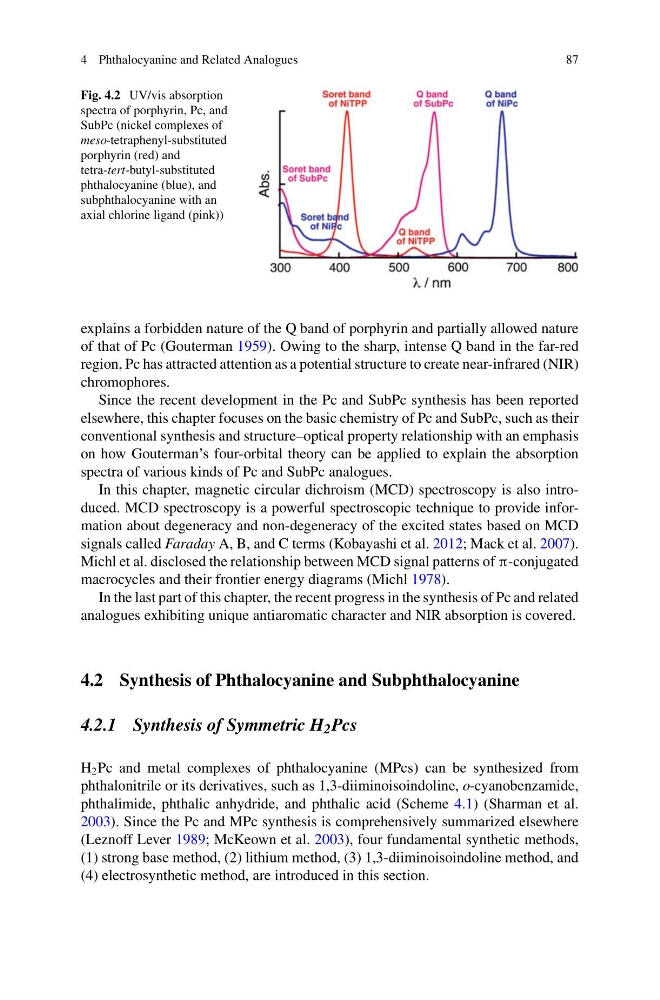
Fig. 4.2 UV/vis absorption
spectra of porphyrin, Pc, and
SubPc (nickel complexes of
meso-tetraphenyl-substituted
porphyrin (red) and
tetra-tert-butyl-substituted
phthalocyanine (blue), and
subphthalocyanine with an
axial chlorine ligand (pink))
explains a forbidden nature of the Q band of porphyrin and partially allowed nature
of that of Pc (Gouterman 1959). Owing to the sharp, intense Q band in the far-red
region, Pc has attracted attention as a potential structure to create near-infrared (NIR)
chromophores.
Since the recent development in the Pc and SubPc synthesis has been reported
elsewhere, this chapter focuses on the basic chemistry of Pc and SubPc, such as their
conventional synthesis and structure–optical property relationship with an emphasis
on how Gouterman’s four-orbital theory can be applied to explain the absorption
spectra of various kinds of Pc and SubPc analogues.
In this chapter, magnetic circular dichroism (MCD) spectroscopy is also introduced. MCD spectroscopy is a powerful spectroscopic technique to provide information about degeneracy and non-degeneracy of the excited states based on MCD
signals called Faraday A, B, and C terms (Kobayashi et al. 2012; Mack et al. 2007).
Michl et al. disclosed the relationship between MCD signal patterns of π-conjugated
macrocycles and their frontier energy diagrams (Michl 1978).
In the last part of this chapter, the recent progress in the synthesis of Pc and related
analogues exhibiting unique antiaromatic character and NIR absorption is covered.
4.2 Synthesis of Phthalocyanine and Subphthalocyanine
4.2.1 Synthesis of Symmetric H 2 Pcs
H 2 Pc and metal complexes of phthalocyanine (MPcs) can be synthesized from
phthalonitrile or its derivatives, such as 1,3-diiminoisoindoline, o-cyanobenzamide,
phthalimide, phthalic anhydride, and phthalic acid (Scheme 4.1) (Sharman et al.
2003). Since the Pc and MPc synthesis is comprehensively summarized elsewhere
(Leznoff Lever 1989; McKeown et al. 2003), four fundamental synthetic methods,
(1) strong base method, (2) lithium method, (3) 1,3-diiminoisoindoline method, and
(4) electrosynthetic method, are introduced in this section.
87
Fig. 4.2 UV/vis absorption
spectra of porphyrin, Pc, and
SubPc (nickel complexes of
meso-tetraphenyl-substituted
porphyrin (red) and
tetra-tert-butyl-substituted
phthalocyanine (blue), and
subphthalocyanine with an
axial chlorine ligand (pink))
explains a forbidden nature of the Q band of porphyrin and partially allowed nature
of that of Pc (Gouterman 1959). Owing to the sharp, intense Q band in the far-red
region, Pc has attracted attention as a potential structure to create near-infrared (NIR)
chromophores.
Since the recent development in the Pc and SubPc synthesis has been reported
elsewhere, this chapter focuses on the basic chemistry of Pc and SubPc, such as their
conventional synthesis and structure–optical property relationship with an emphasis
on how Gouterman’s four-orbital theory can be applied to explain the absorption
spectra of various kinds of Pc and SubPc analogues.
In this chapter, magnetic circular dichroism (MCD) spectroscopy is also introduced. MCD spectroscopy is a powerful spectroscopic technique to provide information about degeneracy and non-degeneracy of the excited states based on MCD
signals called Faraday A, B, and C terms (Kobayashi et al. 2012; Mack et al. 2007).
Michl et al. disclosed the relationship between MCD signal patterns of π-conjugated
macrocycles and their frontier energy diagrams (Michl 1978).
In the last part of this chapter, the recent progress in the synthesis of Pc and related
analogues exhibiting unique antiaromatic character and NIR absorption is covered.
4.2 Synthesis of Phthalocyanine and Subphthalocyanine
4.2.1 Synthesis of Symmetric H 2 Pcs
H 2 Pc and metal complexes of phthalocyanine (MPcs) can be synthesized from
phthalonitrile or its derivatives, such as 1,3-diiminoisoindoline, o-cyanobenzamide,
phthalimide, phthalic anhydride, and phthalic acid (Scheme 4.1) (Sharman et al.
2003). Since the Pc and MPc synthesis is comprehensively summarized elsewhere
(Leznoff Lever 1989; McKeown et al. 2003), four fundamental synthetic methods,
(1) strong base method, (2) lithium method, (3) 1,3-diiminoisoindoline method, and
(4) electrosynthetic method, are introduced in this section.