

86
S. Shimizu
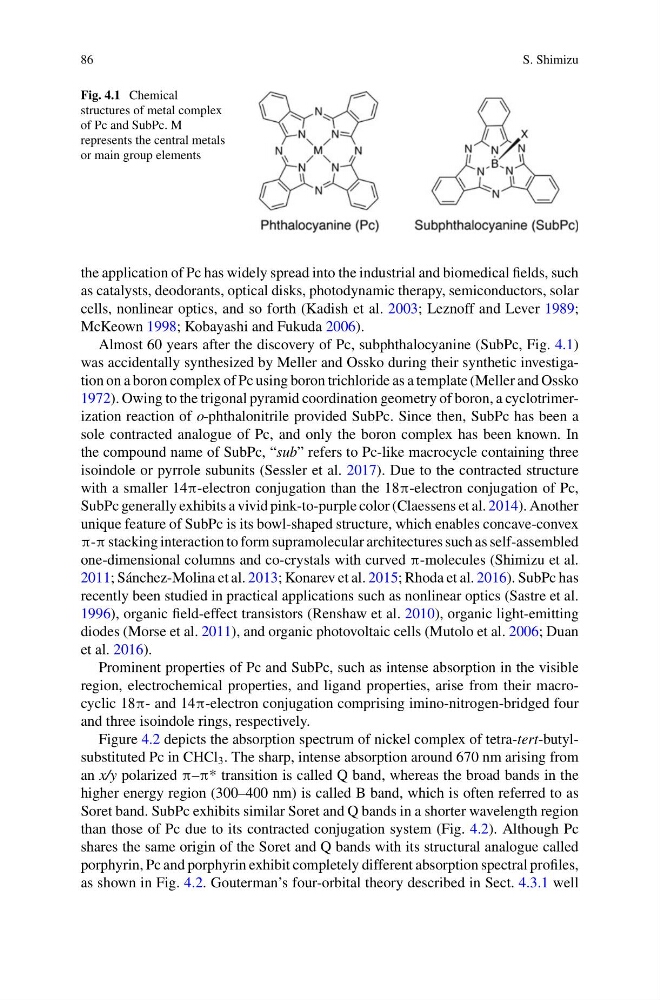
Fig. 4.1 Chemical
structures of metal complex
of Pc and SubPc. M
represents the central metals
or main group elements
the application of Pc has widely spread into the industrial and biomedical fields, such
as catalysts, deodorants, optical disks, photodynamic therapy, semiconductors, solar
cells, nonlinear optics, and so forth (Kadish et al. 2003; Leznoff and Lever 1989;
McKeown 1998; Kobayashi and Fukuda 2006).
Almost 60 years after the discovery of Pc, subphthalocyanine (SubPc, Fig. 4.1)
was accidentally synthesized by Meller and Ossko during their synthetic investigation on a boron complex of Pc using boron trichloride as a template (Meller and Ossko
1972). Owing to the trigonal pyramid coordination geometry of boron, a cyclotrimerization reaction of o-phthalonitrile provided SubPc. Since then, SubPc has been a
sole contracted analogue of Pc, and only the boron complex has been known. In
the compound name of SubPc, “sub” refers to Pc-like macrocycle containing three
isoindole or pyrrole subunits (Sessler et al. 2017). Due to the contracted structure
with a smaller 14π-electron conjugation than the 18π-electron conjugation of Pc,
SubPc generally exhibits a vivid pink-to-purple color (Claessens et al. 2014). Another
unique feature of SubPc is its bowl-shaped structure, which enables concave-convex
π-π stacking interaction to form supramolecular architectures such as self-assembled
one-dimensional columns and co-crystals with curved π-molecules (Shimizu et al.
2011; Sánchez-Molina et al. 2013; Konarev et al. 2015; Rhoda et al. 2016). SubPc has
recently been studied in practical applications such as nonlinear optics (Sastre et al.
1996), organic field-effect transistors (Renshaw et al. 2010), organic light-emitting
diodes (Morse et al. 2011), and organic photovoltaic cells (Mutolo et al. 2006; Duan
et al. 2016).
Prominent properties of Pc and SubPc, such as intense absorption in the visible
region, electrochemical properties, and ligand properties, arise from their macrocyclic 18π- and 14π-electron conjugation comprising imino-nitrogen-bridged four
and three isoindole rings, respectively.
Figure 4.2 depicts the absorption spectrum of nickel complex of tetra-tert-butylsubstituted Pc in CHCl 3 . The sharp, intense absorption around 670 nm arising from
an x/y polarized π–π* transition is called Q band, whereas the broad bands in the
higher energy region (300–400 nm) is called B band, which is often referred to as
Soret band. SubPc exhibits similar Soret and Q bands in a shorter wavelength region
than those of Pc due to its contracted conjugation system (Fig. 4.2). Although Pc
shares the same origin of the Soret and Q bands with its structural analogue called
porphyrin, Pc and porphyrin exhibit completely different absorption spectral profiles,
as shown in Fig. 4.2. Gouterman’s four-orbital theory described in Sect. 4.3.1 well
S. Shimizu
Fig. 4.1 Chemical
structures of metal complex
of Pc and SubPc. M
represents the central metals
or main group elements
the application of Pc has widely spread into the industrial and biomedical fields, such
as catalysts, deodorants, optical disks, photodynamic therapy, semiconductors, solar
cells, nonlinear optics, and so forth (Kadish et al. 2003; Leznoff and Lever 1989;
McKeown 1998; Kobayashi and Fukuda 2006).
Almost 60 years after the discovery of Pc, subphthalocyanine (SubPc, Fig. 4.1)
was accidentally synthesized by Meller and Ossko during their synthetic investigation on a boron complex of Pc using boron trichloride as a template (Meller and Ossko
1972). Owing to the trigonal pyramid coordination geometry of boron, a cyclotrimerization reaction of o-phthalonitrile provided SubPc. Since then, SubPc has been a
sole contracted analogue of Pc, and only the boron complex has been known. In
the compound name of SubPc, “sub” refers to Pc-like macrocycle containing three
isoindole or pyrrole subunits (Sessler et al. 2017). Due to the contracted structure
with a smaller 14π-electron conjugation than the 18π-electron conjugation of Pc,
SubPc generally exhibits a vivid pink-to-purple color (Claessens et al. 2014). Another
unique feature of SubPc is its bowl-shaped structure, which enables concave-convex
π-π stacking interaction to form supramolecular architectures such as self-assembled
one-dimensional columns and co-crystals with curved π-molecules (Shimizu et al.
2011; Sánchez-Molina et al. 2013; Konarev et al. 2015; Rhoda et al. 2016). SubPc has
recently been studied in practical applications such as nonlinear optics (Sastre et al.
1996), organic field-effect transistors (Renshaw et al. 2010), organic light-emitting
diodes (Morse et al. 2011), and organic photovoltaic cells (Mutolo et al. 2006; Duan
et al. 2016).
Prominent properties of Pc and SubPc, such as intense absorption in the visible
region, electrochemical properties, and ligand properties, arise from their macrocyclic 18π- and 14π-electron conjugation comprising imino-nitrogen-bridged four
and three isoindole rings, respectively.
Figure 4.2 depicts the absorption spectrum of nickel complex of tetra-tert-butylsubstituted Pc in CHCl 3 . The sharp, intense absorption around 670 nm arising from
an x/y polarized π–π* transition is called Q band, whereas the broad bands in the
higher energy region (300–400 nm) is called B band, which is often referred to as
Soret band. SubPc exhibits similar Soret and Q bands in a shorter wavelength region
than those of Pc due to its contracted conjugation system (Fig. 4.2). Although Pc
shares the same origin of the Soret and Q bands with its structural analogue called
porphyrin, Pc and porphyrin exhibit completely different absorption spectral profiles,
as shown in Fig. 4.2. Gouterman’s four-orbital theory described in Sect. 4.3.1 well