

3 Porphyrins: Syntheses and Properties
73
could be enabled by simple procedure as already mentioned in the compounds 78,
80, and 91.
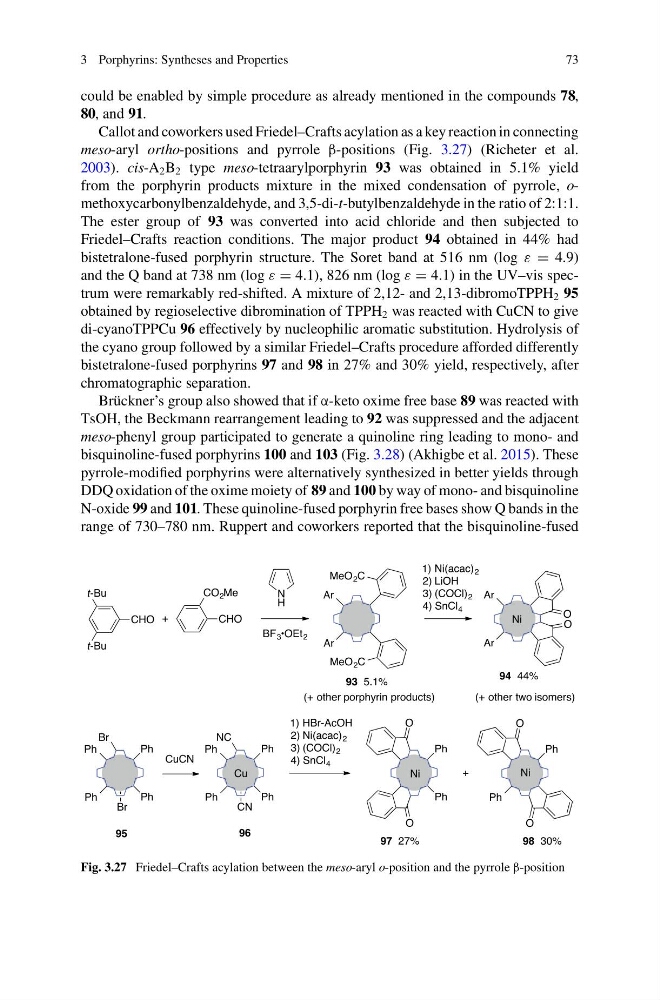
Callot and coworkers used Friedel–Crafts acylation as a key reaction in connecting
meso-aryl ortho-positions and pyrrole β-positions (Fig. 3.27) (Richeter et al.
2003). cis-A 2 B 2 type meso-tetraarylporphyrin 93 was obtained in 5.1% yield
from the porphyrin products mixture in the mixed condensation of pyrrole, omethoxycarbonylbenzaldehyde, and 3,5-di-t-butylbenzaldehyde in the ratio of 2:1:1.
The ester group of 93 was converted into acid chloride and then subjected to
Friedel–Crafts reaction conditions. The major product 94 obtained in 44% had
bistetralone-fused porphyrin structure. The Soret band at 516 nm (log ε = 4.9)
and the Q band at 738 nm (log ε = 4.1), 826 nm (log ε = 4.1) in the UV–vis spectrum were remarkably red-shifted. A mixture of 2,12- and 2,13-dibromoTPPH 2 95
obtained by regioselective dibromination of TPPH 2 was reacted with CuCN to give
di-cyanoTPPCu 96 effectively by nucleophilic aromatic substitution. Hydrolysis of
the cyano group followed by a similar Friedel–Crafts procedure afforded differently
bistetralone-fused porphyrins 97 and 98 in 27% and 30% yield, respectively, after
chromatographic separation.
Brückner’s group also showed that if α-keto oxime free base 89 was reacted with
TsOH, the Beckmann rearrangement leading to 92 was suppressed and the adjacent
meso-phenyl group participated to generate a quinoline ring leading to mono- and
bisquinoline-fused porphyrins 100 and 103 (Fig. 3.28) (Akhigbe et al. 2015). These
pyrrole-modified porphyrins were alternatively synthesized in better yields through
DDQ oxidation of the oxime moiety of 89 and 100 by way of mono- and bisquinoline
N-oxide 99 and 101. These quinoline-fused porphyrin free bases show Q bands in the
range of 730–780 nm. Ruppert and coworkers reported that the bisquinoline-fused
Fig. 3.27 Friedel–Crafts acylation between the meso-aryl o-position and the pyrrole β-position
73
could be enabled by simple procedure as already mentioned in the compounds 78,
80, and 91.
Callot and coworkers used Friedel–Crafts acylation as a key reaction in connecting
meso-aryl ortho-positions and pyrrole β-positions (Fig. 3.27) (Richeter et al.
2003). cis-A 2 B 2 type meso-tetraarylporphyrin 93 was obtained in 5.1% yield
from the porphyrin products mixture in the mixed condensation of pyrrole, omethoxycarbonylbenzaldehyde, and 3,5-di-t-butylbenzaldehyde in the ratio of 2:1:1.
The ester group of 93 was converted into acid chloride and then subjected to
Friedel–Crafts reaction conditions. The major product 94 obtained in 44% had
bistetralone-fused porphyrin structure. The Soret band at 516 nm (log ε = 4.9)
and the Q band at 738 nm (log ε = 4.1), 826 nm (log ε = 4.1) in the UV–vis spectrum were remarkably red-shifted. A mixture of 2,12- and 2,13-dibromoTPPH 2 95
obtained by regioselective dibromination of TPPH 2 was reacted with CuCN to give
di-cyanoTPPCu 96 effectively by nucleophilic aromatic substitution. Hydrolysis of
the cyano group followed by a similar Friedel–Crafts procedure afforded differently
bistetralone-fused porphyrins 97 and 98 in 27% and 30% yield, respectively, after
chromatographic separation.
Brückner’s group also showed that if α-keto oxime free base 89 was reacted with
TsOH, the Beckmann rearrangement leading to 92 was suppressed and the adjacent
meso-phenyl group participated to generate a quinoline ring leading to mono- and
bisquinoline-fused porphyrins 100 and 103 (Fig. 3.28) (Akhigbe et al. 2015). These
pyrrole-modified porphyrins were alternatively synthesized in better yields through
DDQ oxidation of the oxime moiety of 89 and 100 by way of mono- and bisquinoline
N-oxide 99 and 101. These quinoline-fused porphyrin free bases show Q bands in the
range of 730–780 nm. Ruppert and coworkers reported that the bisquinoline-fused
Fig. 3.27 Friedel–Crafts acylation between the meso-aryl o-position and the pyrrole β-position