

3 Porphyrins: Syntheses and Properties
67
of 60 proceeded almost quantitatively to generate cruciform porphyrin 61 that has
overall π-conjugation among 5 porphyrin units (Uoyama et al. 2010).
The UV–vis spectrum of 61 (M = 5Zn) showed strong Soret bands at 415 nm and
498 nm. These Soret bands are red-shifted from those (404 nm and 423 nm) of 60
(M = 5Zn) (Table 3.2). The Q band of 61 (M = 5Zn) at 763 nm is as intense as the
Soret band and far red-shifted in comparison with weak Q bands of 60 (M = 5Zn) at
534 nm, and 573 nm and also with the Q band (638 nm) of the benzene-fused dimeric
Zn porphyrin 58 (M = 2Zn), whereas the UV–vis spectra of bicyclo[2.2.2]octadienefused oligomeric Zn porphyrins 57 and 60 are not so different from that of monomeric
Zn porphyrin.
Two-photon absorption cross section provides information on how far the πconjugation is expanding in the molecular systems. The 2PA cross section values
of the benzene-fused oligomeric Zn porphyrin 58 (M = 2Zn) and 61 (M = 5Zn)
measured by z-scan method were reported as 3000 GM (λ ex 1275 nm) and 3900 GM
(λ ex 1500 nm), respectively (Uoyama et al. 2010). These values are much larger than
those (<100 GM) of monomeric porphyrins, but they are less than those (10
4 –10
5
GM) of meso,meso-butadiyne-linked multiporphyrins like 33(SiR 3 ) 2 and 34(SiR 3 ) 2 .
It was suggested that electronic interaction between porphyrin π-systems by way of
the pyrrole β-positions is not so effective as by way of the meso-positions.
Smith and coworkers prepared the cruciform porphyrin having four mesotetraphenylporphyrin units instead of meso-unsubstituted porphyrin units of 61 in
a simple procedure (Jaquinod et al. 1998). The phenylsulfonyl group was introduced
into sulfolene itself through phenylsulfenyl chloride addition, MCPBA oxidation,
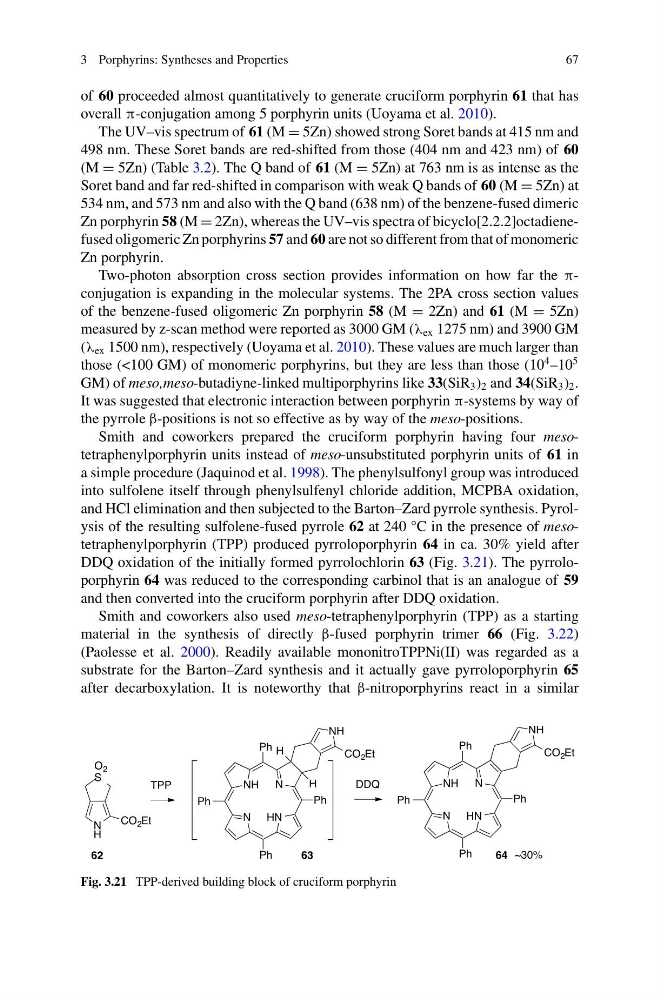
and HCl elimination and then subjected to the Barton–Zard pyrrole synthesis. Pyrolysis of the resulting sulfolene-fused pyrrole 62 at 240 °C in the presence of mesotetraphenylporphyrin (TPP) produced pyrroloporphyrin 64 in ca. 30% yield after
DDQ oxidation of the initially formed pyrrolochlorin 63 (Fig. 3.21). The pyrroloporphyrin 64 was reduced to the corresponding carbinol that is an analogue of 59
and then converted into the cruciform porphyrin after DDQ oxidation.
Smith and coworkers also used meso-tetraphenylporphyrin (TPP) as a starting
material in the synthesis of directly β-fused porphyrin trimer 66 (Fig. 3.22)
(Paolesse et al. 2000). Readily available mononitroTPPNi(II) was regarded as a
substrate for the Barton–Zard synthesis and it actually gave pyrroloporphyrin 65
after decarboxylation. It is noteworthy that β-nitroporphyrins react in a similar
Fig. 3.21 TPP-derived building block of cruciform porphyrin
67
of 60 proceeded almost quantitatively to generate cruciform porphyrin 61 that has
overall π-conjugation among 5 porphyrin units (Uoyama et al. 2010).
The UV–vis spectrum of 61 (M = 5Zn) showed strong Soret bands at 415 nm and
498 nm. These Soret bands are red-shifted from those (404 nm and 423 nm) of 60
(M = 5Zn) (Table 3.2). The Q band of 61 (M = 5Zn) at 763 nm is as intense as the
Soret band and far red-shifted in comparison with weak Q bands of 60 (M = 5Zn) at
534 nm, and 573 nm and also with the Q band (638 nm) of the benzene-fused dimeric
Zn porphyrin 58 (M = 2Zn), whereas the UV–vis spectra of bicyclo[2.2.2]octadienefused oligomeric Zn porphyrins 57 and 60 are not so different from that of monomeric
Zn porphyrin.
Two-photon absorption cross section provides information on how far the πconjugation is expanding in the molecular systems. The 2PA cross section values
of the benzene-fused oligomeric Zn porphyrin 58 (M = 2Zn) and 61 (M = 5Zn)
measured by z-scan method were reported as 3000 GM (λ ex 1275 nm) and 3900 GM
(λ ex 1500 nm), respectively (Uoyama et al. 2010). These values are much larger than
those (<100 GM) of monomeric porphyrins, but they are less than those (10
4 –10
5
GM) of meso,meso-butadiyne-linked multiporphyrins like 33(SiR 3 ) 2 and 34(SiR 3 ) 2 .
It was suggested that electronic interaction between porphyrin π-systems by way of
the pyrrole β-positions is not so effective as by way of the meso-positions.
Smith and coworkers prepared the cruciform porphyrin having four mesotetraphenylporphyrin units instead of meso-unsubstituted porphyrin units of 61 in
a simple procedure (Jaquinod et al. 1998). The phenylsulfonyl group was introduced
into sulfolene itself through phenylsulfenyl chloride addition, MCPBA oxidation,
and HCl elimination and then subjected to the Barton–Zard pyrrole synthesis. Pyrolysis of the resulting sulfolene-fused pyrrole 62 at 240 °C in the presence of mesotetraphenylporphyrin (TPP) produced pyrroloporphyrin 64 in ca. 30% yield after
DDQ oxidation of the initially formed pyrrolochlorin 63 (Fig. 3.21). The pyrroloporphyrin 64 was reduced to the corresponding carbinol that is an analogue of 59
and then converted into the cruciform porphyrin after DDQ oxidation.
Smith and coworkers also used meso-tetraphenylporphyrin (TPP) as a starting
material in the synthesis of directly β-fused porphyrin trimer 66 (Fig. 3.22)
(Paolesse et al. 2000). Readily available mononitroTPPNi(II) was regarded as a
substrate for the Barton–Zard synthesis and it actually gave pyrroloporphyrin 65
after decarboxylation. It is noteworthy that β-nitroporphyrins react in a similar
Fig. 3.21 TPP-derived building block of cruciform porphyrin