

66
J. Setsune
Table 3.2 Selected major
UV–vis absorption bands of
benzoporphyrins
Porphyrin
λ max nm (log ε)
solvent
Soret bands
Q bands
55 (M = Zn, Z
= Ph)
463 (6.44)
609 (5.09), 652
(5.68)
CHCl 3
56 (M = Zn, Z
= Ph)
485 (5.65)
621 (4.35), 667
(4.85)
CHCl 3
56 (M = Zn, Z
= H)
454 (5.62)
597 (4.28), 648
(5.06)
CHCl 3
57 (M = 2Zn) 399 (5.65), 414
(5.65)
533 (4.40), 574
(4.74)
CHCl 3
58 (M = 2Zn) 394 (4.98), 475
(5.36)
621 (4.78), 638
(5.32)
C 5 H 5 N
60 (M = 5Zn) 404 (5.82), 423
(5.61)
534 (4.83), 573
(4.90)
CHCl 3
61 (M = 5Zn)
415 (5.56), 498
(5.32)
721 (4.80), 763
(5.61)
C 5 H 5 N
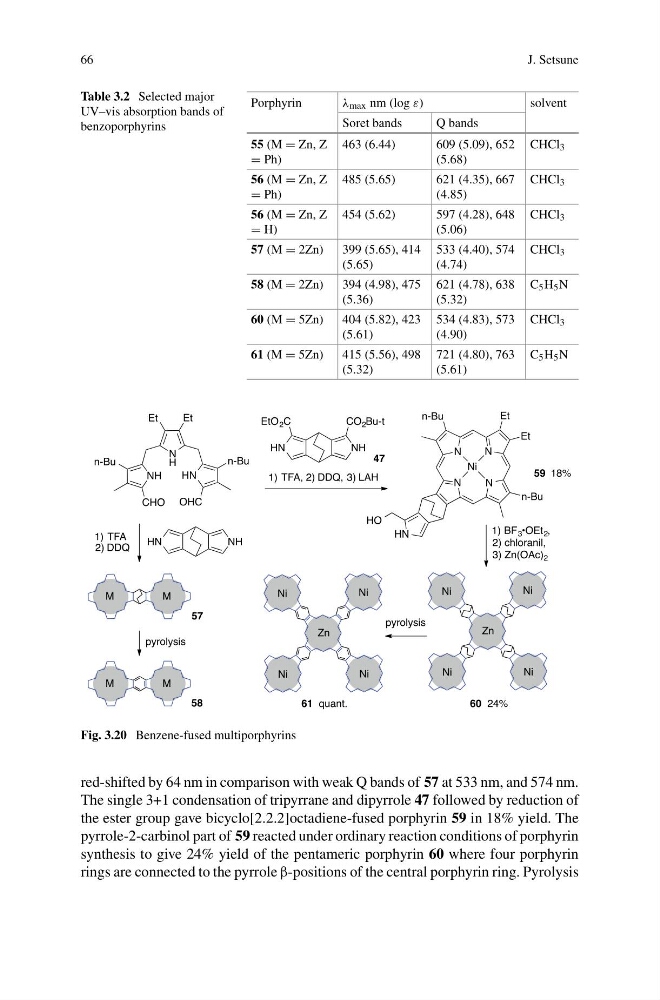
Fig. 3.20 Benzene-fused multiporphyrins
red-shifted by 64 nm in comparison with weak Q bands of 57 at 533 nm, and 574 nm.
The single 3+1 condensation of tripyrrane and dipyrrole 47 followed by reduction of
the ester group gave bicyclo[2.2.2]octadiene-fused porphyrin 59 in 18% yield. The
pyrrole-2-carbinol part of 59 reacted under ordinary reaction conditions of porphyrin
synthesis to give 24% yield of the pentameric porphyrin 60 where four porphyrin
rings are connected to the pyrrole β-positions of the central porphyrin ring. Pyrolysis
J. Setsune
Table 3.2 Selected major
UV–vis absorption bands of
benzoporphyrins
Porphyrin
λ max nm (log ε)
solvent
Soret bands
Q bands
55 (M = Zn, Z
= Ph)
463 (6.44)
609 (5.09), 652
(5.68)
CHCl 3
56 (M = Zn, Z
= Ph)
485 (5.65)
621 (4.35), 667
(4.85)
CHCl 3
56 (M = Zn, Z
= H)
454 (5.62)
597 (4.28), 648
(5.06)
CHCl 3
57 (M = 2Zn) 399 (5.65), 414
(5.65)
533 (4.40), 574
(4.74)
CHCl 3
58 (M = 2Zn) 394 (4.98), 475
(5.36)
621 (4.78), 638
(5.32)
C 5 H 5 N
60 (M = 5Zn) 404 (5.82), 423
(5.61)
534 (4.83), 573
(4.90)
CHCl 3
61 (M = 5Zn)
415 (5.56), 498
(5.32)
721 (4.80), 763
(5.61)
C 5 H 5 N
Fig. 3.20 Benzene-fused multiporphyrins
red-shifted by 64 nm in comparison with weak Q bands of 57 at 533 nm, and 574 nm.
The single 3+1 condensation of tripyrrane and dipyrrole 47 followed by reduction of
the ester group gave bicyclo[2.2.2]octadiene-fused porphyrin 59 in 18% yield. The
pyrrole-2-carbinol part of 59 reacted under ordinary reaction conditions of porphyrin
synthesis to give 24% yield of the pentameric porphyrin 60 where four porphyrin
rings are connected to the pyrrole β-positions of the central porphyrin ring. Pyrolysis