

3 Porphyrins: Syntheses and Properties
65
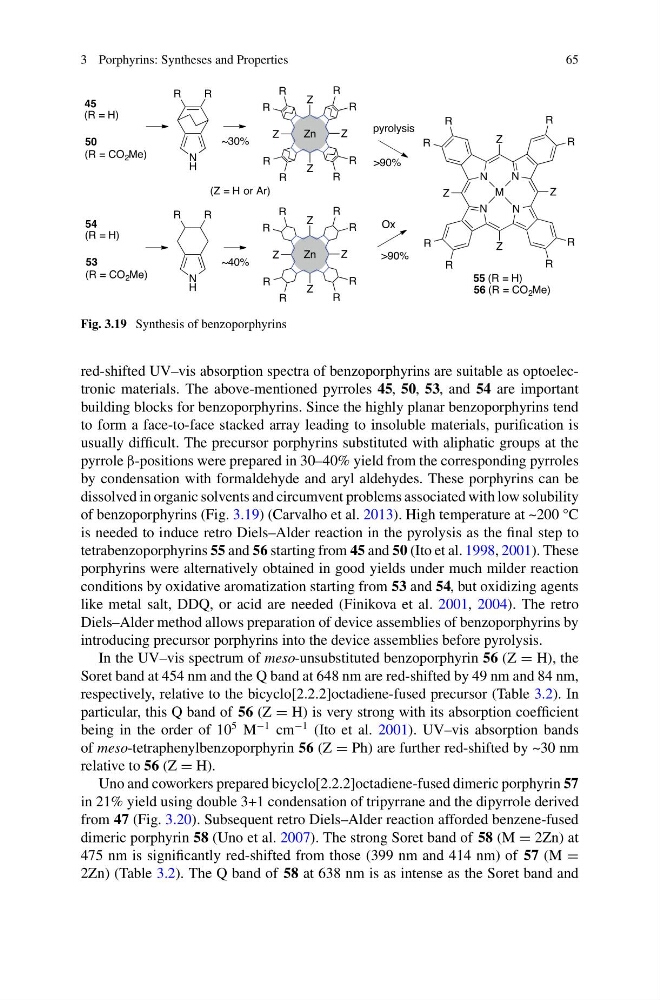
Fig. 3.19 Synthesis of benzoporphyrins
red-shifted UV–vis absorption spectra of benzoporphyrins are suitable as optoelectronic materials. The above-mentioned pyrroles 45, 50, 53, and 54 are important
building blocks for benzoporphyrins. Since the highly planar benzoporphyrins tend
to form a face-to-face stacked array leading to insoluble materials, purification is
usually difficult. The precursor porphyrins substituted with aliphatic groups at the
pyrrole β-positions were prepared in 30–40% yield from the corresponding pyrroles
by condensation with formaldehyde and aryl aldehydes. These porphyrins can be
dissolved in organic solvents and circumvent problems associated with low solubility
of benzoporphyrins (Fig. 3.19) (Carvalho et al. 2013). High temperature at ~200 °C
is needed to induce retro Diels–Alder reaction in the pyrolysis as the final step to
tetrabenzoporphyrins 55 and 56 starting from 45 and 50 (Ito et al. 1998, 2001). These
porphyrins were alternatively obtained in good yields under much milder reaction
conditions by oxidative aromatization starting from 53 and 54, but oxidizing agents
like metal salt, DDQ, or acid are needed (Finikova et al. 2001, 2004). The retro
Diels–Alder method allows preparation of device assemblies of benzoporphyrins by
introducing precursor porphyrins into the device assemblies before pyrolysis.
In the UV–vis spectrum of meso-unsubstituted benzoporphyrin 56 (Z = H), the
Soret band at 454 nm and the Q band at 648 nm are red-shifted by 49 nm and 84 nm,
respectively, relative to the bicyclo[2.2.2]octadiene-fused precursor (Table 3.2). In
particular, this Q band of 56 (Z = H) is very strong with its absorption coefficient
being in the order of 10
5 M
−1 cm
−1 (Ito et al. 2001). UV–vis absorption bands
of meso-tetraphenylbenzoporphyrin 56 (Z = Ph) are further red-shifted by ~30 nm
relative to 56 (Z = H).
Uno and coworkers prepared bicyclo[2.2.2]octadiene-fused dimeric porphyrin 57
in 21% yield using double 3+1 condensation of tripyrrane and the dipyrrole derived
from 47 (Fig. 3.20). Subsequent retro Diels–Alder reaction afforded benzene-fused
dimeric porphyrin 58 (Uno et al. 2007). The strong Soret band of 58 (M = 2Zn) at
475 nm is significantly red-shifted from those (399 nm and 414 nm) of 57 (M =
2Zn) (Table 3.2). The Q band of 58 at 638 nm is as intense as the Soret band and
65
Fig. 3.19 Synthesis of benzoporphyrins
red-shifted UV–vis absorption spectra of benzoporphyrins are suitable as optoelectronic materials. The above-mentioned pyrroles 45, 50, 53, and 54 are important
building blocks for benzoporphyrins. Since the highly planar benzoporphyrins tend
to form a face-to-face stacked array leading to insoluble materials, purification is
usually difficult. The precursor porphyrins substituted with aliphatic groups at the
pyrrole β-positions were prepared in 30–40% yield from the corresponding pyrroles
by condensation with formaldehyde and aryl aldehydes. These porphyrins can be
dissolved in organic solvents and circumvent problems associated with low solubility
of benzoporphyrins (Fig. 3.19) (Carvalho et al. 2013). High temperature at ~200 °C
is needed to induce retro Diels–Alder reaction in the pyrolysis as the final step to
tetrabenzoporphyrins 55 and 56 starting from 45 and 50 (Ito et al. 1998, 2001). These
porphyrins were alternatively obtained in good yields under much milder reaction
conditions by oxidative aromatization starting from 53 and 54, but oxidizing agents
like metal salt, DDQ, or acid are needed (Finikova et al. 2001, 2004). The retro
Diels–Alder method allows preparation of device assemblies of benzoporphyrins by
introducing precursor porphyrins into the device assemblies before pyrolysis.
In the UV–vis spectrum of meso-unsubstituted benzoporphyrin 56 (Z = H), the
Soret band at 454 nm and the Q band at 648 nm are red-shifted by 49 nm and 84 nm,
respectively, relative to the bicyclo[2.2.2]octadiene-fused precursor (Table 3.2). In
particular, this Q band of 56 (Z = H) is very strong with its absorption coefficient
being in the order of 10
5 M
−1 cm
−1 (Ito et al. 2001). UV–vis absorption bands
of meso-tetraphenylbenzoporphyrin 56 (Z = Ph) are further red-shifted by ~30 nm
relative to 56 (Z = H).
Uno and coworkers prepared bicyclo[2.2.2]octadiene-fused dimeric porphyrin 57
in 21% yield using double 3+1 condensation of tripyrrane and the dipyrrole derived
from 47 (Fig. 3.20). Subsequent retro Diels–Alder reaction afforded benzene-fused
dimeric porphyrin 58 (Uno et al. 2007). The strong Soret band of 58 (M = 2Zn) at
475 nm is significantly red-shifted from those (399 nm and 414 nm) of 57 (M =
2Zn) (Table 3.2). The Q band of 58 at 638 nm is as intense as the Soret band and