

58
J. Setsune
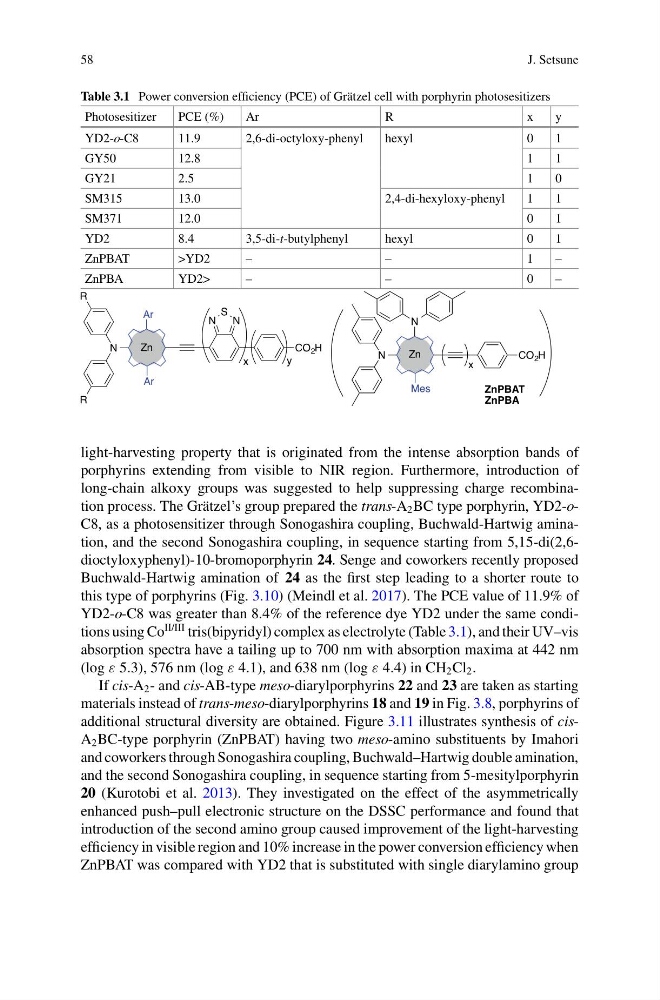
Table 3.1 Power conversion efficiency (PCE) of Grätzel cell with porphyrin photosesitizers
Photosesitizer
PCE (%)
Ar
R
x
y
YD2-o-C8
11.9
2,6-di-octyloxy-phenyl
hexyl
0
1
GY50
12.8
1
1
GY21
2.5
1
0
SM315
13.0
2,4-di-hexyloxy-phenyl
1
1
SM371
12.0
0
1
YD2
8.4
3,5-di-t-butylphenyl
hexyl
0
1
ZnPBAT
>YD2
–
–
1
–
ZnPBA
YD2>
–
–
0
–
light-harvesting property that is originated from the intense absorption bands of
porphyrins extending from visible to NIR region. Furthermore, introduction of
long-chain alkoxy groups was suggested to help suppressing charge recombination process. The Grätzel’s group prepared the trans-A 2 BC type porphyrin, YD2-oC8, as a photosensitizer through Sonogashira coupling, Buchwald-Hartwig amination, and the second Sonogashira coupling, in sequence starting from 5,15-di(2,6dioctyloxyphenyl)-10-bromoporphyrin 24. Senge and coworkers recently proposed
Buchwald-Hartwig amination of 24 as the first step leading to a shorter route to
this type of porphyrins (Fig. 3.10) (Meindl et al. 2017). The PCE value of 11.9% of
YD2-o-C8 was greater than 8.4% of the reference dye YD2 under the same conditions using Co
II/III tris(bipyridyl) complex as electrolyte (Table 3.1), and their UV–vis
absorption spectra have a tailing up to 700 nm with absorption maxima at 442 nm
(log ε 5.3), 576 nm (log ε 4.1), and 638 nm (log ε 4.4) in CH 2 Cl 2 .
If cis-A 2 - and cis-AB-type meso-diarylporphyrins 22 and 23 are taken as starting
materials instead of trans-meso-diarylporphyrins 18 and 19 in Fig. 3.8, porphyrins of
additional structural diversity are obtained. Figure 3.11 illustrates synthesis of cisA 2 BC-type porphyrin (ZnPBAT) having two meso-amino substituents by Imahori
and coworkers through Sonogashira coupling, Buchwald–Hartwig double amination,
and the second Sonogashira coupling, in sequence starting from 5-mesitylporphyrin
20 (Kurotobi et al. 2013). They investigated on the effect of the asymmetrically
enhanced push–pull electronic structure on the DSSC performance and found that
introduction of the second amino group caused improvement of the light-harvesting
efficiency in visible region and 10% increase in the power conversion efficiency when
ZnPBAT was compared with YD2 that is substituted with single diarylamino group
J. Setsune
Table 3.1 Power conversion efficiency (PCE) of Grätzel cell with porphyrin photosesitizers
Photosesitizer
PCE (%)
Ar
R
x
y
YD2-o-C8
11.9
2,6-di-octyloxy-phenyl
hexyl
0
1
GY50
12.8
1
1
GY21
2.5
1
0
SM315
13.0
2,4-di-hexyloxy-phenyl
1
1
SM371
12.0
0
1
YD2
8.4
3,5-di-t-butylphenyl
hexyl
0
1
ZnPBAT
>YD2
–
–
1
–
ZnPBA
YD2>
–
–
0
–
light-harvesting property that is originated from the intense absorption bands of
porphyrins extending from visible to NIR region. Furthermore, introduction of
long-chain alkoxy groups was suggested to help suppressing charge recombination process. The Grätzel’s group prepared the trans-A 2 BC type porphyrin, YD2-oC8, as a photosensitizer through Sonogashira coupling, Buchwald-Hartwig amination, and the second Sonogashira coupling, in sequence starting from 5,15-di(2,6dioctyloxyphenyl)-10-bromoporphyrin 24. Senge and coworkers recently proposed
Buchwald-Hartwig amination of 24 as the first step leading to a shorter route to
this type of porphyrins (Fig. 3.10) (Meindl et al. 2017). The PCE value of 11.9% of
YD2-o-C8 was greater than 8.4% of the reference dye YD2 under the same conditions using Co
II/III tris(bipyridyl) complex as electrolyte (Table 3.1), and their UV–vis
absorption spectra have a tailing up to 700 nm with absorption maxima at 442 nm
(log ε 5.3), 576 nm (log ε 4.1), and 638 nm (log ε 4.4) in CH 2 Cl 2 .
If cis-A 2 - and cis-AB-type meso-diarylporphyrins 22 and 23 are taken as starting
materials instead of trans-meso-diarylporphyrins 18 and 19 in Fig. 3.8, porphyrins of
additional structural diversity are obtained. Figure 3.11 illustrates synthesis of cisA 2 BC-type porphyrin (ZnPBAT) having two meso-amino substituents by Imahori
and coworkers through Sonogashira coupling, Buchwald–Hartwig double amination,
and the second Sonogashira coupling, in sequence starting from 5-mesitylporphyrin
20 (Kurotobi et al. 2013). They investigated on the effect of the asymmetrically
enhanced push–pull electronic structure on the DSSC performance and found that
introduction of the second amino group caused improvement of the light-harvesting
efficiency in visible region and 10% increase in the power conversion efficiency when
ZnPBAT was compared with YD2 that is substituted with single diarylamino group