

3 Porphyrins: Syntheses and Properties
57
afford monobromo compound 24 and dibromo compound 25 in good yields. These
porphyrins can be subjected to various Pd- or Ni-catalyzed cross-coupling reactions
to introduce (hetero)aromatic units by Suzuki coupling and Stille coupling, alkynyl
units by Sonogashira coupling, vinyl units by Mizorogi-Heck reaction, and amines
by Buchwald–Hartwig reaction. ABC-type meso-triarylporphyrins 26 are obtained in
good yields in this way from 24, and these porphyrins were prepared directly from 19
in good yields through the S N Ar reaction. It is noteworthy that alkyllithium reagents
work well to introduce a meso-alkyl substituent that is relatively difficult to achieve by
metal-catalyzed cross-coupling reactions. The iterative procedures starting from 26
afforded ABCD-type meso-tetraarylporphyrins 29. Dioxaborolanylporphyrin 28 was
readily prepared by Pd-catalyzed borylation of bromoporphyrin 27 with pinacolborane (HB(pin)), and it was employed as a coupling partner in the Suzuki coupling,
for example, symmetrical meso,meso-linked diporphyrin 30 was synthesized.
3.2.4 meso-Substituted Porphyrins as Photosensitizers
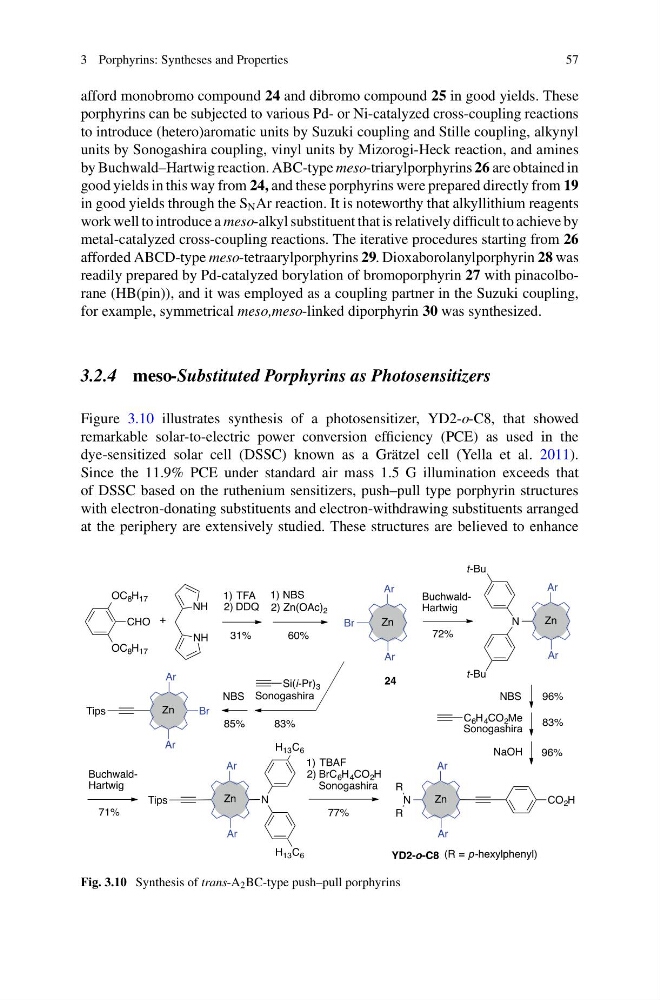
Figure 3.10 illustrates synthesis of a photosensitizer, YD2-o-C8, that showed
remarkable solar-to-electric power conversion efficiency (PCE) as used in the
dye-sensitized solar cell (DSSC) known as a Grätzel cell (Yella et al. 2011).
Since the 11.9% PCE under standard air mass 1.5 G illumination exceeds that
of DSSC based on the ruthenium sensitizers, push–pull type porphyrin structures
with electron-donating substituents and electron-withdrawing substituents arranged
at the periphery are extensively studied. These structures are believed to enhance
Fig. 3.10 Synthesis of trans-A 2 BC-type push–pull porphyrins
57
afford monobromo compound 24 and dibromo compound 25 in good yields. These
porphyrins can be subjected to various Pd- or Ni-catalyzed cross-coupling reactions
to introduce (hetero)aromatic units by Suzuki coupling and Stille coupling, alkynyl
units by Sonogashira coupling, vinyl units by Mizorogi-Heck reaction, and amines
by Buchwald–Hartwig reaction. ABC-type meso-triarylporphyrins 26 are obtained in
good yields in this way from 24, and these porphyrins were prepared directly from 19
in good yields through the S N Ar reaction. It is noteworthy that alkyllithium reagents
work well to introduce a meso-alkyl substituent that is relatively difficult to achieve by
metal-catalyzed cross-coupling reactions. The iterative procedures starting from 26
afforded ABCD-type meso-tetraarylporphyrins 29. Dioxaborolanylporphyrin 28 was
readily prepared by Pd-catalyzed borylation of bromoporphyrin 27 with pinacolborane (HB(pin)), and it was employed as a coupling partner in the Suzuki coupling,
for example, symmetrical meso,meso-linked diporphyrin 30 was synthesized.
3.2.4 meso-Substituted Porphyrins as Photosensitizers
Figure 3.10 illustrates synthesis of a photosensitizer, YD2-o-C8, that showed
remarkable solar-to-electric power conversion efficiency (PCE) as used in the
dye-sensitized solar cell (DSSC) known as a Grätzel cell (Yella et al. 2011).
Since the 11.9% PCE under standard air mass 1.5 G illumination exceeds that
of DSSC based on the ruthenium sensitizers, push–pull type porphyrin structures
with electron-donating substituents and electron-withdrawing substituents arranged
at the periphery are extensively studied. These structures are believed to enhance
Fig. 3.10 Synthesis of trans-A 2 BC-type push–pull porphyrins