

16 Luminescent Materials for Organic Light-Emitting Diodes
585
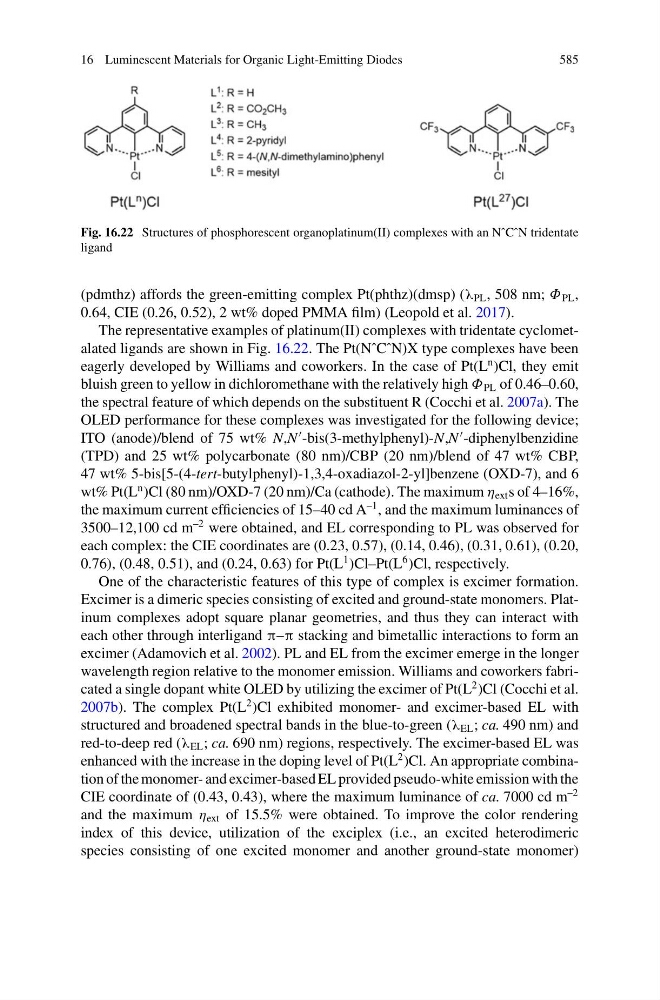
Fig. 16.22 Structures of phosphorescent organoplatinum(II) complexes with an NˆCˆN tridentate
ligand
(pdmthz) affords the green-emitting complex Pt(phthz)(dmsp) (λ PL , 508 nm; Φ PL ,
0.64, CIE (0.26, 0.52), 2 wt% doped PMMA film) (Leopold et al. 2017).
The representative examples of platinum(II) complexes with tridentate cyclometalated ligands are shown in Fig. 16.22. The Pt(NˆCˆN)X type complexes have been
eagerly developed by Williams and coworkers. In the case of Pt(L
n )Cl, they emit
bluish green to yellow in dichloromethane with the relatively high Φ PL of 0.46–0.60,
the spectral feature of which depends on the substituent R (Cocchi et al. 2007a). The
OLED performance for these complexes was investigated for the following device;
ITO (anode)/blend of 75 wt% N,N
-bis(3-methylphenyl)-N,N
-diphenylbenzidine
(TPD) and 25 wt% polycarbonate (80 nm)/CBP (20 nm)/blend of 47 wt% CBP,
47 wt% 5-bis[5-(4-tert-butylphenyl)-1,3,4-oxadiazol-2-yl]benzene (OXD-7), and 6
wt% Pt(L
n )Cl (80 nm)/OXD-7 (20 nm)/Ca (cathode). The maximum η ext s of 4–16%,
the maximum current efficiencies of 15–40 cd A
–1 , and the maximum luminances of
3500–12,100 cd m
–2 were obtained, and EL corresponding to PL was observed for
each complex: the CIE coordinates are (0.23, 0.57), (0.14, 0.46), (0.31, 0.61), (0.20,
0.76), (0.48, 0.51), and (0.24, 0.63) for Pt(L
1 )Cl–Pt(L
6 )Cl, respectively.
One of the characteristic features of this type of complex is excimer formation.
Excimer is a dimeric species consisting of excited and ground-state monomers. Platinum complexes adopt square planar geometries, and thus they can interact with
each other through interligand π–π stacking and bimetallic interactions to form an
excimer (Adamovich et al. 2002). PL and EL from the excimer emerge in the longer
wavelength region relative to the monomer emission. Williams and coworkers fabricated a single dopant white OLED by utilizing the excimer of Pt(L
2 )Cl (Cocchi et al.
2007b). The complex Pt(L
2 )Cl exhibited monomer- and excimer-based EL with
structured and broadened spectral bands in the blue-to-green (λ EL ; ca. 490 nm) and
red-to-deep red (λ EL ; ca. 690 nm) regions, respectively. The excimer-based EL was
enhanced with the increase in the doping level of Pt(L
2 )Cl. An appropriate combination of the monomer- and excimer-based EL provided pseudo-white emission with the
CIE coordinate of (0.43, 0.43), where the maximum luminance of ca. 7000 cd m
–2
and the maximum η ext of 15.5% were obtained. To improve the color rendering
index of this device, utilization of the exciplex (i.e., an excited heterodimeric
species consisting of one excited monomer and another ground-state monomer)