

586
S. Yagi
between Pt(L
2 )Cl and a hole-transporting host (4,4
,4
-tris(N-(3-methylphenyl)-Nphenylamino)triphenylamine, m-MTDATA) (Kalinowski et al. 2007). The energy
level of the exciplex is higher than that of the excimer and lower than that of the excited
monomer, and so the spectral band of the exciplex-based EL emerges between the
monomer- and excimer-based spectral bands, affording the EL spectrum covering
the whole visible region. As a result, the color rendering index of white EL was
improved from 60 to 90. Williams and coworkers also modified the NˆCˆN ligand to
obtain near-infrared electrophosphorescence based on the excimer formation (Rossi
et al. 2011). Introduction of a trifluoromethyl group to each pyridine ring of Pt(L
1 )Cl
led to red shifts of the monomer and excimer emission bands. Employing a neat film
of Pt(L
27 )Cl (Fig. 16.22) as EML allowed for fabrication of OLED emitting in the
near-infrared region of 750–800 nm.
As for organoplatinum(II) complexes with a tetradentate ligand, excellent red
and blue phosphorescent emitters were reported. A research group in Science
and Technology Research Laboratories of Japan Broadcasting Corporation (NHK)
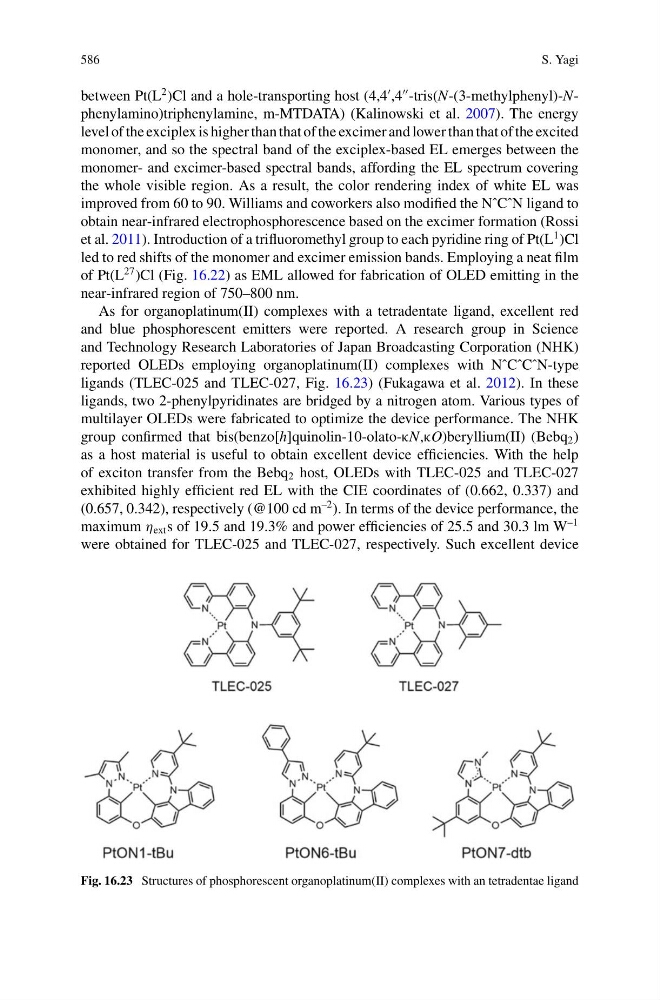
reported OLEDs employing organoplatinum(II) complexes with NˆCˆCˆN-type
ligands (TLEC-025 and TLEC-027, Fig. 16.23) (Fukagawa et al. 2012). In these
ligands, two 2-phenylpyridinates are bridged by a nitrogen atom. Various types of
multilayer OLEDs were fabricated to optimize the device performance. The NHK
group confirmed that bis(benzo[h]quinolin-10-olato-κN,κO)beryllium(II) (Bebq 2 )
as a host material is useful to obtain excellent device efficiencies. With the help
of exciton transfer from the Bebq 2 host, OLEDs with TLEC-025 and TLEC-027
exhibited highly efficient red EL with the CIE coordinates of (0.662, 0.337) and
(0.657, 0.342), respectively (@100 cd m
–2 ). In terms of the device performance, the
maximum η ext s of 19.5 and 19.3% and power efficiencies of 25.5 and 30.3 lm W
–1
were obtained for TLEC-025 and TLEC-027, respectively. Such excellent device
Fig. 16.23 Structures of phosphorescent organoplatinum(II) complexes with an tetradentae ligand