

584
S. Yagi
Cyclometalated platinum(II) complexes with carbene-based cyclometalated
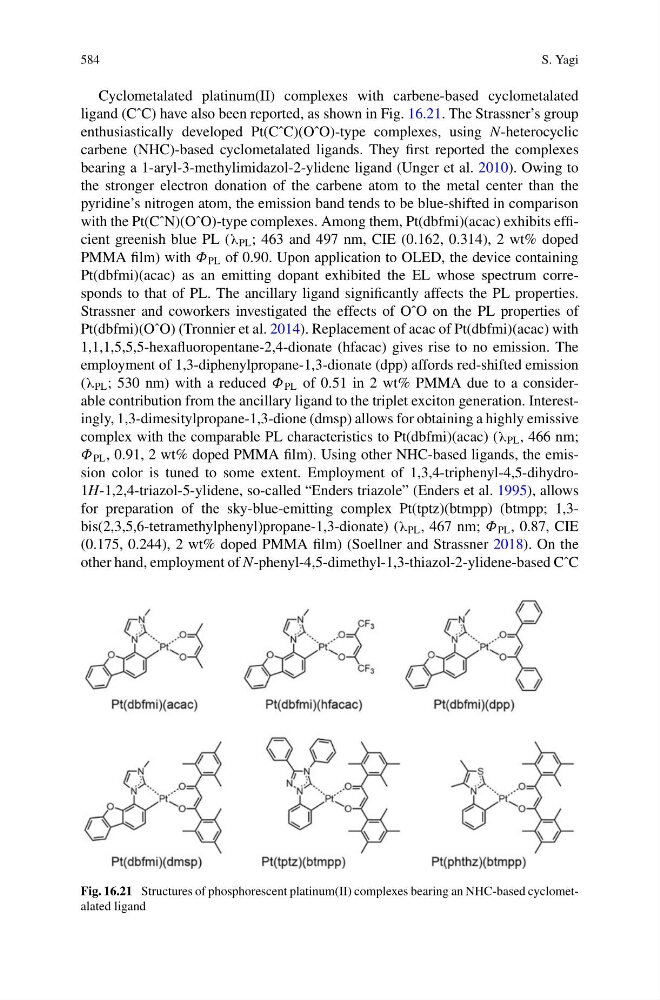
ligand (CˆC) have also been reported, as shown in Fig. 16.21. The Strassner’s group
enthusiastically developed Pt(CˆC)(OˆO)-type complexes, using N-heterocyclic
carbene (NHC)-based cyclometalated ligands. They first reported the complexes
bearing a 1-aryl-3-methylimidazol-2-ylidene ligand (Unger et al. 2010). Owing to
the stronger electron donation of the carbene atom to the metal center than the
pyridine’s nitrogen atom, the emission band tends to be blue-shifted in comparison
with the Pt(CˆN)(OˆO)-type complexes. Among them, Pt(dbfmi)(acac) exhibits efficient greenish blue PL (λ PL ; 463 and 497 nm, CIE (0.162, 0.314), 2 wt% doped
PMMA film) with Φ PL of 0.90. Upon application to OLED, the device containing
Pt(dbfmi)(acac) as an emitting dopant exhibited the EL whose spectrum corresponds to that of PL. The ancillary ligand significantly affects the PL properties.
Strassner and coworkers investigated the effects of OˆO on the PL properties of
Pt(dbfmi)(OˆO) (Tronnier et al. 2014). Replacement of acac of Pt(dbfmi)(acac) with
1,1,1,5,5,5-hexafluoropentane-2,4-dionate (hfacac) gives rise to no emission. The
employment of 1,3-diphenylpropane-1,3-dionate (dpp) affords red-shifted emission
(λ PL ; 530 nm) with a reduced Φ PL of 0.51 in 2 wt% PMMA due to a considerable contribution from the ancillary ligand to the triplet exciton generation. Interestingly, 1,3-dimesitylpropane-1,3-dione (dmsp) allows for obtaining a highly emissive
complex with the comparable PL characteristics to Pt(dbfmi)(acac) (λ PL , 466 nm;
Φ PL , 0.91, 2 wt% doped PMMA film). Using other NHC-based ligands, the emission color is tuned to some extent. Employment of 1,3,4-triphenyl-4,5-dihydro1H-1,2,4-triazol-5-ylidene, so-called “Enders triazole” (Enders et al. 1995), allows
for preparation of the sky-blue-emitting complex Pt(tptz)(btmpp) (btmpp; 1,3bis(2,3,5,6-tetramethylphenyl)propane-1,3-dionate) (λ PL , 467 nm; Φ PL , 0.87, CIE
(0.175, 0.244), 2 wt% doped PMMA film) (Soellner and Strassner 2018). On the
other hand, employment of N-phenyl-4,5-dimethyl-1,3-thiazol-2-ylidene-based CˆC
Fig. 16.21 Structures of phosphorescent platinum(II) complexes bearing an NHC-based cyclometalated ligand