

16 Luminescent Materials for Organic Light-Emitting Diodes
583
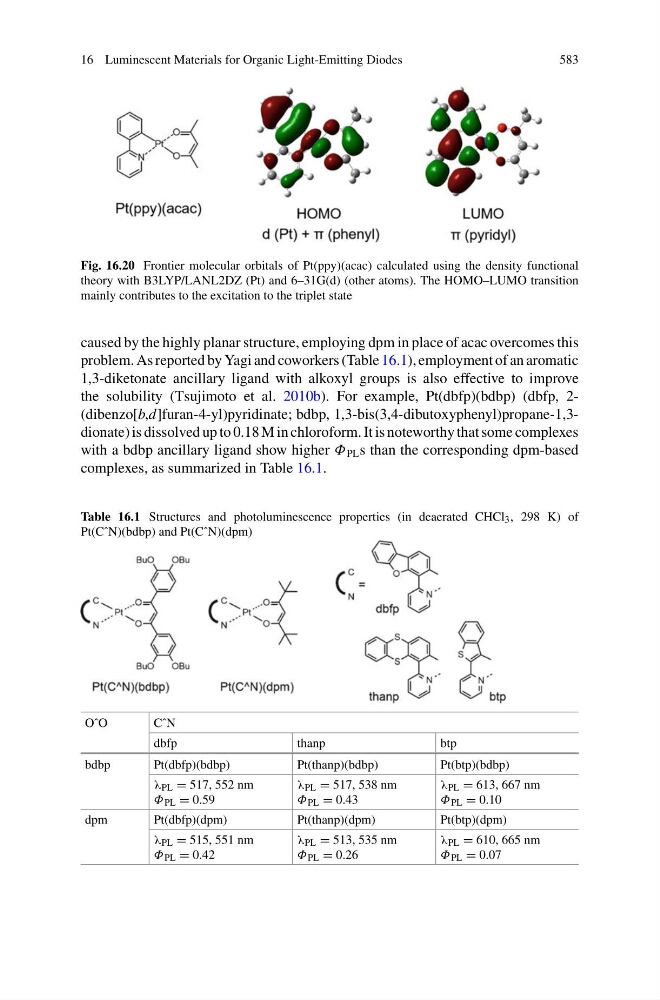
Fig. 16.20 Frontier molecular orbitals of Pt(ppy)(acac) calculated using the density functional
theory with B3LYP/LANL2DZ (Pt) and 6–31G(d) (other atoms). The HOMO–LUMO transition
mainly contributes to the excitation to the triplet state
caused by the highly planar structure, employing dpm in place of acac overcomes this
problem. As reported by Yagi and coworkers (Table 16.1), employment of an aromatic
1,3-diketonate ancillary ligand with alkoxyl groups is also effective to improve
the solubility (Tsujimoto et al. 2010b). For example, Pt(dbfp)(bdbp) (dbfp, 2(dibenzo[b,d]furan-4-yl)pyridinate; bdbp, 1,3-bis(3,4-dibutoxyphenyl)propane-1,3dionate) is dissolved up to 0.18 M in chloroform. It is noteworthy that some complexes
with a bdbp ancillary ligand show higher Φ PL s than the corresponding dpm-based
complexes, as summarized in Table 16.1.
Table 16.1 Structures and photoluminescence properties (in deaerated CHCl 3 , 298 K) of
Pt(CˆN)(bdbp) and Pt(CˆN)(dpm)
OˆO
CˆN
dbfp
thanp
btp
bdbp
Pt(dbfp)(bdbp)
Pt(thanp)(bdbp)
Pt(btp)(bdbp)
λ PL = 517, 552 nm
Φ PL = 0.59
λ PL = 517, 538 nm
Φ PL = 0.43
λ PL = 613, 667 nm
Φ PL = 0.10
dpm
Pt(dbfp)(dpm)
Pt(thanp)(dpm)
Pt(btp)(dpm)
λ PL = 515, 551 nm
Φ PL = 0.42
λ PL = 513, 535 nm
Φ PL = 0.26
λ PL = 610, 665 nm
Φ PL = 0.07