

582
S. Yagi
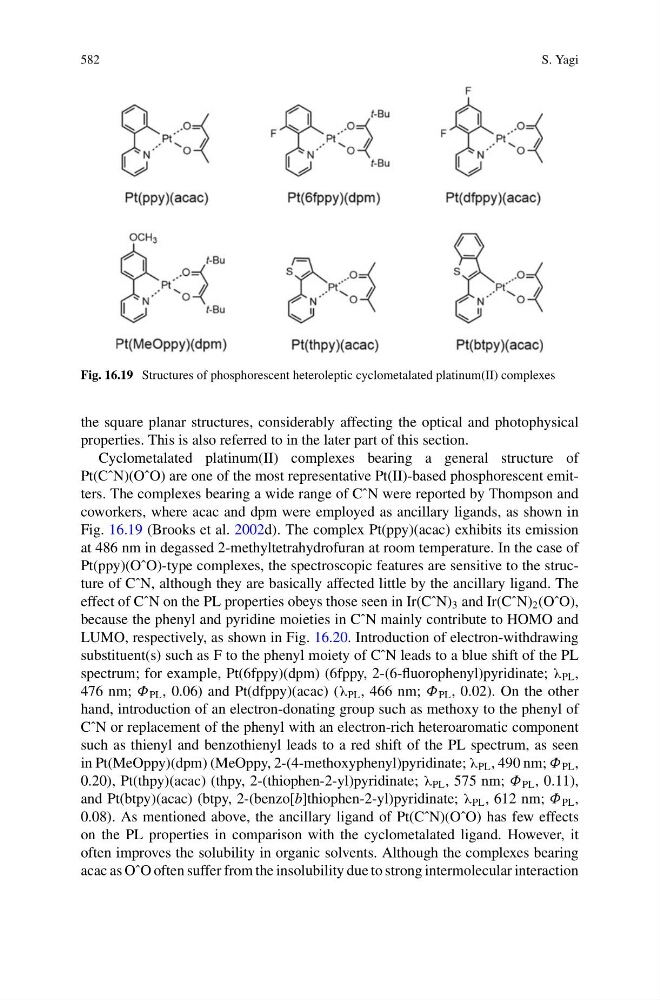
Fig. 16.19 Structures of phosphorescent heteroleptic cyclometalated platinum(II) complexes
the square planar structures, considerably affecting the optical and photophysical
properties. This is also referred to in the later part of this section.
Cyclometalated platinum(II) complexes bearing a general structure of
Pt(CˆN)(OˆO) are one of the most representative Pt(II)-based phosphorescent emitters. The complexes bearing a wide range of CˆN were reported by Thompson and
coworkers, where acac and dpm were employed as ancillary ligands, as shown in
Fig. 16.19 (Brooks et al. 2002d). The complex Pt(ppy)(acac) exhibits its emission
at 486 nm in degassed 2-methyltetrahydrofuran at room temperature. In the case of
Pt(ppy)(OˆO)-type complexes, the spectroscopic features are sensitive to the structure of CˆN, although they are basically affected little by the ancillary ligand. The
effect of CˆN on the PL properties obeys those seen in Ir(CˆN) 3 and Ir(CˆN) 2 (OˆO),
because the phenyl and pyridine moieties in CˆN mainly contribute to HOMO and
LUMO, respectively, as shown in Fig. 16.20. Introduction of electron-withdrawing
substituent(s) such as F to the phenyl moiety of CˆN leads to a blue shift of the PL
spectrum; for example, Pt(6fppy)(dpm) (6fppy, 2-(6-fluorophenyl)pyridinate; λ PL ,
476 nm; Φ PL , 0.06) and Pt(dfppy)(acac) (λ PL , 466 nm; Φ PL , 0.02). On the other
hand, introduction of an electron-donating group such as methoxy to the phenyl of
CˆN or replacement of the phenyl with an electron-rich heteroaromatic component
such as thienyl and benzothienyl leads to a red shift of the PL spectrum, as seen
in Pt(MeOppy)(dpm) (MeOppy, 2-(4-methoxyphenyl)pyridinate; λ PL , 490 nm; Φ PL ,
0.20), Pt(thpy)(acac) (thpy, 2-(thiophen-2-yl)pyridinate; λ PL , 575 nm; Φ PL , 0.11),
and Pt(btpy)(acac) (btpy, 2-(benzo[b]thiophen-2-yl)pyridinate; λ PL , 612 nm; Φ PL ,
0.08). As mentioned above, the ancillary ligand of Pt(CˆN)(OˆO) has few effects
on the PL properties in comparison with the cyclometalated ligand. However, it
often improves the solubility in organic solvents. Although the complexes bearing
acac as OˆO often suffer from the insolubility due to strong intermolecular interaction