

16 Luminescent Materials for Organic Light-Emitting Diodes
577
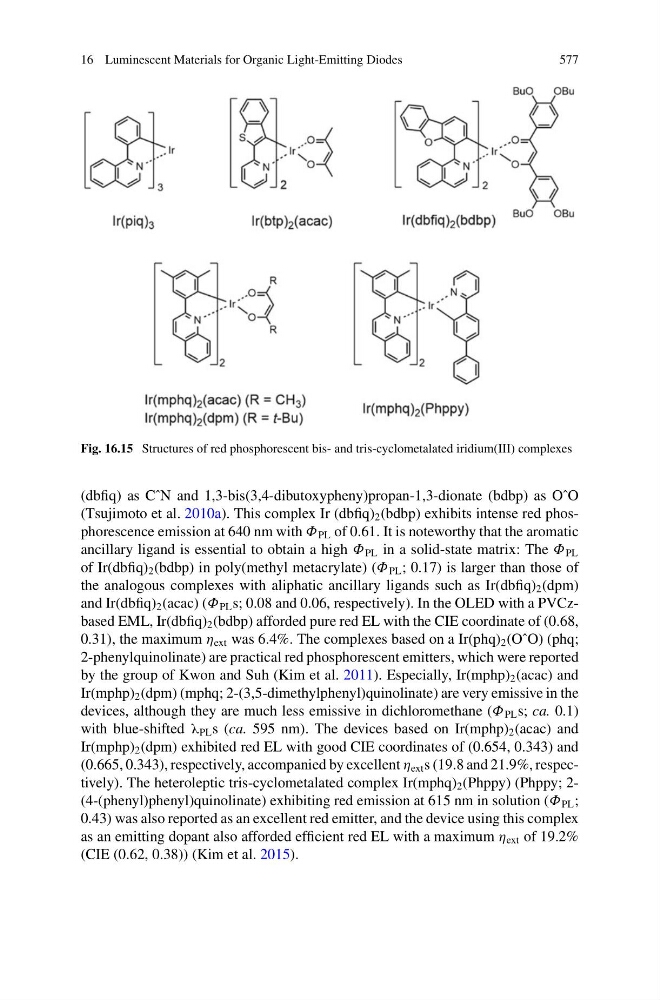
Fig. 16.15 Structures of red phosphorescent bis- and tris-cyclometalated iridium(III) complexes
(dbfiq) as CˆN and 1,3-bis(3,4-dibutoxypheny)propan-1,3-dionate (bdbp) as OˆO
(Tsujimoto et al. 2010a). This complex Ir (dbfiq) 2 (bdbp) exhibits intense red phosphorescence emission at 640 nm with Φ PL of 0.61. It is noteworthy that the aromatic
ancillary ligand is essential to obtain a high Φ PL in a solid-state matrix: The Φ PL
of Ir(dbfiq) 2 (bdbp) in poly(methyl metacrylate) (Φ PL ; 0.17) is larger than those of
the analogous complexes with aliphatic ancillary ligands such as Ir(dbfiq) 2 (dpm)
and Ir(dbfiq) 2 (acac) (Φ PL s; 0.08 and 0.06, respectively). In the OLED with a PVCzbased EML, Ir(dbfiq) 2 (bdbp) afforded pure red EL with the CIE coordinate of (0.68,
0.31), the maximum η ext was 6.4%. The complexes based on a Ir(phq) 2 (OˆO) (phq;
2-phenylquinolinate) are practical red phosphorescent emitters, which were reported
by the group of Kwon and Suh (Kim et al. 2011). Especially, Ir(mphp) 2 (acac) and
Ir(mphp) 2 (dpm) (mphq; 2-(3,5-dimethylphenyl)quinolinate) are very emissive in the
devices, although they are much less emissive in dichloromethane (Φ PL s; ca. 0.1)
with blue-shifted λ PL s (ca. 595 nm). The devices based on Ir(mphp) 2 (acac) and
Ir(mphp) 2 (dpm) exhibited red EL with good CIE coordinates of (0.654, 0.343) and
(0.665, 0.343), respectively, accompanied by excellent η ext s (19.8 and 21.9%, respectively). The heteroleptic tris-cyclometalated complex Ir(mphq) 2 (Phppy) (Phppy; 2(4-(phenyl)phenyl)quinolinate) exhibiting red emission at 615 nm in solution (Φ PL ;
0.43) was also reported as an excellent red emitter, and the device using this complex
as an emitting dopant also afforded efficient red EL with a maximum η ext of 19.2%
(CIE (0.62, 0.38)) (Kim et al. 2015).