

576
S. Yagi
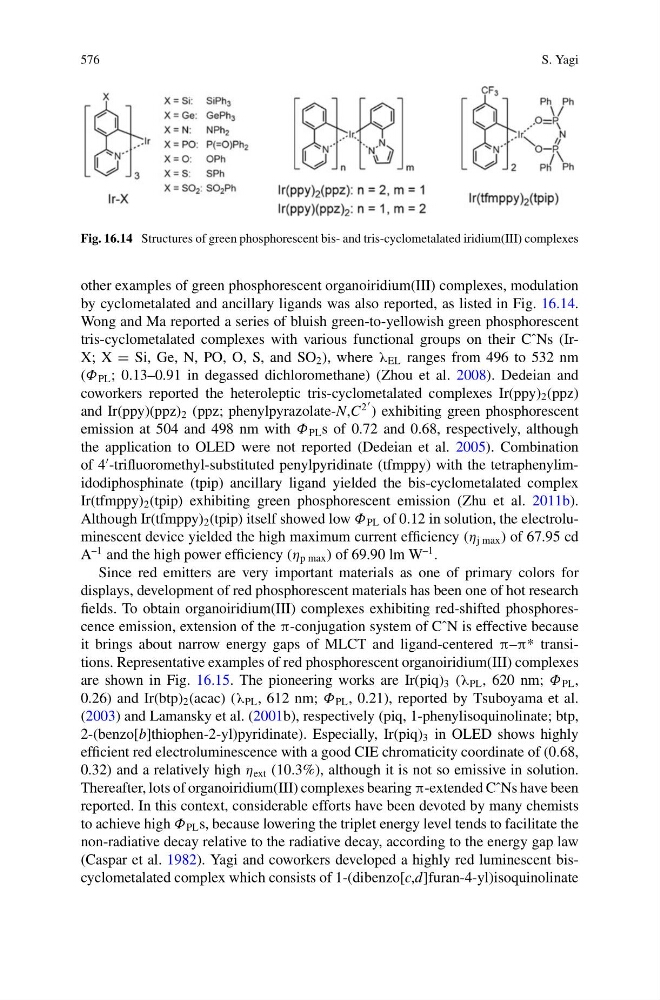
Fig. 16.14 Structures of green phosphorescent bis- and tris-cyclometalated iridium(III) complexes
other examples of green phosphorescent organoiridium(III) complexes, modulation
by cyclometalated and ancillary ligands was also reported, as listed in Fig. 16.14.
Wong and Ma reported a series of bluish green-to-yellowish green phosphorescent
tris-cyclometalated complexes with various functional groups on their CˆNs (IrX; X = Si, Ge, N, PO, O, S, and SO 2 ), where λ EL ranges from 496 to 532 nm
(Φ PL ; 0.13–0.91 in degassed dichloromethane) (Zhou et al. 2008). Dedeian and
coworkers reported the heteroleptic tris-cyclometalated complexes Ir(ppy) 2 (ppz)
and Ir(ppy)(ppz) 2 (ppz; phenylpyrazolate-N,C
2 ) exhibiting green phosphorescent
emission at 504 and 498 nm with Φ PL s of 0.72 and 0.68, respectively, although
the application to OLED were not reported (Dedeian et al. 2005). Combination
of 4
-trifluoromethyl-substituted penylpyridinate (tfmppy) with the tetraphenylimidodiphosphinate (tpip) ancillary ligand yielded the bis-cyclometalated complex
Ir(tfmppy) 2 (tpip) exhibiting green phosphorescent emission (Zhu et al. 2011b).
Although Ir(tfmppy) 2 (tpip) itself showed low Φ PL of 0.12 in solution, the electroluminescent device yielded the high maximum current efficiency (η j max ) of 67.95 cd
A
–1 and the high power efficiency (η p max ) of 69.90 lm W
–1 .
Since red emitters are very important materials as one of primary colors for
displays, development of red phosphorescent materials has been one of hot research
fields. To obtain organoiridium(III) complexes exhibiting red-shifted phosphorescence emission, extension of the π-conjugation system of CˆN is effective because
it brings about narrow energy gaps of MLCT and ligand-centered π–π* transitions. Representative examples of red phosphorescent organoiridium(III) complexes
are shown in Fig. 16.15. The pioneering works are Ir(piq) 3 (λ PL , 620 nm; Φ PL ,
0.26) and Ir(btp) 2 (acac) (λ PL , 612 nm; Φ PL , 0.21), reported by Tsuboyama et al.
(2003) and Lamansky et al. (2001b), respectively (piq, 1-phenylisoquinolinate; btp,
2-(benzo[b]thiophen-2-yl)pyridinate). Especially, Ir(piq) 3 in OLED shows highly
efficient red electroluminescence with a good CIE chromaticity coordinate of (0.68,
0.32) and a relatively high η ext (10.3%), although it is not so emissive in solution.
Thereafter, lots of organoiridium(III) complexes bearing π-extended CˆNs have been
reported. In this context, considerable efforts have been devoted by many chemists
to achieve high Φ PL s, because lowering the triplet energy level tends to facilitate the
non-radiative decay relative to the radiative decay, according to the energy gap law
(Caspar et al. 1982). Yagi and coworkers developed a highly red luminescent biscyclometalated complex which consists of 1-(dibenzo[c,d]furan-4-yl)isoquinolinate